 Jobboy

Introduction to Resume Writing for Blue-Collar Jobs in 2026
Job seekers in trades and manual labor fields such as construction, manufacturing, and logistics encounter distinct challenges when crafting resumes that stand out in competitive 2026 hiring markets. Employers in these sectors increasingly value demonstrated hands-on skills, safety certifications, and quantifiable project outcomes rather than traditional academic credentials. This comprehensive guide provides actionable, step-by-step instructions to build resumes that successfully navigate applicant tracking systems while capturing the attention of hiring managers who prioritize practical experience.
Understanding current trends is essential. In 2026, industrial recruiters scan for evidence of real-world problem solving, equipment proficiency, and compliance with regulations. Overly polished corporate language often fails to connect with decision-makers in these fields. Instead, focus on clear, metric-driven descriptions that showcase your direct contributions to projects, teams, and operational efficiency.
Choosing the Right Resume Format for Non-Office Roles
Selecting an appropriate format forms the foundation of an effective blue-collar resume. Combination or functional formats typically outperform purely chronological ones for trades workers because they lead with skills and certifications before detailing employment history. A combination resume works well if you have consistent work experience, allowing you to highlight both your strongest abilities and your career progression. Functional resumes benefit individuals returning to the workforce or transitioning between trades by emphasizing transferable competencies first.
Consider your employment timeline when deciding. If you have steady advancement in one industry, a hybrid approach that blends skills at the top with a reverse-chronological work history below provides balance. Always keep the document to one or two pages, using clean fonts and ample white space for readability in both digital and printed formats.
Integrating ATS Keywords for Industrial Hiring Systems
Many large employers in construction, manufacturing, and logistics rely on applicant tracking systems to filter incoming applications. To improve visibility, mirror language directly from target job descriptions. Common keywords include OSHA 10 certification, forklift operation, preventive maintenance, inventory control, lean manufacturing principles, heavy equipment operation, quality assurance protocols, and supply chain coordination. Research each posting thoroughly and incorporate exact phrases naturally throughout your resume rather than stuffing them unnaturally.
Place primary keywords in the skills section and weave secondary ones into experience bullet points. For example, instead of generic statements, write "Maintained compliance with OSHA standards during all site operations." This approach satisfies both automated scanners and human reviewers.
Structuring the Experience Section with Quantifiable Results
The experience section demands the most attention because it proves your value through concrete achievements. Begin each entry with your job title, company name, location, and employment dates. Follow immediately with three to five bullet points that start with action verbs and end with measurable outcomes. Avoid vague duties; replace them with results such as "Reduced material waste by 18 percent through improved cutting techniques" or "Coordinated logistics for 40 weekly shipments ensuring on-time delivery rates above 97 percent."
Construction Industry Example
Foreman, Metro Builders LLC, Chicago, IL (2023–2026)
• Directed crews of up to 22 workers across multi-phase commercial projects totaling $4.8 million in contract value.
• Implemented new safety briefing protocols that eliminated recordable incidents for 14 consecutive months.
• Trained 11 apprentices on blueprint interpretation and equipment calibration, accelerating onboarding by three weeks on average.
Manufacturing Industry Example
CNC Machinist, Precision Parts Inc., Detroit, MI (2022–2025)
• Produced 650 high-tolerance components daily while maintaining 99.2 percent first-pass yield rate.
• Performed routine calibration and troubleshooting on five-axis milling machines, cutting unplanned downtime by 32 percent.
• Collaborated with engineering teams to refine tooling processes, resulting in annual cost savings of $87,000.
Logistics Industry Example
Warehouse Lead, Apex Distribution Center, Houston, TX (2021–2024)
• Oversaw receiving and shipping operations for 1,200+ SKUs with zero lost shipments over 18 months.
• Optimized pick-and-pack workflows using RF scanning technology, improving order fulfillment speed by 41 percent.
• Mentored 15 seasonal associates on hazardous materials handling and inventory software systems.
Building a Powerful Skills and Certifications Section
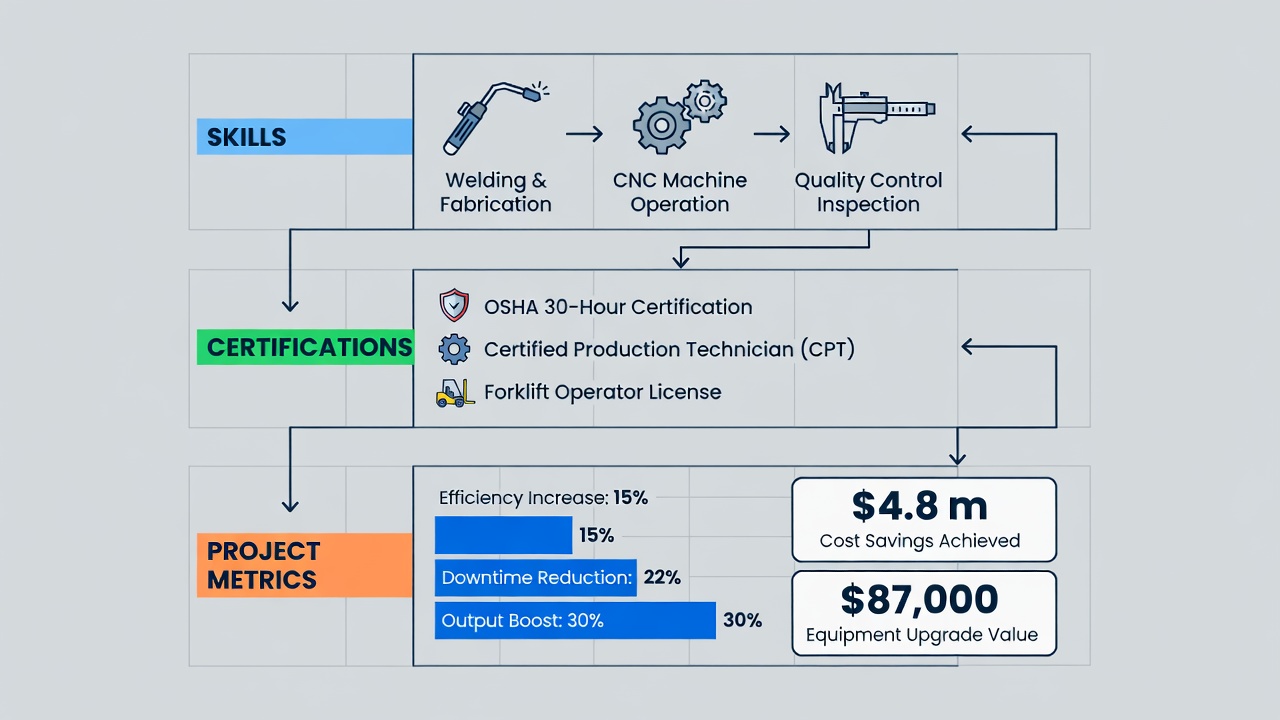
Dedicate a prominent skills block near the top of the resume after your professional summary. Organize entries into technical skills, safety certifications, and soft skills that matter in field environments. Technical examples include welding (MIG/TIG), blueprint reading, hydraulic systems repair, and ERP software navigation. Safety credentials such as OSHA 30-hour card, forklift certification, and HAZMAT handling should appear first because they often serve as minimum requirements. Soft skills like team leadership, conflict resolution under deadline pressure, and clear communication with diverse crews round out the list.
Additional Sections: Education, Licenses, and Professional Development
Although blue-collar employers place less emphasis on degrees, include any relevant vocational training, apprenticeships, or licenses in a dedicated section. List high school diplomas only if you lack post-secondary credentials. Add professional development items such as recent equipment-specific training courses or union continuing education to demonstrate ongoing commitment to skill growth.
Successful Versus Unsuccessful Resume Comparisons
Successful resumes feature specific metrics, industry terminology, and clear formatting that passes ATS filters. They avoid filler phrases and instead present evidence of impact. Unsuccessful versions rely on generic claims like "responsible for daily operations" without numbers or context, overuse buzzwords such as "synergy" or "empower," and contain spelling errors that immediately disqualify candidates. Reviewing side-by-side examples reveals that detail-oriented submissions receive callbacks at significantly higher rates.
Handling Employment Gaps in Trades and Manual Labor Sectors
Employment gaps appear frequently in these industries due to project-based work, seasonal fluctuations, or personal circumstances. Address them briefly in a cover letter by highlighting any freelance gigs, volunteer construction projects, or self-directed skill upgrades completed during the gap. During interviews, frame gaps as periods of targeted learning or family priority without over-explaining. Many logistics and manufacturing managers understand cyclical hiring patterns and focus more on recent demonstrated ability than perfect continuity.
Common Mistakes to Avoid When Applying for Trades Roles
- Using overly corporate language that feels disconnected from field realities.
- Omitting safety certifications or placing them at the bottom of the document.
- Failing to customize the resume for each application by incorporating job-specific keywords.
- Including irrelevant personal information such as marital status or age.
- Neglecting to proofread for typos that undermine credibility in precision-driven trades.
Conclusion
Crafting a strong resume for blue-collar positions in 2026 requires deliberate focus on measurable achievements, relevant certifications, and ATS-compatible language. By following the structured approach outlined above and studying the provided industry examples, job seekers can create documents that effectively communicate their value to employers in construction, manufacturing, and logistics. For the latest workforce data and regulatory guidance, refer to the U.S. Bureau of Labor Statistics, the U.S. Department of Labor, and safety standards published by OSHA. Apply these principles consistently to improve your chances of securing interviews and advancing your career in the trades.


No comments yet. Be the first!