 Jobboy

Introduction to ESG Metrics in 2026 Interviews
Mid-career professionals preparing for sustainability roles must demonstrate strategic command of ESG metrics. Employers now expect candidates to translate regulatory requirements and stakeholder demands into quantifiable outcomes. This guide equips you with the knowledge to answer advanced questions confidently using real data from ESG reports. In 2026, interview panels routinely probe beyond basic awareness, seeking evidence of how you have measured, reported, and improved climate impact and diversity, equity, and inclusion results. Success requires blending technical fluency with compelling storytelling that highlights measurable progress.
Researching Company ESG Reports Effectively
Start by analyzing the target company’s latest sustainability report. Identify baseline metrics such as Scope 1, 2, and 3 emissions, water usage intensity, and board diversity percentages. Cross-reference these figures against industry benchmarks to show you understand context-specific performance. Download the most recent annual and sustainability reports from the company website and examine the assurance statements to verify data credibility. Look for alignment with frameworks such as the GHG Protocol and note any year-over-year trends or gaps. Prepare three specific observations about the company’s ESG performance that you can reference naturally during the interview. For example, if a firm reports a 15 percent reduction in Scope 2 emissions but stagnant Scope 3 figures, you can discuss targeted supplier engagement strategies that address upstream impacts.
Navigating Regulatory Frameworks Like CSRD
The Corporate Sustainability Reporting Directive (CSRD) mandates double materiality assessments. Candidates should explain how they would map financial and impact materiality for a given sector. Reference official guidance from the European Commission to demonstrate up-to-date regulatory awareness. Beyond CSRD, familiarize yourself with the International Sustainability Standards Board (ISSB) standards and the EU Taxonomy Regulation. Practice articulating how double materiality differs from single materiality and why it matters for investor decision-making. Prepare examples of how you would conduct a materiality assessment, including stakeholder engagement methods and threshold-setting processes. This level of detail signals that you can help organizations stay compliant while driving strategic value.
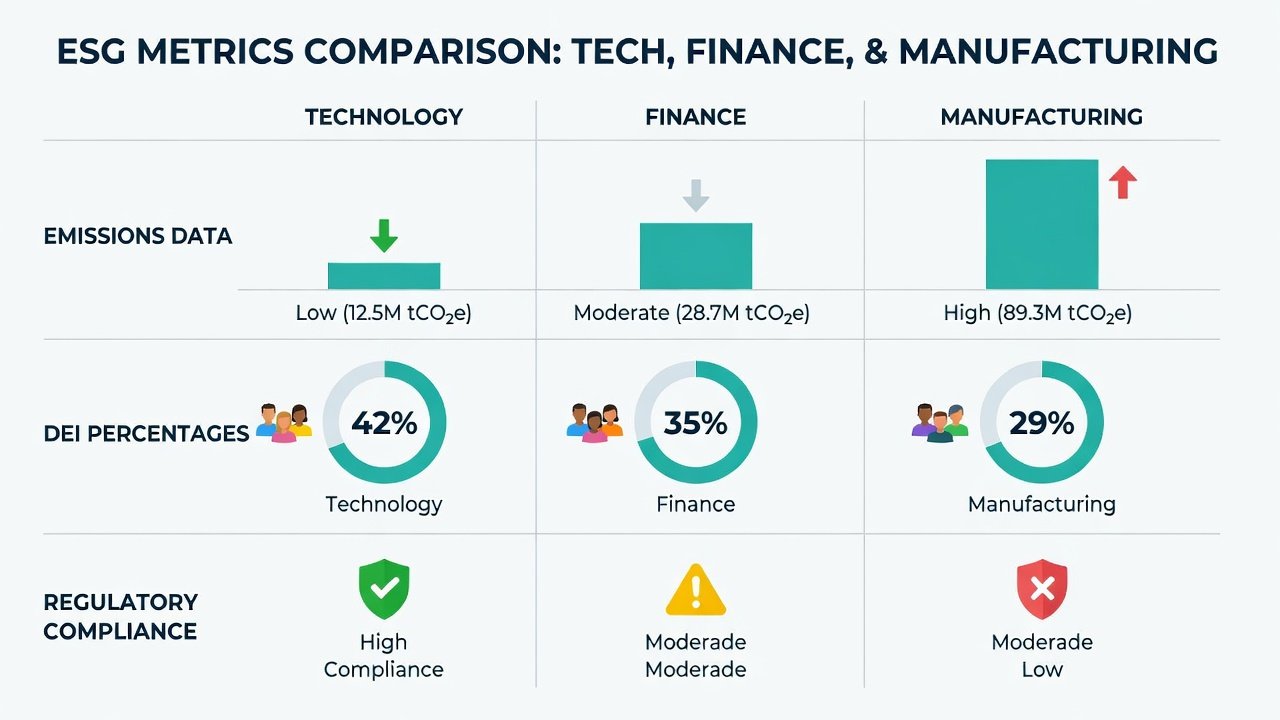
Sector Comparisons: Tech, Finance, and Manufacturing
Tech companies typically focus on energy consumption of data centers and responsible AI governance. Finance firms emphasize financed emissions and sustainable investment screening. Manufacturing roles require expertise in supply-chain traceability and circular economy indicators. Prepare comparative tables that highlight these differences during interviews. In technology, key metrics include power usage effectiveness (PUE) ratios and renewable energy procurement percentages. Finance professionals often discuss portfolio alignment with net-zero pathways and exclusion criteria for high-carbon sectors. Manufacturing candidates must address Scope 3 emissions from raw material sourcing and waste diversion rates. Understanding these sector nuances allows you to tailor answers and demonstrate that you can adapt ESG strategies to specific operational realities.
STAR Method Examples for ESG Questions
Question: “Describe how you reduced greenhouse gas emissions in a previous role.” Weak answer: “I helped lower emissions by implementing some green initiatives.” Strong STAR answer: Situation – Our manufacturing plant emitted 45,000 tCO2e annually. Task – I was tasked with achieving a 20 percent reduction within 18 months. Action – Conducted Scope 3 mapping, introduced renewable energy contracts covering 80 percent of electricity needs, and launched supplier engagement programs that improved data collection from 40 to 120 tier-one suppliers. Result – Delivered a 23 percent reduction verified by third-party audit, equivalent to 10,350 tCO2e avoided, while also cutting energy costs by 12 percent. Another example: Question on DEI outcomes. Situation – Gender representation at senior levels stood at 22 percent. Task – Develop a measurable inclusion program. Action – Implemented sponsorship initiatives and bias-reduced promotion processes. Result – Increased representation to 34 percent within two years, with retention rates for women rising 18 percentage points.
Weak Versus Strong Answer Scripts
- Weak: Vague language without numbers or timelines.
- Strong: Specific metrics, methodology references, and verified outcomes.
- Weak: Ignores trade-offs or stakeholder pushback.
- Strong: Addresses challenges and mitigation strategies explicitly.
- Weak: Focuses only on activities rather than results.
- Strong: Quantifies business impact such as cost savings or risk reduction.
Tools for Bias Mitigation in Responses
Use structured frameworks such as the GHG Protocol and GRI Standards to anchor answers in objective methodologies. Reference GHG Protocol guidance when discussing emissions calculations. Practice peer review of responses to catch unconscious bias in language around DEI metrics. Maintain consistency by referencing the same data sources across multiple questions. Additional tools include maintaining a personal metrics dashboard and rehearsing answers with colleagues from diverse backgrounds to surface blind spots in narrative framing.
Impact Measurement Checklists
- Define clear KPIs aligned with company strategy and materiality assessment results.
- Establish baseline data from the most recent reporting year using consistent boundaries.
- Apply science-based targets where applicable and document the target-setting methodology.
- Document data collection methods, frequency, and any third-party assurance processes.
- Track year-over-year progress with transparent attribution of contributing initiatives.
- Include forward-looking targets and scenario analysis for climate resilience planning.
FAQ on Reporting Standards
What is the difference between CSRD and ISSB?
CSRD focuses on EU double materiality while ISSB standards emphasize investor-focused climate disclosures. Reference IFRS Foundation resources for detailed comparisons. CSRD requires broader stakeholder consideration and assurance, whereas ISSB prioritizes financial materiality for capital markets.
How should I quantify DEI outcomes?
Use representation rates, pay equity ratios, and retention metrics for underrepresented groups. Tie these to business outcomes such as innovation indices or employee engagement scores. Always disclose data collection methods and any limitations in sample size.
Which tools help with ESG data collection?
Common platforms include Workiva, Salesforce Net Zero Cloud, and Sphera. Choose tools based on integration capabilities with existing ERP systems and the level of assurance required.
Conclusion
Strategic preparation for ESG metrics questions positions you as a forward-thinking leader. Combine rigorous data analysis with clear storytelling to stand out in 2026 sustainability interviews. By mastering company research, regulatory context, sector-specific metrics, and structured response techniques, you demonstrate the strategic ESG knowledge that organizations seek in mid-career professionals.
Discover more job search tips tailored to sustainability interviews.
Build on this with career development strategies for ESG professionals.

No comments yet. Be the first!