 Jobboy

Understanding Unconscious Bias in Modern Hiring
Unconscious bias continues to shape hiring decisions in 2026, often without interviewers realizing it. Candidates who prepare targeted responses can navigate these challenges while maintaining professionalism and advancing their careers. This comprehensive guide explores proven strategies to spot and counter biases such as the halo effect and affinity bias during interviews, supported by real-world examples, data insights, and actionable frameworks that help you respond with confidence and poise.
Common Types of Interviewer Bias with Real-World Examples
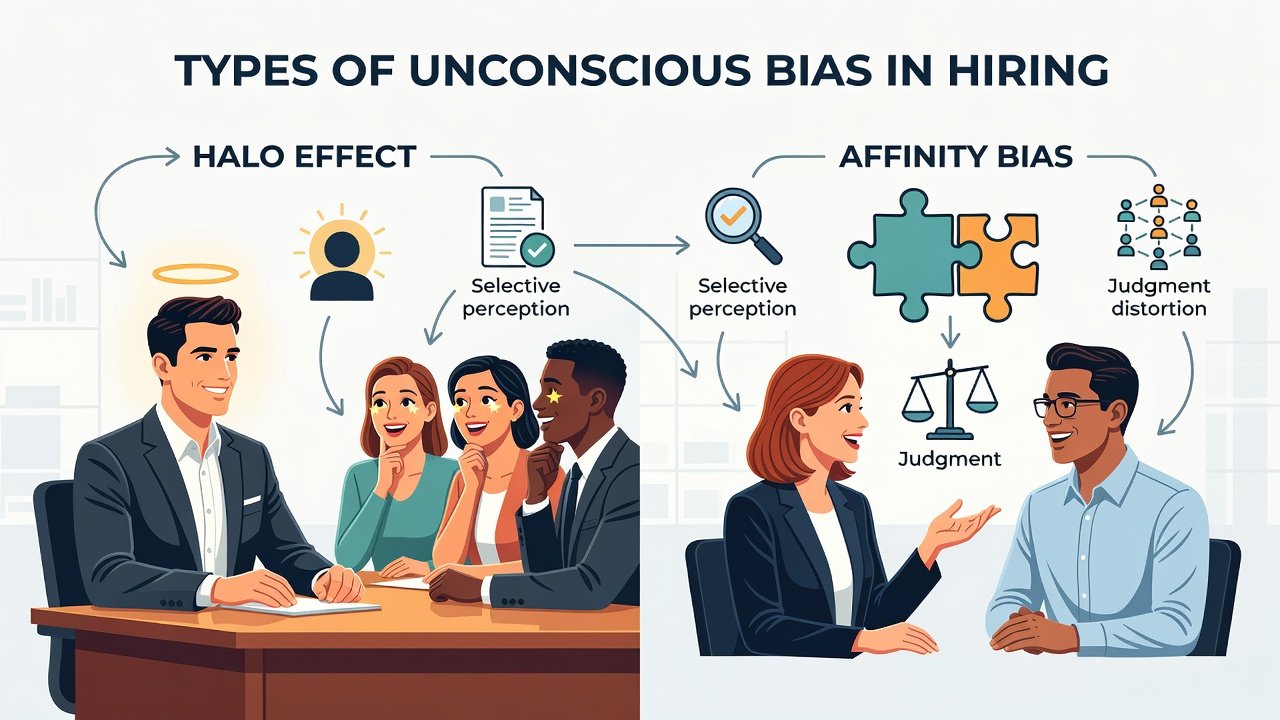
The halo effect occurs when one strong trait, like a prestigious alma mater or a single impressive project, influences perceptions of all other qualities. For instance, a candidate from a top university might receive undue credit for unrelated skills in communication or technical execution, overshadowing equally qualified applicants from less prominent backgrounds. Affinity bias arises when interviewers favor candidates who share similar backgrounds, such as attending the same college, enjoying the same hobbies, or coming from comparable cultural experiences, leading to less diverse hires and reduced innovation in teams.
Other prevalent biases include confirmation bias, where interviewers seek evidence that supports initial impressions and ignore contradictory information; attribution bias, attributing successes to luck for some groups but innate skill for others; and similarity bias, which extends affinity into assumptions about cultural fit. In tech interviews, affinity bias might manifest as preference for candidates who reference the same open-source projects the interviewer enjoys, while in sales roles, halo effect could elevate someone based solely on prior quota achievements without assessing team collaboration potential.
Data on How Bias Impacts Hiring Outcomes
Research from leading organizations shows bias significantly affects hiring. Studies indicate that biased processes can reduce diversity in shortlists by notable margins in competitive fields. The U.S. Equal Employment Opportunity Commission highlights how subtle biases contribute to disparities in selection rates across demographics. In 2026, companies focused on measurable DEI progress report improved retention when bias training is paired with structured interviews. These patterns underscore the need for candidates to prepare responses that emphasize objective achievements and inclusive practices.
Sector-Specific Comparisons of Bias Challenges
Finance and consulting sectors often see stronger halo effects tied to elite education credentials, where interviewers assume broad competence from pedigree alone. Tech and creative industries face higher affinity bias due to cultural fit emphasis, sometimes resulting in homogeneous teams that limit creative problem-solving. Healthcare and education roles may encounter attribution bias more frequently when evaluating leadership potential, with certain candidates credited differently for the same outcomes. Government and nonprofit positions can exhibit confirmation bias during panel interviews. Candidates should research industry norms to anticipate bias patterns and prepare accordingly, tailoring examples to highlight diverse collaboration and measurable results.
STAR-Based Response Frameworks for Behavioral Questions
The STAR method (Situation, Task, Action, Result) provides structure to answer bias-prone questions confidently. When facing affinity bias, pivot responses to emphasize unique contributions. Example: For "Tell me about a time you worked with a difficult team," describe the Situation of cross-department misalignment, the Task of aligning goals, your Action in facilitating data-driven discussions, and the Result of a 20 percent efficiency gain. Break down each component with specific metrics to redirect focus from personal similarities to professional impact. Practice adapting STAR stories to cover multiple bias types, ensuring every answer reinforces qualifications over assumed common ground.
Self-Advocacy Scripts That Tie into Behavioral Questions
Practice subtle scripts like: "Building on that, my experience leading cross-functional projects at my previous role allowed me to deliver results through diverse collaboration, increasing team output by 25 percent." Another variation: "While shared interests can build rapport, what truly drove success in my last role was implementing structured feedback loops that improved project delivery timelines." This ties personal achievements to measurable impact without directly confronting bias. Always maintain poise and redirect to qualifications. Prepare three to five variations for common questions such as leadership challenges or conflict resolution to ensure natural delivery.
Integrating ESG and DEI Talking Points Effectively
Weave ESG and DEI into answers naturally. For sustainability-focused roles, discuss how your initiatives aligned with environmental goals and stakeholder inclusion. Reference the Society for Human Resource Management resources when discussing equitable talent practices. Avoid forced mentions; connect them to the role's objectives, such as explaining how diverse hiring improved innovation metrics in a prior position. This demonstrates strategic thinking aligned with modern corporate priorities.
Practical Checklists for Interview Preparation
- Research company DEI reports and recent initiatives before the interview using official sources.
- Prepare 3-5 STAR stories emphasizing objective metrics over personal similarities.
- Practice redirecting affinity-based questions to skills and results with timed rehearsals.
- Review common bias triggers in your target industry through case studies and reports.
- Prepare follow-up questions that demonstrate inclusive thinking and forward-looking perspectives.
- Record practice sessions to analyze tone and ensure responses stay professional and concise.
- Build a mental library of examples showcasing collaboration across different backgrounds.
Practice Scenarios and How to Respond
Scenario 1: Interviewer assumes shared interests and pivots conversation personally. Response: Acknowledge briefly then shift to professional achievements using STAR, highlighting quantifiable team outcomes. Scenario 2: Halo effect from a prior candidate's credentials creates skewed expectations. Counter by reinforcing your distinct qualifications with specific examples of problem-solving under constraints. Scenario 3: Attribution bias surfaces when successes are questioned. Reframe with detailed actions and results that demonstrate personal agency. Scenario 4: Confirmation bias appears in follow-up probes. Gently provide balanced evidence through additional STAR narratives. Rehearse these with a mentor or peer for natural delivery and timing.
Mistakes to Avoid When Navigating Bias
Common pitfalls include becoming defensive, which can escalate tension; over-explaining personal background instead of focusing on skills; or ignoring bias entirely and missing opportunities to demonstrate inclusive leadership. Avoid vague language that lacks metrics, as it weakens impact. Never accuse directly during the interview; instead, document observations afterward for personal reflection or formal channels if warranted. These strategies preserve professionalism while positioning you as a strong, self-aware candidate.
FAQs on Maintaining Professionalism While Addressing Bias
Q: How do I address bias without seeming confrontational? A: Focus on facts and achievements rather than accusations, using structured frameworks like STAR to keep responses objective. Q: Is it safe to mention DEI in answers? A: Yes, when tied directly to the role and supported by concrete examples of positive outcomes. Q: What if bias feels overt? A: Document internally and consider reporting through formal channels post-interview if appropriate, while prioritizing your immediate performance. Q: Should I prepare differently for virtual versus in-person interviews? A: Yes, virtual settings may amplify certain biases through limited nonverbal cues, so emphasize clear verbal examples and structured responses. Q: How can I recover if I sense bias mid-interview? A: Pause, refocus on your prepared stories, and use bridging phrases to return to qualifications.
Conclusion
Mastering responses to unconscious bias empowers candidates in 2026 interviews. By combining preparation frameworks, data awareness, sector insights, expanded checklists, and strategic communication scripts, professionals can advocate for themselves effectively while advancing inclusive hiring practices. Consistent practice transforms potential challenges into opportunities to showcase resilience and expertise.

No comments yet. Be the first!