 Jobboy

Introduction: Why Career Changers Need a Different Resume Approach in 2026
Switching careers is more common than ever, but traditional resumes often fail to showcase your value when pivoting industries. In 2026, recruiters scan applications in seconds, prioritizing relevance and transferable skills over linear experience. This guide walks you through building a resume that reframes your background effectively, addresses employment gaps, and uses data-driven examples to boost your chances. Whether you are moving from education to corporate training, retail to tech sales, or healthcare administration to project management, the principles remain consistent: focus on outcomes that align with the target role rather than chronological job titles.
The 2026 job market rewards adaptability. Many professionals are seeking new paths due to industry shifts, automation, and personal growth goals. A well-crafted resume for career changers tells a clear story of progression, not disruption. It bridges the gap between your past and your future by emphasizing skills like leadership, problem-solving, and communication that transfer across sectors.
Understanding Search Intent for Career Change Resumes
Job seekers searching this topic want practical, step-by-step advice with real examples. They need help mapping old achievements to new roles, selecting formats that minimize gaps, and writing summaries that sell the transition. This article delivers exactly that through rewriting exercises, comparison tools, and recruiter insights drawn from hiring platforms. We go beyond surface-level tips to provide concrete templates you can adapt immediately.
Step 1: Map Your Old Achievements to New Job Requirements
Start by pulling 3-5 target job descriptions from sites like Indeed. Identify keywords like "project management," "data analysis," or "stakeholder communication." Then audit your past roles for matching accomplishments. For instance, a teacher transitioning to corporate training might translate "developed lesson plans for 30 students" into "designed and delivered training modules that improved team performance by 25%."
Practical exercise: Create a two-column table. Left side lists target skills; right side lists your achievements. Repeat this for each job posting. This mapping ensures every bullet point earns its place and demonstrates direct relevance. Expand further by quantifying results wherever possible—use metrics like percentages, dollar amounts saved, or time efficiencies gained. If exact numbers are unavailable, use ranges or qualitative impact statements supported by context from your experience.
Step 2: Choose the Right Resume Format
Traditional chronological resumes emphasize tenure, which can highlight gaps. For career changers, a hybrid or functional format works better by leading with skills. Use a skills section at the top, followed by a condensed work history. Avoid pure functional formats, as many applicant tracking systems (ATS) penalize them. In 2026, most large companies still rely on ATS software, so balance readability for humans with keyword optimization for machines.
Hybrid resumes typically open with contact information and a professional summary, move into a core competencies section, then present a reverse-chronological work history with only the most recent 10-15 years detailed. This structure allows you to foreground transferable abilities while still providing the employment timeline recruiters expect.
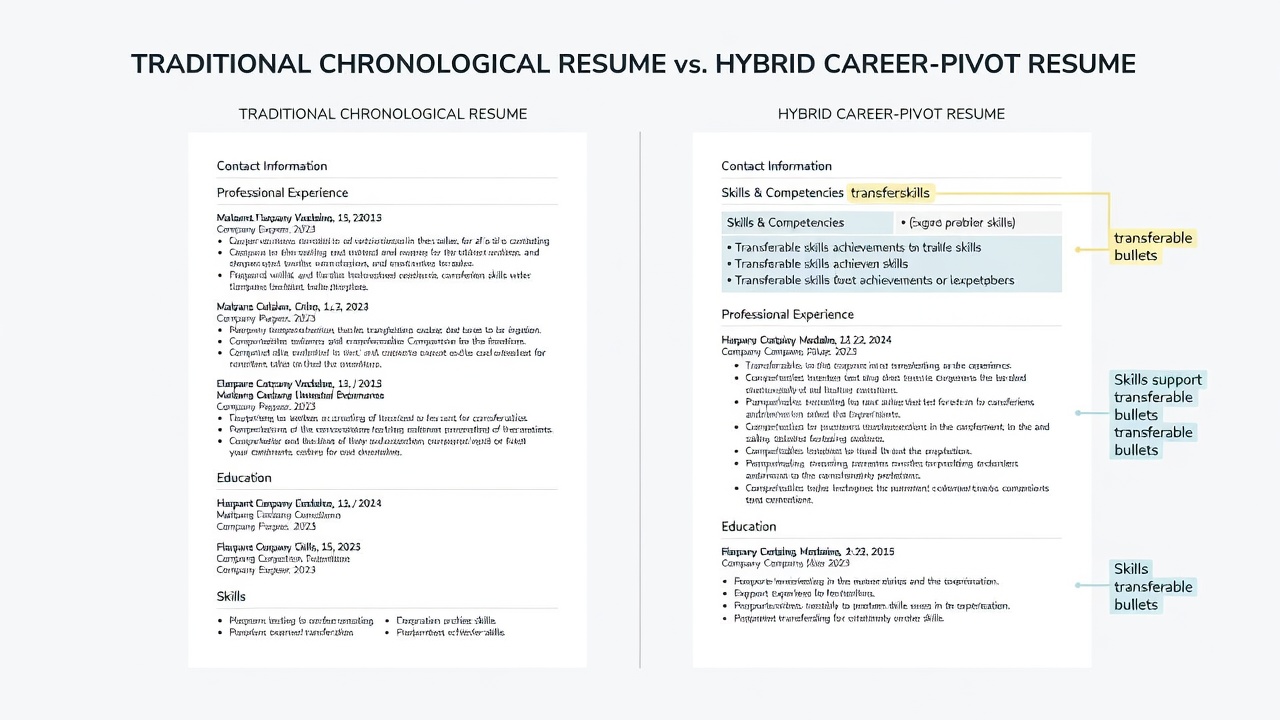
Comparison: Traditional vs. Career Pivot Resume
- Traditional: Starts with job titles and dates; focuses on industry-specific duties; works well for staying in the same field.
- Pivot Version: Opens with a targeted summary and skills; bullets emphasize outcomes transferable across sectors; minimizes unrelated details and highlights learning agility.
Step 3: Write a Strong Professional Summary
Your summary is the hook. Limit to 3-4 lines that state your pivot goal, key transferable skills, and one quantifiable win. Example: "Results-driven marketing professional pivoting to UX design with 5+ years in user research and content strategy. Delivered campaigns that increased engagement 40% and eager to apply design thinking to create intuitive digital experiences." Tailor this paragraph for every application by mirroring language from the job posting. Avoid generic statements; instead, weave in specific tools or methodologies the new role requires.
Step 4: Reframe Experience with Targeted Bullet Points
Transform duties into achievements. Before: "Managed a team of 8." After: "Led cross-functional team of 8 to launch initiatives that reduced costs 15% and improved collaboration across departments." Include 4-6 bullets per role, prioritizing the most relevant first. For earlier positions, condense to 2-3 bullets or group them under a single "Previous Experience" heading if they are less relevant. This keeps the document focused and prevents it from exceeding the preferred one- or two-page length.
Optimizing Your Resume for ATS and Recruiter Review
Applicant tracking systems parse resumes for keywords, so integrate them naturally throughout your document. Use standard section headings like "Professional Experience" and "Skills" rather than creative alternatives. Save files as .docx or PDF depending on the application instructions. Recruiters also appreciate clean formatting—avoid tables, graphics, or unusual fonts that can break parsing. Test your resume by copying it into a plain text editor to ensure all content remains intact.
Handling Employment Gaps and Recruiter Perspectives
Address gaps briefly in the summary or a short note if longer than six months. Focus on what you did during the gap, such as freelance projects or upskilling. Recruiters at platforms like LinkedIn report that transparent, skills-focused resumes from career switchers succeed when they demonstrate quick learning and impact. Many hiring managers view gaps positively if you show proactive steps like certifications or volunteer work that build relevant competencies.
Common Mistakes to Avoid When Changing Careers
- Listing every past responsibility instead of selecting only transferable achievements.
- Using industry jargon from your old field that the new employer may not recognize.
- Ignoring soft skills that are often the bridge between unrelated roles.
- Failing to customize the resume for each application, which reduces relevance scores in ATS.
FAQs on Career Changer Resumes
- How long should my resume be? One page for most pivots unless you have 15+ years of highly relevant experience. Two pages are acceptable only when every line adds clear value to the target role.
- Should I include an objective statement? Replace it with a professional summary that highlights the transition and your unique value proposition.
- What if my previous industry is unrelated? Emphasize soft skills like leadership and problem-solving that apply universally, and use the summary to explicitly state your motivation for the switch.
- Can I include volunteer or freelance work? Yes—treat these as professional experience when they demonstrate relevant skills, especially if they fill employment gaps.
- How do I handle references? List "References available upon request" or provide them separately after the interview stage to keep the resume concise.
Conclusion
By following these steps—mapping skills, choosing a hybrid format, crafting a compelling summary, and reframing bullets—you'll create a resume that positions you as an asset in your new field. Update your LinkedIn profile to match and practice tailoring for each application. Start rewriting today to accelerate your 2026 career pivot. For additional labor market data supporting high-demand transition fields, consult resources from the Bureau of Labor Statistics.

No comments yet. Be the first!