 Jobboy

Introduction: Why Unified Narratives Matter in 2026
In today's competitive job market, experienced professionals must go beyond basic tailoring to stand out. A cohesive resume and cover letter narrative creates a powerful, unified professional story that resonates with hiring managers and applicant tracking systems alike. This approach emphasizes consistency in themes, language, and achievements to demonstrate clear career progression and value. Job seekers who align these documents strategically position themselves as intentional candidates rather than those with scattered experiences. Research from authoritative sources like the U.S. Department of Labor highlights how structured application materials improve hiring outcomes. This article provides in-depth guidance on building such narratives, including practical steps, comparisons, real-world scenarios, and tools tailored for advanced users seeking to elevate their materials.
Identifying Core Career Themes
Begin by distilling your professional journey into 2-3 central themes, such as leadership in digital transformation, expertise in sustainable business practices, or mastery of cross-functional project delivery. Review your past roles, projects, and skills to find recurring patterns that align with target positions. This foundation ensures both documents reinforce the same story without dilution. For instance, if your theme centers on innovation, highlight initiatives where you drove technological change across multiple experiences. Consider your career arc holistically: map early roles as foundational, mid-career positions as growth accelerators, and recent achievements as culminations. This prevents fragmented applications and builds a compelling arc that hiring managers can follow effortlessly. Experienced professionals often discover that themes like "strategic problem-solving" emerge naturally when analyzing performance reviews and project outcomes over five or more years.
Practical Steps for Narrative Mapping
Follow these actionable steps to map your narrative effectively and create alignment across documents:
- Analyze 3-5 target job descriptions for recurring requirements, values, and responsibilities, noting exact phrases that match your background.
- List your top 8-10 key achievements with quantifiable results, then match them directly to the identified job requirements.
- Create a shared outline that sequences experiences logically, ensuring the resume leads with impact and the cover letter provides context and storytelling.
- Review for gaps in the narrative and reinforce connections using transitional phrases like "building on this foundation" in the cover letter.
- Iterate the mapping process by drafting the resume first, then expanding into the cover letter while cross-referencing for consistency.
Apply this mapping iteratively over several days, allowing time for refinement. This structured method transforms vague experiences into a clear professional trajectory.
Mirroring Key Achievements and Language
Consistency in phrasing and accomplishments strengthens your overall story. Use parallel language, such as repeating action verbs like "spearheaded," "optimized," or "orchestrated," across both documents. Mirror specific metrics where possible to provide evidence without unnecessary repetition. For example, if your resume states "Led a team that increased revenue by 35%," the cover letter might expand with "This initiative, which boosted revenue by 35% through targeted process improvements, exemplifies my approach to scalable growth." This mirroring technique helps hiring managers quickly connect the dots between your resume highlights and the expanded stories in your cover letter, creating a seamless reading experience.
Maintaining Consistency in Tone and Structure
Adopt a professional yet engaging tone throughout both documents. Structure the cover letter to echo the resume's sections, such as beginning with a summary that parallels your professional profile. Avoid shifting from concise bullet points in the resume to overly narrative prose in the letter without clear bridges. Ensure visual elements like formatting and font choices align if submitting as combined PDFs. This consistency signals attention to detail and reinforces your personal brand.
Incorporating ATS Keywords Naturally
Integrate keywords from job postings organically by weaving them into achievements rather than stuffing lists. Tools and resources from sites like CareerOneStop can help identify relevant terms such as "cross-functional collaboration," "data-driven decision making," or "agile methodologies." This natural inclusion boosts visibility while preserving readability for human reviewers. Test your documents by pasting them into free ATS simulators to verify keyword density remains balanced and contextual.
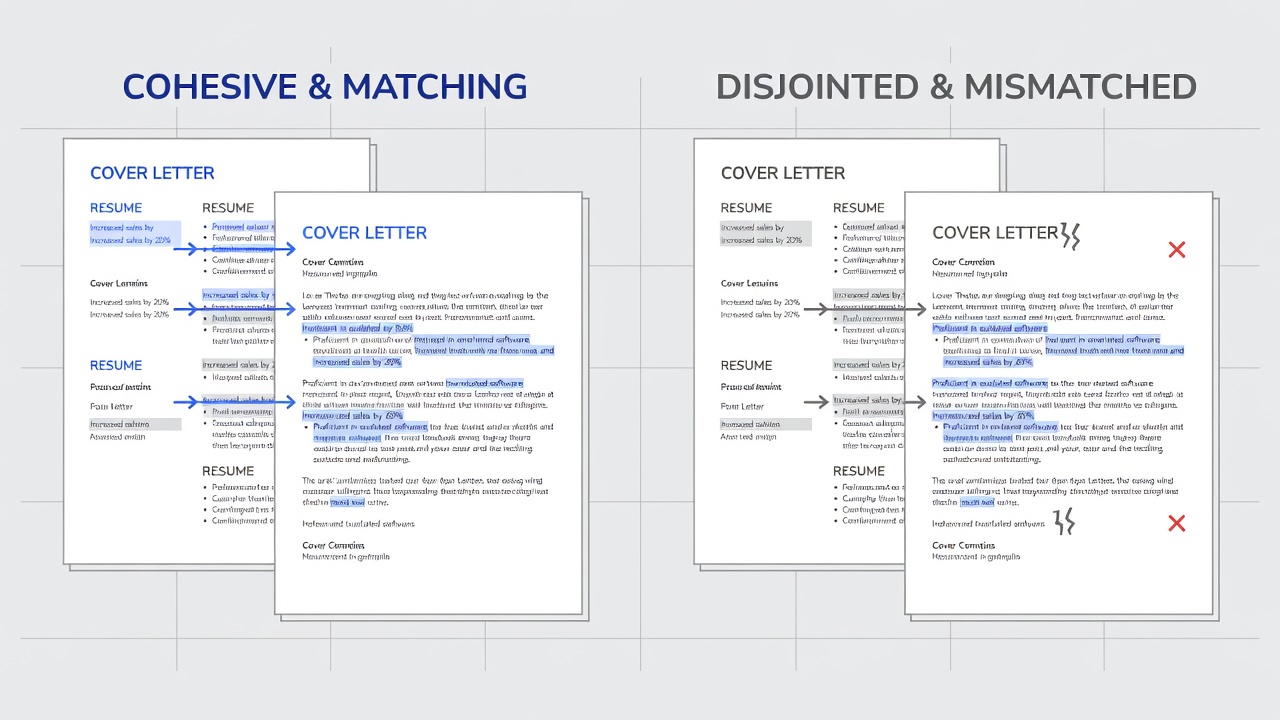
Side-by-Side Comparisons: Cohesive vs. Disjointed Examples
Consider these contrasts for a marketing leadership role targeting growth-focused companies:
- Disjointed Resume: Scattered bullets on unrelated sales metrics, administrative tasks, and vague skills without thematic links.
- Cohesive Resume: Focused bullets on campaign strategy, team leadership, and ROI improvements all tied explicitly to growth and innovation themes.
- Disjointed Cover Letter: Random anecdotes about past jobs without linking back to resume points or future goals.
- Cohesive Cover Letter: Opens with the growth theme, expands on 2-3 mirrored achievements with context, and closes with forward-looking alignment to the company's objectives.
These examples illustrate how cohesion transforms applications from generic to memorable and persuasive.
Actionable Checklists for Alignment
Use this comprehensive checklist before final submission to ensure full narrative unity:
- Have core themes been clearly identified and repeated consistently?
- Are achievements mirrored with similar metrics, verbs, and emphasis?
- Have ATS keywords been integrated naturally without forced repetition?
- Does the tone and overall structure align between the two documents?
- Have you proofread for grammar, flow, and logical transitions across both pieces?
- Does the cover letter add depth rather than repeat resume content verbatim?
Common Mistakes to Avoid
Many experienced candidates undermine their applications by including conflicting details, such as emphasizing different skills in each document or using varying terminology for the same accomplishment. Another frequent error is neglecting to update older experiences to reflect current themes, resulting in an outdated narrative arc. Avoid generic language that fails to tie achievements to the target role's priorities. Instead, always cross-reference both documents side by side during revisions.
Real-World Application Scenarios
An experienced project manager transitioning from tech to healthcare might map themes of risk mitigation and stakeholder engagement. The resume lists quantified successes like "Reduced project delays by 40% through proactive risk protocols," while the cover letter narrates a pivotal project that demonstrates adaptability in regulated environments. This unified approach has helped professionals secure roles in new sectors by clarifying transferable value. Similarly, a senior marketing executive could unify around "data-informed creativity," using both documents to showcase campaigns that combined analytics with innovative storytelling, leading to higher engagement rates.
FAQs on Narrative Alignment Challenges
How do I handle career gaps in a cohesive story?
Frame gaps as periods of skill development or strategic pivots, linking them back to your core themes in both documents with positive, forward-focused language.
Can I use the same cover letter template for multiple applications?
Customize each letter while maintaining the overarching narrative structure to preserve authenticity and relevance to each unique opportunity.
What if my experiences don't fit neatly into 2-3 themes?
Prioritize the themes most relevant to the target role and de-emphasize outliers through selective highlighting and concise descriptions.
How long should the aligned documents be for senior roles?
Keep the resume to two pages maximum and the cover letter to one page, ensuring every element advances the unified narrative without unnecessary detail.
Conclusion
Building cohesive resume and cover letter narratives elevates your applications in 2026 by creating a resonant, unified professional story. By focusing on themes, mirroring content, optimizing for ATS, and avoiding common pitfalls, experienced job seekers can differentiate themselves effectively. Apply these strategies consistently to achieve stronger results and advance your career trajectory.
No comments yet. Be the first!