 Jobboy

Introduction
Job seekers with non-linear work histories often face challenges when applying for full-time roles. Contract and freelance experience can appear scattered or unstable if not presented correctly. However, in 2026, employers actively seek candidates who bring specialized skills, quick adaptability, and proven results from project-based work. This comprehensive guide explains how to integrate contract experience seamlessly into your resume. It covers strategic formatting, project selection, gap avoidance, ATS optimization, and provides detailed examples, tables, checklists, and FAQs to help you create a compelling narrative that lands interviews.
Why Contract Experience Matters in 2026
Contract roles allow professionals to demonstrate expertise across multiple industries and deliver immediate value without extended ramp-up time. Research from LinkedIn shows that candidates who quantify impact from short-term engagements often advance further in hiring processes. These positions highlight your ability to manage diverse stakeholder needs, meet tight deadlines, and apply cutting-edge tools in varied environments. For job seekers targeting stable full-time positions, contract work serves as evidence of continuous skill development and resilience in dynamic markets. It also provides exposure to emerging trends that permanent roles might not offer as quickly.
Strategic Formatting Options
Choosing the right format depends on the length and relevance of your contracts. One effective method groups multiple short engagements under a single umbrella heading such as “Freelance Digital Strategist” or “Independent IT Consultant.” This approach creates a clean timeline and emphasizes cumulative achievements. Alternatively, list substantial contracts individually when each role lasted several months and aligns directly with the target position. Both strategies maintain readability while showcasing breadth of experience. Consider your career level: mid-career professionals benefit more from grouping, while specialists may prefer detailed individual entries to highlight niche accomplishments.
Selecting Relevant Projects
Not every contract belongs on your resume. Evaluate each project against the job description by asking three questions: Does it demonstrate core skills required for the role? Did I achieve measurable outcomes? Can I describe the work in language that matches industry terminology? Prioritize contracts involving tools, methodologies, or challenges mentioned in the posting. For example, if applying for a project management position, emphasize contracts where you led cross-functional teams or implemented new processes. Discard minor tasks that add little strategic value, such as one-off administrative support, unless they fill a critical skill gap in your overall profile.
Avoiding the Perception of Employment Gaps
Recruiters scan resumes quickly and may interpret unexplained gaps negatively. Present contract work in reverse chronological order with consistent month-year formatting. When short gaps exist between engagements, add a concise line under your professional summary such as “Completed targeted certifications in cloud architecture during transition periods.” This proactive framing shows intentional career management. If you took time for personal reasons, briefly note it without over-explaining. The goal is to keep the focus on your professional momentum rather than absences.
Balancing ATS Compatibility with Readability
Applicant tracking systems parse resumes using standard headings and keyword matching. Use titles like “Contract Financial Analyst” and incorporate exact phrases from the job posting naturally within bullet points. Avoid creative formatting such as columns or graphics that confuse parsers. At the same time, human readers appreciate clear visual hierarchy through bold role titles and consistent spacing. Test your document by submitting it to free ATS simulators before sending applications. This dual focus ensures your contract experience reaches hiring managers without being filtered out prematurely.
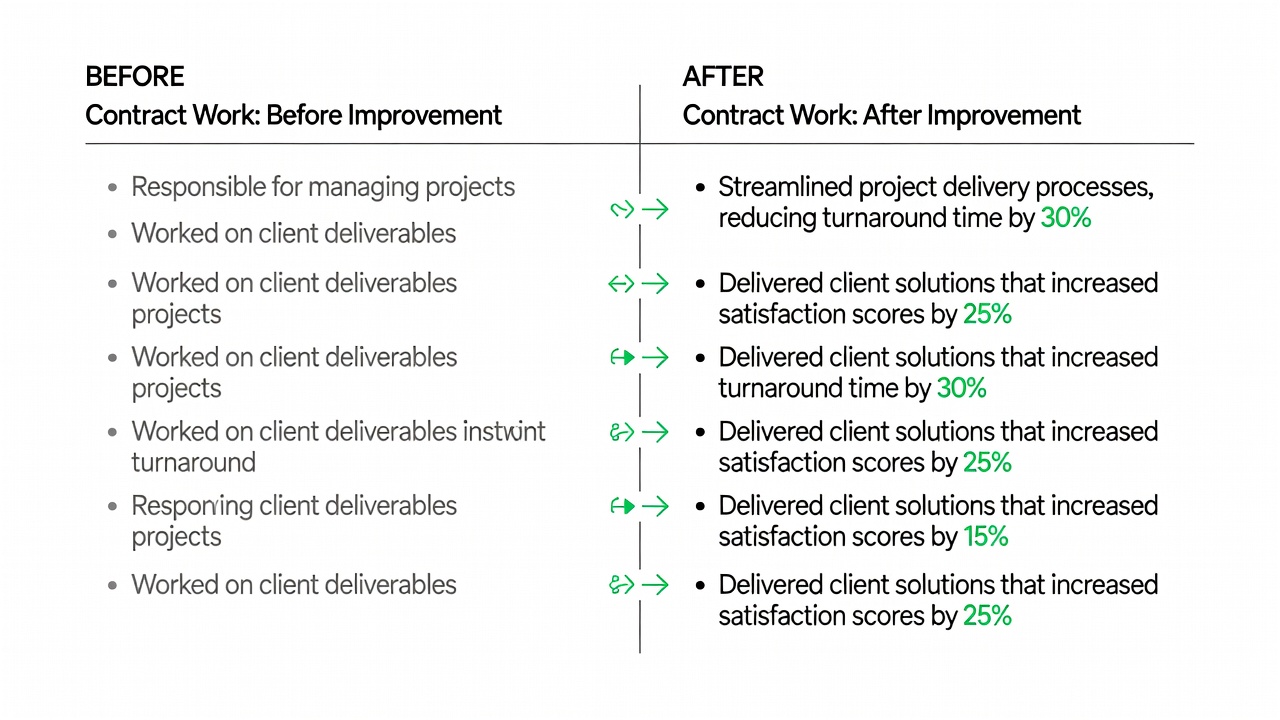
Before-and-After Bullet Point Examples
Transform generic descriptions into powerful statements by adding context, actions, and results. Weak example: “Provided consulting services to small businesses.” Strong example: “Delivered digital transformation consulting to five small businesses, implementing CRM systems that reduced client administrative time by 35% and increased revenue by an average of $48,000 within the first quarter.” Another weak version: “Managed marketing campaigns.” Improved version: “Led end-to-end marketing campaigns for three SaaS clients, achieving a 62% increase in qualified leads and lowering cost-per-acquisition by 28% across six-month contracts.” These revisions demonstrate impact and make your contributions concrete and memorable.
Contract vs Permanent Role Phrasing Comparison
| Aspect | Contract Phrasing | Permanent Phrasing |
|---|---|---|
| Role Title | Contract Software Engineer | Software Engineer |
| Bullet Focus | Delivered three-month migration project reducing downtime 30% | Maintained legacy systems and mentored junior engineers |
| Duration | June 2025 – September 2025 | June 2023 – Present |
| Skills Emphasis | Rapid onboarding and cross-platform integration | Long-term system ownership and team development |
Step-by-Step Checklist
- Compile a complete list of all contract and freelance work from the past seven years, including client names, dates, and key deliverables.
- Group short-term projects under umbrella headings when they share similar functions to create visual continuity.
- Craft three to five achievement-oriented bullets per significant engagement using the Challenge-Action-Result framework for clarity.
- Incorporate relevant keywords from target job descriptions while maintaining natural language flow.
- Run the full resume through multiple ATS compatibility tools and adjust formatting based on results.
- Customize the professional summary to explicitly connect your contract background to the stability and contributions expected in a full-time role.
- Have a trusted colleague or mentor review the document for tone, accuracy, and overall narrative strength.
- Prepare talking points for interviews that explain how contract experience prepared you for long-term commitment.
Common Mistakes to Avoid
Many candidates over-emphasize the temporary nature of contracts instead of focusing on outcomes. Another frequent error is using vague language that fails to quantify success. Avoid listing every minor gig, which can make your history appear fragmented. Finally, do not neglect to tailor each resume version; a generic document weakens the connection between your contract work and the specific opening.
Frequently Asked Questions
Should I list every short contract?
Only include contracts that showcase relevant skills or significant achievements. Minor one-week projects are better summarized in a single line or omitted entirely to keep the document focused.
How do I handle overlapping contracts?
Clearly note concurrent work and highlight distinct skill applications or industry contexts. This demonstrates strong time-management abilities rather than suggesting divided attention.
Will recruiters think I’m not committed to full-time roles?
Frame contract experience as deliberate skill-building that now positions you for long-term contribution. Use your summary statement to express enthusiasm for stable employment and the unique perspectives gained from varied projects.
What if my contracts were in a completely different field?
Emphasize transferable skills such as project management, client communication, or technical problem-solving that apply across industries. Provide brief context on how those experiences built capabilities relevant to your target role.
Conclusion
Contract and freelance experience represents a valuable asset when presented with strategic clarity and measurable results. By following the formatting approaches, detailed examples, comparison guidance, and actionable checklist outlined in this 2026 guide, you can transform a non-linear history into a powerful story of adaptability and achievement. The result is a resume that satisfies both ATS requirements and human readers, increasing your chances of securing the full-time opportunities you deserve.


No comments yet. Be the first!