 Jobboy

Introduction
In 2026, job markets in specialized sectors such as renewable energy and biotechnology have become increasingly competitive. A generic resume no longer suffices when employers receive hundreds of applications for a single position. Customization is essential to demonstrate not only your qualifications but also your deep understanding of the industry's unique challenges and terminology. This comprehensive guide walks you through every aspect of tailoring resumes for niche fields, from dissecting job descriptions to measuring real-world application outcomes. Whether you are pivoting into solar technology or advancing in genetic engineering, the methods outlined here will help you create documents that pass both human reviewers and sophisticated applicant tracking systems.
Analyzing Unique Job Descriptions
Every successful customization begins with a thorough analysis of the target job posting. Start by highlighting required hard skills, preferred certifications, and even implied soft skills. For renewable energy roles, postings often emphasize experience with “intermittent power integration,” “battery storage systems,” or “regulatory compliance for wind farms.” Biotech listings frequently mention “next-generation sequencing,” “GMP manufacturing,” or “clinical data analysis using specific software platforms.” Create a spreadsheet to categorize these elements into must-have, nice-to-have, and transferable categories. This structured approach ensures you address every key requirement without overlooking subtle cues about company culture or project scale.
Selecting Industry-Specific Keywords
Keyword optimization remains critical for ATS compatibility while also resonating with specialized recruiters. Use tools like industry glossaries and recent publications to identify current terminology. In renewable energy, incorporate phrases such as “levelized cost of energy,” “grid modernization,” and “decentralized energy systems.” Biotech professionals should weave in terms like “CRISPR-Cas9 gene editing,” “biopharmaceutical process validation,” and “pharmacovigilance reporting.” Distribute keywords naturally across your summary, skills, and experience sections rather than forcing them into a single paragraph. Authoritative references such as energy.gov and nih.gov provide reliable, up-to-date language that mirrors what hiring managers expect.
Structuring Content to Highlight Relevant Expertise
A well-structured resume places your most pertinent achievements front and center. Begin with a professional summary that directly references the target role and industry. Follow with a skills matrix that lists both technical proficiencies and relevant tools. In the experience section, transform routine duties into impact-driven bullets. For example, instead of stating “Conducted laboratory experiments,” write “Designed and executed CRISPR-based assays that accelerated target validation timelines by four weeks.” Always quantify results where possible, using percentages, dollar amounts, or time savings to demonstrate value.
Step-by-Step Customization Process
- Download the job description and create a master keyword list.
- Select an ATS-friendly template with clean formatting and standard fonts.
- Write a customized professional summary in three to four sentences that mirror posting language.
- Reorder your experience bullets to prioritize niche-relevant projects first.
- Integrate certifications such as NABCEP for solar or ASQ for biotech quality roles.
- Run the document through an ATS checker and adjust spacing or headings as needed.
- Save in both PDF and Word formats for different submission portals.
Before-and-After Examples
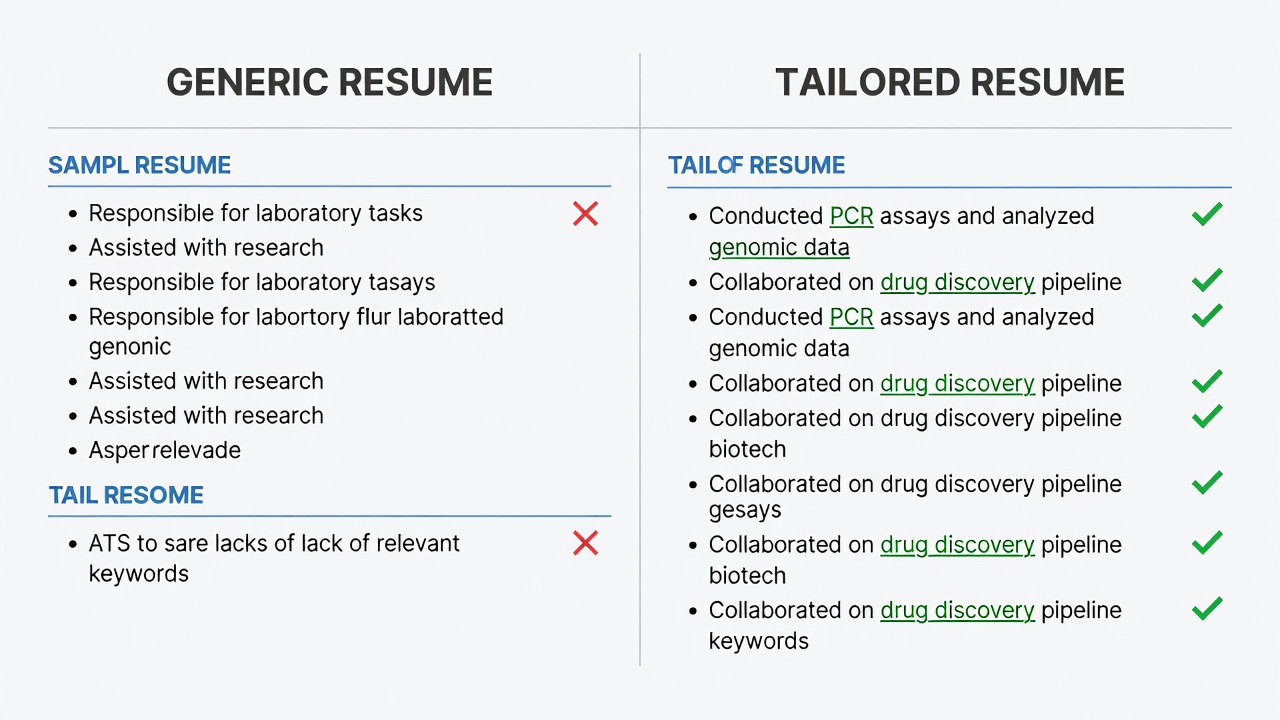
Consider a renewable energy project manager. The generic bullet read: “Managed energy projects and coordinated teams.” The tailored version states: “Directed a 120 MW offshore wind development project, coordinating with 15 vendors and securing $45 million in financing while ensuring compliance with BOEM permitting requirements.” In biotech, a generic line might say “Performed research in molecular biology.” A customized version becomes: “Led a team of five scientists in developing a novel monoclonal antibody platform, resulting in two patent filings and a 35% reduction in development cycle time.” These transformations show employers exactly how your background aligns with their needs.
ATS Compatibility Best Practices
Modern ATS platforms parse resumes using natural language processing, so avoid columns, text boxes, or heavy graphics. Stick to standard headings like “Work Experience,” “Education,” and “Certifications.” Use .docx or PDF formats as requested, and test submissions through free online simulators. Maintain consistent date formatting such as “January 2023 – Present” to prevent parsing errors. For highly technical roles, include both spelled-out terms and common acronyms on first use.
Aligning Your Cover Letter
A strong cover letter complements the resume by providing narrative context. Reference two or three specific resume achievements and explain your motivation for entering or advancing within the niche industry. Use parallel language so the recruiter sees immediate connections. For instance, if your resume highlights a solar microgrid project, the cover letter can describe the problem-solving process and lessons learned. This alignment increases the perceived professionalism of your application package.
Measuring Application Success Rates
Track key performance indicators including callback rate, time to response, and interview-to-offer conversion. Industry data indicates that targeted applications can improve interview invitations by 30 to 50 percent compared with generic submissions. Maintain a simple spreadsheet logging each application, the keywords used, and outcomes. Review monthly to identify which customizations yield the highest returns and refine future submissions accordingly.
Common Mistakes to Avoid
- Overusing buzzwords without supporting evidence or context.
- Failing to update older experience to reflect current industry standards.
- Ignoring soft skills such as cross-functional collaboration valued in biotech teams.
- Submitting without proofreading for both spelling and ATS compatibility.
- Neglecting to synchronize LinkedIn profiles with resume changes.
Additional Resources and Tools
Leverage official government portals for the latest terminology and certification requirements. The U.S. Department of Energy site offers detailed reports on emerging renewable technologies, while the National Institutes of Health provides extensive biotech career resources. Consider fda.gov for regulatory guidance relevant to life-science roles. Combine these references with professional association websites to stay ahead of evolving expectations in 2026.
FAQs
How long should a tailored resume be for niche roles?
Most professionals should aim for one page. Extend to two pages only when you possess more than ten years of directly applicable experience with quantifiable achievements.
Are different resume formats required for renewable energy versus biotech?
The foundational structure stays consistent, yet renewable energy resumes often emphasize project scale and regulatory knowledge while biotech resumes highlight laboratory techniques and compliance milestones.
How frequently should keywords be refreshed?
Review industry publications and job postings every three to six months to capture emerging terms such as new storage technologies or gene-editing advancements.
What metrics indicate successful customization?
A callback rate above 15 percent and consistent interview invitations within two weeks of submission suggest effective tailoring.
Conclusion
Mastering resume customization for niche industries in 2026 requires deliberate analysis, precise language, and ongoing measurement. By following the detailed processes, examples, and best practices presented in this guide, professionals can create compelling applications that resonate with both ATS platforms and human decision-makers in renewable energy, biotechnology, and similar specialized fields. Consistent effort in these areas translates directly into higher interview rates and accelerated career advancement.

No comments yet. Be the first!