 Jobboy

Introduction: Why Resume Myths Persist in 2026
The job market in 2026 continues to evolve with new technologies, remote work norms, and shifting employer expectations, yet many job seekers still rely on outdated resume advice passed down from previous decades. These myths can lead to missed opportunities, as hiring managers and applicant tracking systems prioritize relevance, clarity, and demonstrated impact over rigid rules. According to the latest insights from the Bureau of Labor Statistics, competitive sectors see hundreds of applications per role, making it essential to craft documents that truly reflect your value rather than following folklore. This comprehensive guide examines prevalent misconceptions around resume length, formatting choices, what content to include or exclude, and strategies for ATS compatibility. We also explore how these myths influence cover letters and provide concrete, real-world examples to help you build stronger applications.
Understanding the facts empowers candidates to move beyond generic templates and create tailored materials that resonate with both human readers and software filters. Throughout this article, we draw on established guidance from government resources and practical hiring trends to deliver actionable recommendations that stand up in today's environment.
Myth 1: Resumes Must Be Exactly One Page Long
One of the most enduring myths claims that any resume longer than a single page will be immediately discarded. While brevity remains valuable, the one-page rule is not absolute in 2026. For entry-level candidates or those with under five years of experience, a concise single page often suffices. However, mid-career and senior professionals frequently benefit from two pages when they have substantial achievements, multiple relevant positions, or specialized skills to highlight. Recruiters focus on substance and scannability rather than strict page counts. Forcing content onto one page can result in omitting quantifiable accomplishments such as revenue increases, process improvements, or team leadership outcomes.
Consider a project manager with twelve years of experience: limiting the document to one page might eliminate details about cross-functional initiatives that demonstrate leadership. In practice, two-page resumes are common and effective when the additional space adds meaningful context without fluff. The key is prioritizing the most recent and relevant roles while condensing older positions into brief summaries.
Myth 2: Creative Formats and Visual Elements Are Always Inappropriate
Many applicants assume resumes must remain plain black text on white paper with no design elements. This advice originated when most submissions were printed and mailed, but today's digital landscape allows for nuanced formatting in certain contexts. For roles in marketing, design, or tech, subtle use of columns, icons, or color accents can enhance readability when the resume is sent directly to a hiring manager. However, when applying through online portals, simpler layouts are safer to ensure ATS compatibility. The distinction lies in understanding the submission method: creative touches work best for networking or direct emails, while standard fonts like Arial or Calibri at 10-12 point size remain reliable defaults for automated systems.
Myth 3: Always Include an Objective Statement, Personal Photos, and Every Past Job
Objective statements have largely been replaced by professional summaries that emphasize what you bring to the role rather than what you want. Personal photos are generally discouraged in the United States due to potential bias concerns and are unnecessary unless applying for positions where appearance is central, such as modeling. Similarly, the notion that every past job must appear on the resume is false. Focus on the last 10-15 years of relevant experience and use a selective approach for older roles. Including references or the phrase "references available upon request" wastes space; provide them only when specifically requested.
Myth 4: ATS Optimization Requires Heavy Keyword Stuffing
Applicant tracking systems scan for keywords, but excessive repetition can flag a resume as spammy and reduce its effectiveness. The better approach involves naturally integrating terms from the job description throughout your experience and skills sections. Resources from the Department of Labor highlight that relevance and context matter more than density. Test your resume by mirroring language from postings while maintaining authentic descriptions of your work. Tools that simulate ATS parsing can help verify readability without over-optimization.
Myth 5: Education Must Always Appear Before Experience and Templates Are Inherently Bad
For most professionals, experience takes precedence over education once you have several years in the workforce. Placing education at the top is only advisable for recent graduates or career changers with limited professional history. Regarding templates, the issue is not templates themselves but generic ones that fail to highlight individual strengths. Customizing a clean template with your specific achievements produces better results than starting from scratch or using overly ornate designs.
How These Myths Influence Cover Letters
Resume misconceptions often carry over into cover letters, leading to overly brief or repetitive documents. A cover letter should expand on key resume points with narrative examples rather than restating bullet points. For instance, if your resume lists a 30% efficiency gain, the cover letter can describe the specific challenge and your strategic approach. Avoiding myth-driven brevity allows cover letters to showcase personality and cultural fit while addressing potential gaps that the resume cannot fully explain.
Before-and-After Resume Examples
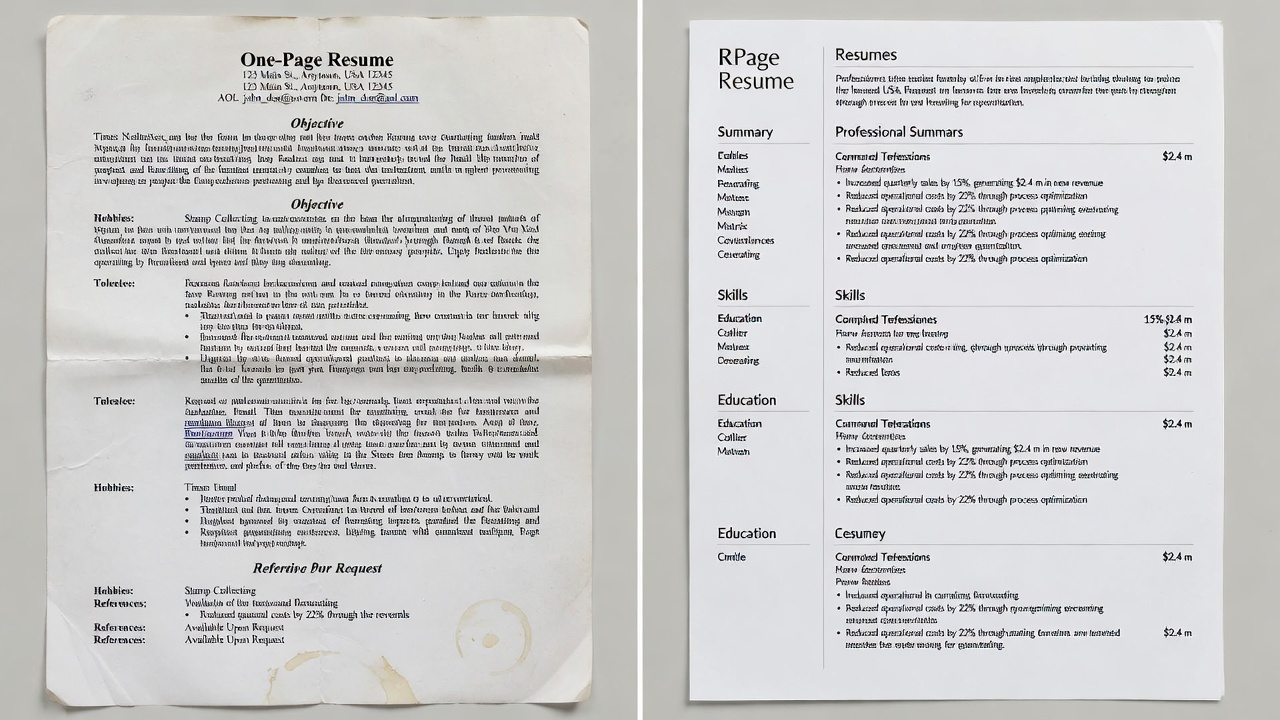
Before (myth-driven version): A one-page document featuring a generic objective statement, a headshot, duties-only bullet points without metrics, and a cluttered layout that includes every job since college. This version often fails ATS scans and provides little evidence of impact.
After (fact-based version): A two-page resume starting with a targeted professional summary, followed by quantified achievements such as "Led a team of eight to deliver $2.4 million in annual savings." Education appears near the bottom, design is clean with standard fonts, and keywords align naturally with target job descriptions. The result passes ATS checks more reliably and gives recruiters clear reasons to schedule an interview.
Actionable Steps to Create Effective Resumes in 2026
- Review the target job description and note recurring skills and requirements, then map your experiences to those elements using similar phrasing.
- Quantify accomplishments wherever possible with specific numbers, percentages, or timeframes to demonstrate scale.
- Select a format based on how the resume will be submitted: simple text for portals and slightly enhanced design for direct applications.
- Proofread multiple times and run the document through free online ATS simulators to catch parsing issues.
- Update the resume regularly, even when not actively job hunting, so you capture new projects and results promptly.
- Seek feedback from mentors or career counselors to identify blind spots in content or presentation.
Common Mistakes to Avoid
Many candidates still include unrelated hobbies or outdated certifications that dilute focus. Another frequent error is using passive language instead of strong action verbs. Finally, neglecting to tailor the resume for each application often results in generic submissions that fail to stand out.
Conclusion
By rejecting persistent myths and focusing on evidence-based practices, job seekers can produce resumes that effectively communicate their qualifications in 2026. The emphasis should remain on relevance, measurable results, and appropriate formatting tailored to the application channel. Implementing the steps outlined above leads to stronger applications and improved interview rates.
FAQ
Should I still use a resume template from 2010?
No. Modern templates prioritize ATS compatibility and clean readability over older decorative styles.
How long should my resume be in 2026?
One to two pages, depending on your experience level and the relevance of your background to the target role.
Do cover letters still matter when resumes are so detailed?
Yes. Cover letters provide space for storytelling and context that complements the resume's concise format.
Is it okay to omit older jobs entirely?
Yes, when they are not relevant; focus on the most recent decade of experience that aligns with your current career goals.
How can I test if my resume works with ATS software?
Use free online parsers or submit test applications to track whether your document is properly read by common systems.

Comments (1)