 Jobboy

Introduction
Professionals evaluating a career transition between the private and public sectors often discover that base salary alone does not tell the full story. Total compensation in 2026 encompasses base pay, variable incentives, health and wellness benefits, retirement vehicles, paid leave policies, professional development support, and intangible factors such as job security and schedule predictability. This comprehensive comparison equips decision-makers with data-driven insights, evaluation frameworks, and real-world examples so they can weigh immediate earnings against long-term financial security and lifestyle alignment.
Whether you currently work in corporate environments or government agencies, understanding sector-specific compensation philosophies helps you negotiate smarter offers and avoid common pitfalls that erode lifetime earnings. The following sections dissect each major component and provide actionable tools for side-by-side offer analysis.
Base Salary Averages Across Key Industries
Private sector compensation tends to reward specialized skills with higher starting salaries in fast-moving fields. Technology, financial services, consulting, and advanced manufacturing frequently post premium base pay to attract talent amid competitive labor markets. Public sector salaries, by contrast, follow transparent pay scales tied to grade levels and locality adjustments, delivering consistency across roles in education, regulatory oversight, public health, and infrastructure management.
Industry examples illustrate the divergence. An experienced data scientist in private enterprise may receive performance-tied increases that outpace inflation, while a comparable analyst in a state agency benefits from automatic step increases and cost-of-living adjustments. Healthcare administrators in private hospital systems often see larger bonuses linked to operational metrics, whereas their public-sector counterparts enjoy broader pension eligibility. These patterns underscore the importance of mapping your specific occupation to both sectors before assuming one path is universally superior.
Benefits Structures and Work-Life Perks
Benefit design reflects differing employer priorities. Private firms commonly emphasize flexible spending accounts, equity participation, mental health stipends, and on-site or subsidized wellness programs. Public employers typically deliver robust defined-benefit health coverage, substantial sick and annual leave accruals, and tuition reimbursement that supports long-term credentialing. Remote and hybrid arrangements appear more frequently in private technology and professional services companies, while public roles may prioritize predictable core hours and strong protections against arbitrary schedule changes.
When comparing packages, examine not only the listed benefits but also employee utilization data and administrative ease. Some private wellness credits require extensive paperwork, whereas public leave banks often roll over year to year with minimal restrictions.
Pension Plans and Long-Term Retirement Security
Retirement vehicles remain one of the most consequential differentiators. Many public sector positions still maintain traditional defined-benefit pensions that promise a percentage of final average salary after a set vesting period, providing predictable lifetime income. Private sector retirement plans center on defined-contribution vehicles such as 401(k) or 403(b) accounts, where employer matching varies widely and ultimate payouts depend on investment performance and contribution discipline.
Portability also differs. Public pensions may allow limited credit transfers between government entities, yet they rarely transfer outside the sector. Private retirement accounts generally roll over to new employers or IRAs with fewer barriers. Professionals planning multiple sector switches should model both immediate contribution rates and projected replacement income at typical retirement ages.
How to Calculate Total Compensation Value: A Step-by-Step Framework
Accurate valuation requires converting every component into comparable annual figures. Begin by gathering complete offer letters and summary plan descriptions. Next, quantify employer-paid premiums for health, dental, and vision coverage using current market benchmarks. Assign dollar values to paid time off by multiplying daily rate by total days granted. Add employer retirement contributions as a percentage of salary, then project future balances using conservative investment return assumptions.
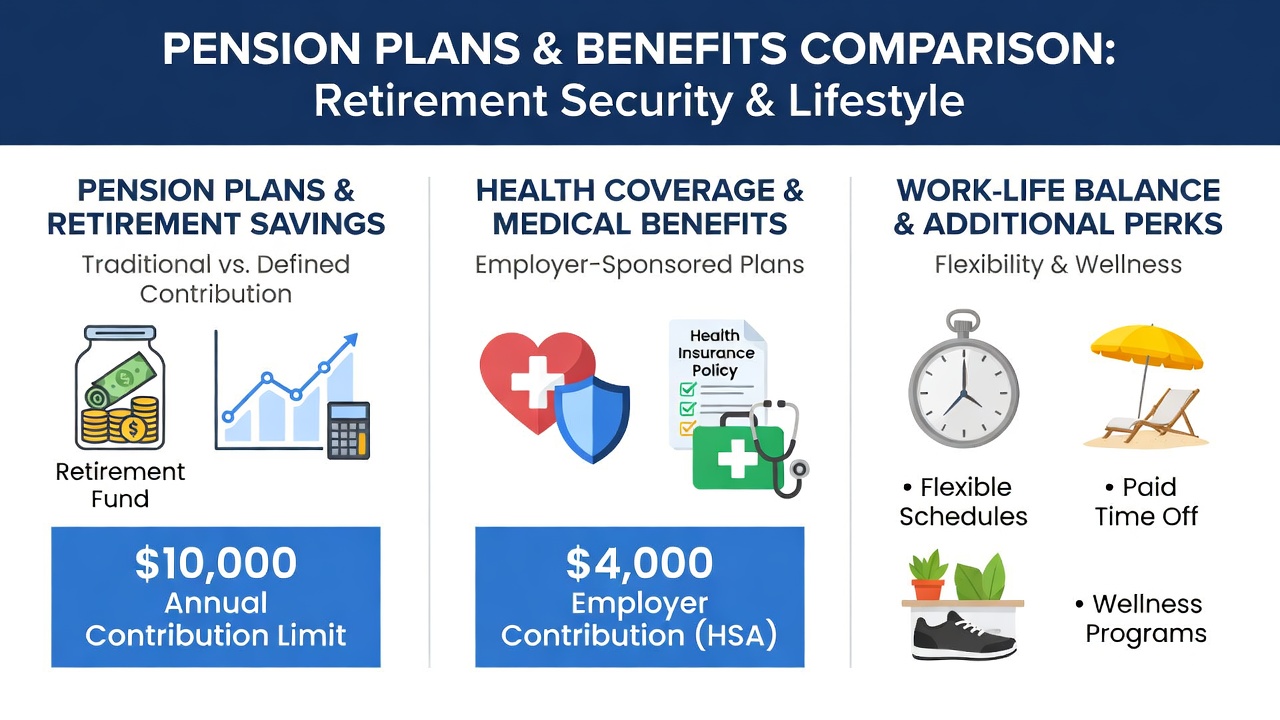
Practical example: an offer showing $10,000 higher base salary but $4,000 lower annual retirement match and two fewer weeks of leave may actually deliver lower total value once all elements are tallied. Extend the analysis over ten- and twenty-year horizons to capture compounding effects and pension vesting cliffs. Finally, adjust for differences in cost of living, state tax treatment, and commute expenses to arrive at a net personal value.
Real-World Case Studies of Sector Transitions
Case one: A mid-level cybersecurity specialist left a federal agency for a private defense contractor. The move produced an immediate base salary increase and equity grant, yet the professional accepted reduced pension accrual and longer average workweeks. After three years, total accumulated wealth was higher, but work-life balance suffered during peak project cycles.
Case two: A municipal finance director transitioned into state government service. Although base pay declined modestly, the new role provided earlier pension vesting, superior health coverage for dependents, and a shorter commute. The candidate reported lower stress and higher long-term retirement security despite slower salary growth.
Case three: An education technology product manager moved from a startup to a public university system. The switch traded variable bonuses for stable hours and generous tuition waivers for family members, illustrating how non-monetary perks can outweigh headline compensation differences when family priorities dominate.
Negotiation Leverage Points by Sector
Private sector discussions often revolve around equity refreshers, sign-on bonuses, and accelerated review cycles. Public sector negotiations focus on grade reclassification, leave accrual rates, telework agreements, and professional development funding. In both environments, candidates strengthen their position by presenting total compensation analyses rather than salary-only requests and by referencing external market data from authoritative sources.
Checklists for Comparing Job Offers
- Review health, dental, vision, and prescription drug coverage details including premiums, deductibles, and out-of-pocket maximums.
- Compare retirement contribution formulas, vesting schedules, and loan provisions.
- Assess total paid leave including holidays, sick time, parental leave, and sabbatical eligibility.
- Evaluate professional development budgets, certification reimbursements, and tuition assistance caps.
- Factor in commute or remote-work stipends, parking allowances, and equipment provisions.
- Examine performance review cycles and promotion pathways for long-term earning potential.
- Consider job security provisions such as union representation or severance policies.
Mistakes to Avoid When Evaluating Offers
Common errors include focusing exclusively on base salary, ignoring vesting cliffs that delay pension eligibility, underestimating the tax advantages of public-sector retirement income, and overlooking differences in liability protection and continuing education requirements. Another frequent oversight is failing to model inflation-adjusted income needs over a 30-year retirement horizon.
FAQs on Long-Term Earning Potential
Which sector typically delivers higher lifetime earnings?
Private sector roles often accelerate earnings in the first 15 years, while public positions frequently provide superior replacement income after age 55 due to pension structures.
How do taxes and inflation affect net differences?
Public pensions may receive favorable state tax treatment in certain jurisdictions, whereas private withdrawals are taxed as ordinary income; inflation erodes fixed pensions more slowly than variable portfolios when cost-of-living adjustments are present.
Can benefits be transferred when switching sectors?
Defined-contribution accounts generally roll over, but defined-benefit pensions remain largely sector-specific and require careful analysis of buy-back or deferred options.
What role does job security play in total compensation?
Public roles historically demonstrate lower layoff rates during economic downturns, effectively functioning as an insurance policy that has monetary value for risk-averse professionals.
Conclusion
Choosing between private and public sector employment in 2026 requires a holistic assessment that extends well beyond starting salary. By applying the frameworks, checklists, and case studies outlined above, professionals can quantify total compensation, anticipate long-term outcomes, and negotiate offers that align with both financial objectives and personal values. Authoritative labor market resources such as the Bureau of Labor Statistics and the U.S. Office of Personnel Management supply additional benchmarks to refine your analysis and support confident career decisions.


No comments yet. Be the first!