 Jobboy

Introduction to 2027 Executive Compensation Trends
As companies prepare for 2027, executive total rewards packages are evolving rapidly, with a strong emphasis on equity-based compensation, phantom stock plans, and long-term incentives tailored for private firms. These strategies help align executive performance with company growth while navigating complex tax rules and market uncertainties. Executives in private companies face unique challenges such as limited liquidity and valuation opacity compared to public peers. This article provides in-depth analysis, real-world scenarios, and actionable frameworks to help executives and boards design competitive packages that drive retention and performance through the next decade.
Understanding Equity, Phantom Stock, and Long-Term Incentives in Depth
Equity compensation grants executives ownership stakes, but in private companies, liquidity is limited until an exit event like an IPO or acquisition. Phantom stock offers cash bonuses tied to company valuation without actual shares, making it attractive for firms that want to avoid dilution. Long-term incentives (LTIs) often include performance units or restricted stock units that vest over time. In 2027, firms are increasingly blending these to retain talent amid economic shifts and automation impacts. For instance, a private SaaS company might combine 60% phantom stock with 40% performance-based equity to balance cash flow needs with ownership alignment.
Real-World Scenario: Tech Startup Equity Mix
Consider a mid-stage private technology firm valued at a recent funding round. The CEO receives a package with 1% equity subject to a four-year vesting schedule, supplemented by phantom units that pay out based on a 3x valuation multiple at exit. This structure protects the executive if the company remains private longer than expected while still rewarding growth.
Valuation Methods for Private Company Equity
Accurate valuation is critical for compliance and fairness. Common approaches include the 409A valuation for tax compliance, discounted cash flow analysis, and market comparables from recent transactions. Boards must document these methods thoroughly to avoid IRS scrutiny. A manufacturing firm might blend income and market approaches, applying a 20-30% illiquidity discount. Executives should request detailed valuation reports annually and model sensitivity analyses for different exit timelines.
Tax Implications Across Incentive Types
Tax treatment varies significantly by instrument and jurisdiction. Traditional stock options may trigger ordinary income at exercise, while phantom stock is taxed as ordinary income upon payout. Executives should consult specialists for strategies like deferral elections. Learn more from authoritative guidance at IRS.gov. In private firms, Section 83(b) elections can accelerate taxation on restricted stock to capture lower valuations early. Another key resource is available at SEC.gov for disclosure requirements. Careful planning can reduce effective tax rates by 10-15% through timing of exercises and deferrals.
Vesting Schedules and Performance Conditions Explained
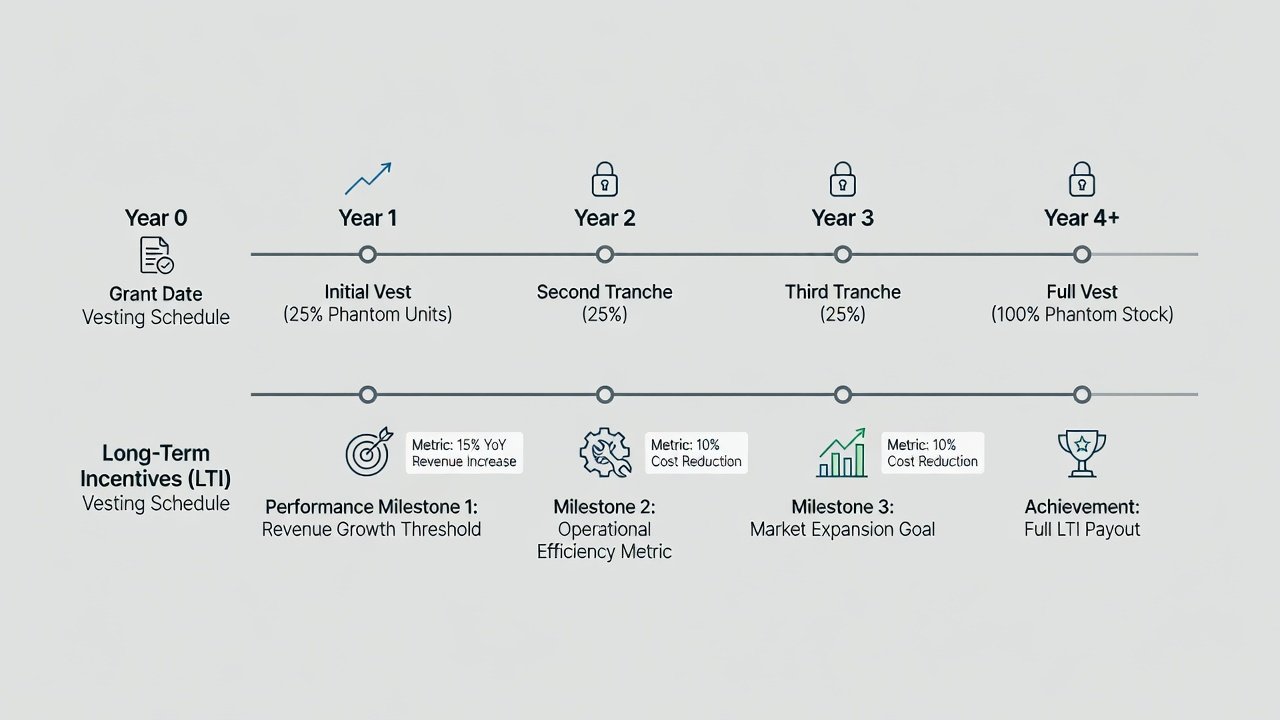
Standard vesting spans three to five years with one-year cliffs to encourage retention. Performance-based vesting ties awards to metrics like revenue targets or EBITDA growth. A manufacturing executive might negotiate a schedule where 50% vests on time and 50% on hitting specific KPIs, reducing risk in volatile sectors. In practice, hybrid schedules that include both time and performance elements have become standard in 2027 to balance motivation with fairness during economic downturns.
Step-by-Step Framework for Comparing Total Rewards Packages
- Calculate total potential value including equity upside, cash components, and severance protections.
- Assess liquidity timelines, downside protection mechanisms, and change-of-control provisions.
- Compare industry benchmarks by company stage (early-stage, growth-stage, mature private firms).
- Model tax scenarios under different exit assumptions using current tax tables.
- Negotiate adjustments for personal risk tolerance, family obligations, and career stage.
- Review non-compete clauses and post-employment benefits in detail.
- Stress-test packages against automation-driven role changes and market volatility.
Real-World Negotiation Playbooks and Email Templates
High-stakes discussions require preparation. Start with a checklist covering current equity holdings, expected dilution from future rounds, and severance protections. Use this email template for initial outreach: "Dear [Board Chair], Following our discussion on total rewards, I propose reviewing the equity component to better align with 2027 growth projections and recent market conditions. Could we schedule time to explore phantom stock alternatives and performance vesting adjustments?" Follow up with a second template that includes proposed metrics and supporting data from peer companies.
Common Pitfalls and How to Avoid Them
- Overvaluing illiquid equity without stress-testing multiple exit scenarios, which can lead to disappointment at realization.
- Ignoring tax timing, leading to unexpected liabilities during liquidity events.
- Failing to secure performance-based bonuses tied to measurable, achievable outcomes rather than subjective goals.
- Neglecting waterfall provisions in private company exits that prioritize investors over executives.
- Overlooking the impact of future funding rounds on personal ownership percentages.
Checklists for High-Stakes Compensation Discussions
Prepare by reviewing: company cap table and capitalization history, recent 409A report with assumptions, peer compensation data from reliable surveys, personal financial goals and retirement timeline, legal counsel input on enforceability, and modeling of multiple economic scenarios including downturns and automation-driven changes. Update the checklist quarterly as company valuation evolves.
Adapting to Economic Shifts and Automation Impacts
Economic uncertainty and automation require flexible plan designs. Executives should advocate for metrics that reward efficiency gains from technology adoption while including protective features like accelerated vesting on termination without cause. Phantom plans often prove resilient because payouts can be funded from operations rather than equity sales.
FAQs on Adapting to Economic Shifts and Automation
How do automation trends affect 2027 incentives? Executives should push for metrics that reward efficiency gains from technology adoption and process improvements, ensuring rewards reflect value created beyond headcount.
What if the economy shifts dramatically? Include clawback provisions and flexible vesting to protect both parties during prolonged downturns.
Are phantom plans better than equity in uncertain times? They provide cash alignment without ownership dilution, ideal for private firms concerned about cap table complexity.
Conclusion
Mastering 2027 executive total rewards requires balancing equity innovation with practical safeguards. By applying these frameworks, leaders can secure packages that drive performance while mitigating risks associated with illiquidity, taxes, and market changes.

No comments yet. Be the first!