 Jobboy

Introduction to Remote Executive Equity in 2026
As remote work solidifies its place in the corporate landscape, mid-to-senior leaders negotiating across borders face unique challenges in structuring compensation packages that include phantom stock and cost-of-living adjustments. These elements help bridge gaps in total rewards when executives operate from different countries without relocating physically. Phantom equity allows companies to offer ownership-like incentives without diluting actual shares, while COL factors ensure fairness in purchasing power. This comprehensive guide delves into valuation techniques, tax considerations, vesting structures, and proven negotiation approaches for 2026, drawing on cross-border best practices to help leaders maximize value.
Understanding Phantom Equity Valuation Methods
Phantom stock plans grant executives the economic benefits of stock ownership without transferring real shares. Common valuation approaches include the income method, which projects future cash flows discounted to present value, and the market method, comparing the company to similar publicly traded firms. For remote executives, valuations must also incorporate currency fluctuations and regional economic conditions. Leaders should insist on third-party appraisals conducted annually to maintain transparency. In practice, a technology firm might use a hybrid model blending discounted cash flows with recent funding rounds to arrive at a per-unit phantom value. This method protects both parties by aligning incentives with long-term company performance rather than short-term market swings.
Incorporating Cost-of-Living Adjustments
Cost-of-living adjustments form a critical layer in remote total compensation, accounting for variances in housing, healthcare, transportation, and taxation across locations. For example, an executive based in a lower-cost European city may receive an uplift to match the effective purchasing power of a counterpart in a major US hub. These adjustments are typically calculated using established indices and reviewed yearly. Companies often apply multipliers ranging from 0.8 to 1.3 depending on the destination, ensuring the package remains competitive. Remote leaders benefit by negotiating these as fixed adders rather than discretionary bonuses, which provides stability amid economic shifts. Detailed modeling of personal expenses versus assumed location costs helps during initial offer discussions.
Tax Implications Across Borders
Tax treatment of phantom stock payouts varies significantly between jurisdictions, creating complexity for cross-border executives. In the United States, gains are generally taxed as ordinary income upon vesting or payout, subject to federal and potentially state levies. European Union executives encounter diverse rules, with some countries treating phantom income as employment earnings while others apply capital gains rates under specific conditions. Double taxation risks arise without proper planning, making treaty relief essential. Executives should reference authoritative guidance from the IRS website for US filing requirements and the European Commission for harmonized EU tax principles. Additional insights on international tax coordination appear on the OECD tax portal. Early consultation with cross-border tax specialists prevents unexpected liabilities that could erode net compensation.
Vesting Schedules and Benchmarks by Experience
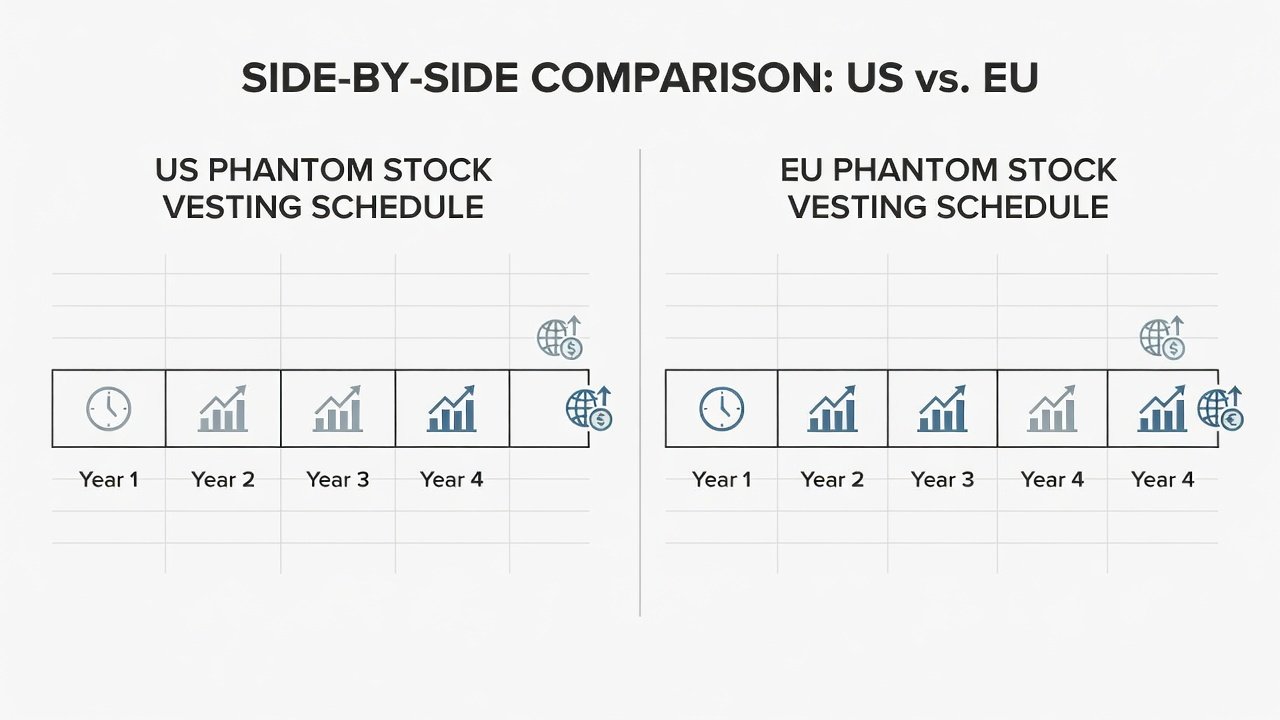
Vesting schedules determine when phantom units convert into payable value, commonly structured over three to four years with an initial one-year cliff. Senior executives with extensive track records frequently negotiate back-loaded or performance-accelerated terms that reward milestones such as revenue targets or successful product launches. Mid-level leaders might encounter standard time-based vesting, while those with fifteen or more years of experience often secure partial immediate vesting or shortened cliffs. Benchmarks indicate that technology and finance sectors favor four-year schedules with 25 percent annual increments after the cliff, balancing retention with executive mobility.
Step-by-Step Negotiation Scripts
Effective negotiation begins with thorough preparation. First, gather market data on comparable roles and propose COL multipliers supported by location-specific expense breakdowns. Second, present multiple phantom valuation scenarios, including conservative and optimistic projections, to demonstrate flexibility. Third, explicitly request tax gross-up provisions to neutralize cross-border differences. Sample language includes: “To ensure parity with domestic peers, I suggest a COL adjustment calibrated to current indices, paired with a four-year vesting schedule featuring a performance accelerator.” Follow up by addressing forfeiture clauses and inflation protections in writing. Rehearse these points to maintain a collaborative tone while advocating for balanced terms.
US vs EU Role Comparisons
US-based remote executive packages frequently emphasize high-upside phantom equity with aggressive vesting, reflecting a culture of rapid growth and liquidity events. In contrast, EU roles prioritize comprehensive benefits, statutory protections, and stable base elements alongside equity. Case comparisons reveal that a US technology executive might trade higher phantom grants for fewer paid leave days, while an EU counterpart negotiates stronger COL safeguards and inflation-linked reviews. Real-world examples show successful bridging through hybrid structures that blend US-style equity upside with EU-mandated employee protections, resulting in mutually attractive offers that retain talent across continents.
Avoiding Common Pitfalls
One frequent error involves overvaluing unvested phantom awards by assuming immediate liquidity or ignoring forfeiture triggers such as voluntary resignation. Executives should model worst-case scenarios where awards lapse and factor in opportunity costs of staying in role. Another pitfall is neglecting inflation erosion on future payouts; annual reviews tied to consumer price metrics help mitigate this. Always request clear documentation on change-of-control provisions and currency conversion methods to avoid surprises. Diligent scenario planning and independent legal review protect against these common missteps.
FAQ: Relocation Clauses and Inflation Adjustments
Q: How do relocation clauses affect phantom stock? A: Many agreements include accelerated vesting or cash buyouts if an executive relocates, preserving value during transitions.
Q: Are inflation adjustments standard in 2026 packages? A: Leading firms incorporate annual COL recalibrations linked to published indices, reviewed each fiscal quarter to maintain real purchasing power.
Q: What documentation should accompany cross-border phantom grants? A: Expect detailed plan summaries, valuation reports, and tax impact statements before signing.
Conclusion
Mastering phantom stock valuation, COL integration, tax navigation, and structured negotiation equips remote executives for stronger outcomes in 2026 global roles. By applying these tactics with precision and seeking expert input, leaders can construct resilient compensation frameworks that deliver lasting value across borders.

No comments yet. Be the first!