 Jobboy

Introduction to Equity Valuation in 2026
Experienced professionals with five or more years in their fields face unique challenges when evaluating equity compensation packages. Unlike entry-level candidates, these hires often negotiate complex instruments such as restricted stock units (RSUs), stock options, and phantom stock in private companies. This guide provides actionable tactics tailored to 2026 market conditions, helping you quantify total compensation accurately while accounting for liquidity risks and tax consequences. Equity forms a growing portion of total pay in competitive sectors like technology and finance, making precise valuation essential for long-term financial planning.
Understanding valuation starts with recognizing that equity is rarely cash-equivalent. Private firm shares require careful modeling of growth assumptions, discount rates, and exit scenarios. Professionals who master these methods gain leverage in negotiations and avoid common overvaluation traps that can leave years of effort undervalued. The 2026 landscape includes evolving regulatory guidance and shifting investor sentiment, so staying current with market data strengthens your position during discussions with hiring managers.
Understanding Key Equity Instruments
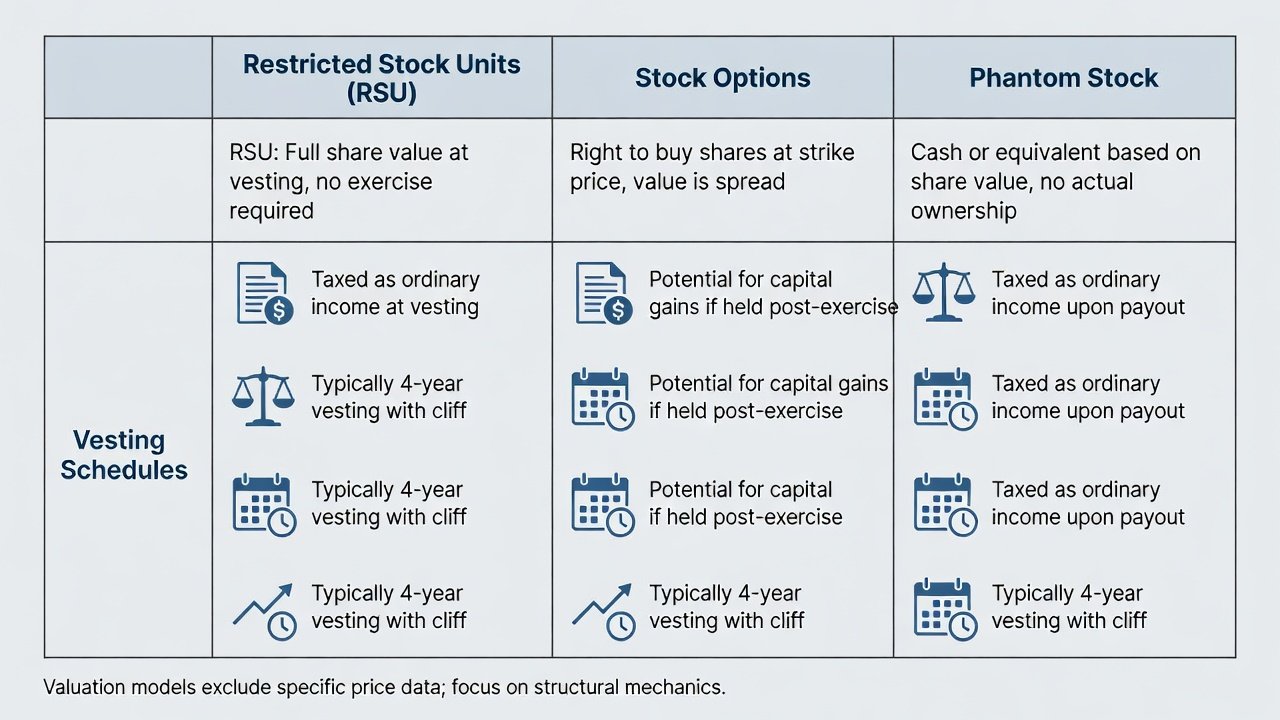
Before diving into calculations, clarify the differences among RSUs, stock options, and phantom stock. RSUs convert to actual shares upon vesting and carry immediate tax events at fair market value. Stock options provide the right to buy shares at a predetermined strike price, offering upside potential if the company grows. Phantom stock delivers cash equivalents based on share appreciation without granting ownership, which simplifies some administrative aspects but introduces different tax timing.
Each instrument interacts differently with vesting schedules. Most packages use a four-year vesting period with a one-year cliff, followed by monthly or quarterly releases. Accelerated vesting clauses triggered by change of control or termination without cause can significantly boost value. Experienced candidates should request detailed vesting waterfalls and model multiple scenarios before accepting an offer.
Step-by-Step Process for Assessing Private Company Equity
Begin by obtaining the most recent 409A valuation report from the company. Next, review the capitalization table to understand dilution from future funding rounds. Apply appropriate discounts for lack of marketability, typically ranging from twenty to thirty percent for illiquid private shares. Then project potential exit multiples based on comparable public companies and recent acquisitions in the same sector. Finally, run sensitivity analyses across base, optimistic, and conservative cases to arrive at a defensible range of values.
Document every assumption with sources. This preparation allows you to present data-driven counteroffers rather than emotional requests. Incorporate current economic indicators from reliable sources when adjusting discount rates or growth projections.
Tax Implications and Vesting Considerations
Tax rules significantly impact net equity value. RSU vesting triggers ordinary income tax at the then-current fair market value, while qualified stock options may qualify for long-term capital gains treatment if holding periods are met. Phantom stock often falls under nonqualified deferred compensation rules, requiring careful plan design to avoid early taxation penalties. Consult IRS guidelines on deferred compensation at IRS.gov for the latest Section 409A updates. International hires should also examine cross-border tax treaties that may affect withholding.
Vesting schedules typically span four years with monthly or quarterly tranches after the cliff. Negotiate for partial acceleration if performance milestones are met early. Consider electing an 83(b) filing for early exercised options when appropriate, though this carries risk if the company fails. Always model after-tax proceeds across different exit timelines to avoid surprises at liquidity events.
Real-World Examples from Tech and Finance
In tech, a 2026 hire at a fintech unicorn used multiple offers to secure a fifteen percent equity uplift by demonstrating competing valuations from similar Series D companies. The candidate modeled a potential IPO within three years and highlighted the illiquidity discount applied to the initial offer. In finance, a private equity associate modeled phantom stock against public market multiples from SEC.gov filings, securing better terms during due diligence by showing how the proposed grant compared unfavorably to recent peer transactions.
Another example involves a product director at a healthtech firm who negotiated for a mix of RSUs and options after analyzing the company's burn rate and runway. By presenting a detailed spreadsheet with exit assumptions, the candidate obtained an additional grant that vested earlier than standard, improving overall expected value.
Building Comparison Tables of Total Compensation Scenarios
Create tables that compare base salary plus equity under multiple market conditions. Include columns for current 409A price, projected five-year value, tax impact, and net present value after liquidity discounts. Factor in potential dilution from subsequent funding rounds and changes in control provisions. Experienced professionals should update these tables whenever new market data emerges, such as quarterly funding announcements or macroeconomic shifts reported by the Federal Reserve.
Sample structure includes rows for each instrument type and columns for low, base, and high cases. This visual approach helps hiring teams quickly see the gap between their offer and market reality.
Scripts for Counteroffers and Negotiation Strategies
Use this framework when responding to an initial offer: "Based on my analysis of the latest 409A valuation and comparable exits in our sector, the proposed equity grant represents a meaningful gap versus market. I propose increasing the RSU allocation by an additional amount that closes this difference, along with standard acceleration triggers upon change of control." Practice delivering these requests calmly and support them with printed or shared models.
Another effective script addresses vesting: "I appreciate the four-year schedule. Given my experience leading similar initiatives, I would value a partial acceleration clause after year two if key performance metrics are achieved." Always tie requests to data rather than personal circumstances.
Common Pitfalls and How to Avoid Them
- Overvaluing illiquid equity without applying realistic discounts for lack of marketability and time to liquidity.
- Ignoring tax timing and modeling only pre-tax figures, which can overstate take-home value by thirty percent or more.
- Failing to leverage multiple offers by presenting competing term sheets professionally and without ultimatums.
- Neglecting future dilution from planned funding rounds that can reduce ownership percentage substantially.
- Accepting standard vesting without negotiating for performance-based acceleration or sign-on equity grants.
Leveraging Multiple Offers Effectively
When you hold competing offers, create a summary matrix that highlights differences in equity value, vesting, and tax treatment. Share this matrix selectively with the preferred employer while requesting they match or exceed the strongest elements. Maintain professionalism throughout to preserve relationships even if you ultimately choose another path.
FAQs on Timing Negotiations and Using 2026 Market Data
When should I negotiate equity? Align discussions with performance reviews, promotion cycles, or immediately after receiving a competing offer. Timing negotiations during annual compensation reviews often yields better results because budgets are being allocated. How do I use 2026 data? Reference recent funding rounds, public comps, and economic reports from authoritative sources to anchor your models in current conditions. What if the company refuses to share the 409A? Request at least a summary valuation range and comparable company data to build your own defensible estimate.
In conclusion, disciplined valuation empowers experienced professionals to secure equitable packages that reflect both current market realities and future upside potential. Apply these tactics consistently to maximize the value of your next career move.

No comments yet. Be the first!