 Jobboy

Introduction
Awards and honors serve as powerful differentiators on resumes in 2026, providing concrete evidence of excellence that catches the eye of both human recruiters and applicant tracking systems. In today's competitive job market, where many applicants hold similar qualifications, strategically showcasing these achievements can dramatically increase visibility and interview invitations. This comprehensive guide delves into every aspect of listing awards effectively, from ATS-optimized formatting and precise placement strategies to relevance filtering for career transitions and advanced techniques that tie awards to transferable skills. Whether you are a recent graduate, mid-career professional, or someone pivoting industries, understanding how to present awards with impact and quantification will help your resume stand out.
Why Awards Improve ATS Scores and Interview Rates
Research into modern hiring practices indicates that resumes incorporating quantified achievements, including awards, tend to rank higher in ATS algorithms because these systems prioritize keywords related to success metrics and recognition. Awards function as external validation of your capabilities, often leading to higher recruiter engagement rates. For instance, candidates who list awards with specific outcomes report improved callback rates compared to those who omit them. These honors also highlight soft skills such as leadership, innovation, and resilience, which ATS software increasingly scans for alongside hard skills. Data-backed insights from recruitment platforms show that award mentions can elevate a resume's score by emphasizing results-oriented language that aligns with job descriptions.
Strategic Placement on Your Resume
Determining where to position awards depends on your career stage and the role you seek. Early-career professionals and recent graduates benefit from a dedicated "Awards and Honors" section placed near the top, right after the professional summary, to immediately establish credibility. Mid-level and senior candidates should integrate awards directly into their professional experience bullet points, linking each honor to specific job responsibilities and outcomes. For executive resumes, awards may appear in a summary or achievements highlight box at the top. Always prioritize recency and relevance; older awards from more than seven years ago should only appear if they remain highly prestigious or directly relevant to the target position. Consider the flow of the document so recruiters encounter these highlights within the first 10 seconds of scanning.
ATS-Friendly Formatting and Citation Styles
ATS compatibility requires clean, text-based formatting without tables, graphics, or special symbols that parsing engines struggle to read. Use a consistent structure such as: Award Name, Issuing Organization, Year – Brief description with quantified impact. Example: "National Marketing Excellence Award, American Marketing Association, 2025 – Led campaign that increased brand engagement by 42%." Keep entries concise yet descriptive, incorporating keywords from the job posting. Avoid vague phrases like "won award"; instead, specify the scope and results. Indeed emphasizes testing your formatted resume through free ATS simulators to ensure proper parsing before submission.
Distinguishing National vs. Internal Awards
National or international awards carry substantial weight and deserve prominent placement with full context, including the issuing body and selection criteria. For example, "Global Innovator Award, World Economic Forum, 2025" signals broad recognition. Internal company awards, while valuable, require additional details to demonstrate their significance beyond the organization. Frame them as: "President's Club Award, 2025 – Top 5% of sales team across 12 regions, generating $2.8 million in revenue." This approach helps recruiters understand the competitive scope and achievement level regardless of whether the award is external or internal.
Relevance Filtering for Career Changers
Career changers must carefully curate which awards to include, selecting only those that demonstrate transferable competencies valued in the new field. A teacher transitioning to corporate training might emphasize "Educator of the Year, 2024 – Developed curriculum adopted by 15 districts" over subject-specific teaching awards. This filtering process ensures the resume remains targeted rather than cluttered. Review the target job description for keywords and map your awards to those terms, rewriting descriptions to highlight skills like project management, stakeholder communication, or data analysis that bridge the two industries.
Integrating Awards with Bullet Points and Examples
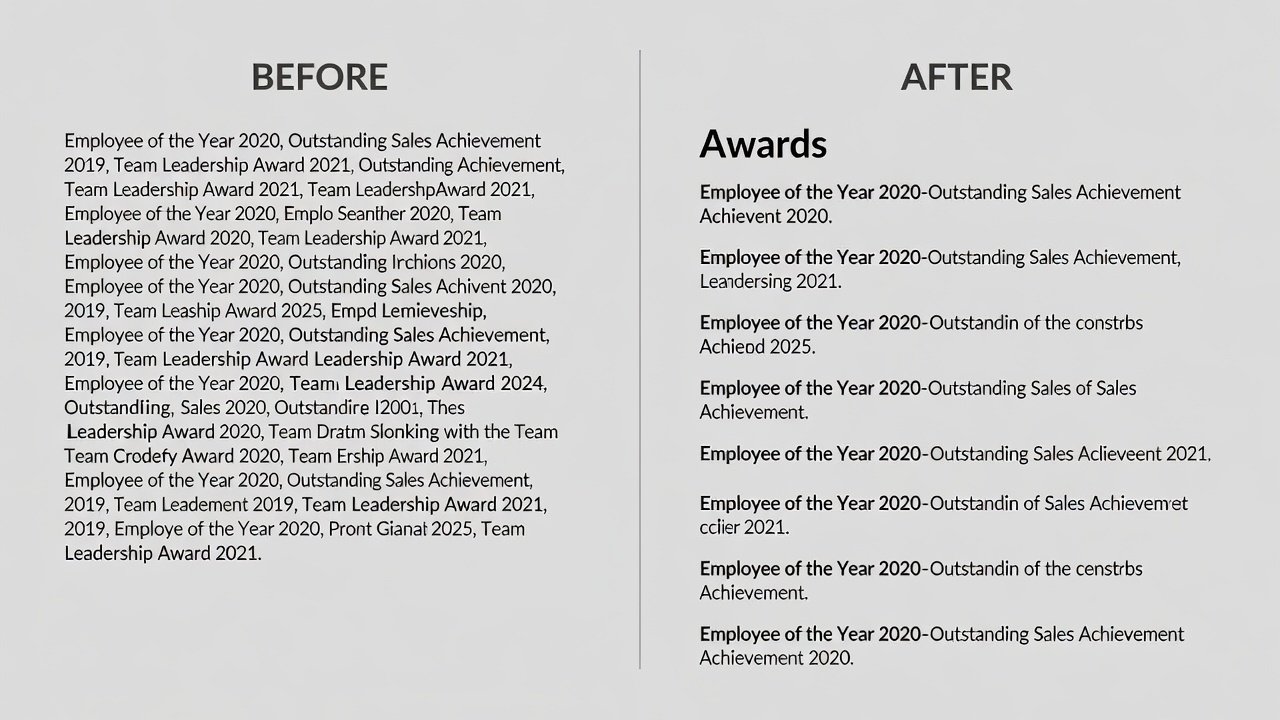
Transform generic award listings into compelling bullet points that quantify results and align with job requirements. Before example: "Received Outstanding Performance Award." After example: "Earned Outstanding Performance Award, 2025, for implementing workflow improvements that boosted team productivity by 28% and reduced errors by 15%." Industry-specific samples include technology ("Patent Recognition Award for AI-driven solution adopted company-wide"), healthcare ("Patient Safety Excellence Award, 2025 – Contributed to 99.2% compliance rate"), and finance ("Compliance Champion Award – Streamlined reporting processes meeting new regulatory standards ahead of deadline"). These transformations consistently improve how recruiters perceive candidate value.
Common Pitfalls to Avoid
- Including awards older than seven years without strong relevance or prestige.
- Failing to quantify impact, leaving entries feeling generic and forgettable.
- Using inconsistent date formats or abbreviations that confuse ATS parsers.
- Overloading the document with numerous minor internal recognitions that dilute stronger achievements.
- Neglecting to tailor awards to the specific role, resulting in a scattered narrative.
- Placing awards in hard-to-scan sections or using complex formatting that breaks ATS compatibility.
Checklists for Effective Award Listings
- Confirm each award is recent enough and directly relevant to the target position.
- Include the award name, issuing organization, year, and one quantified outcome.
- Incorporate job-description keywords naturally within descriptions.
- Ensure formatting remains uniform across all entries for visual and ATS consistency.
- Review the full resume for balance, avoiding an awards section that overshadows core experience.
- Test the document in multiple ATS platforms and with human reviewers for clarity.
- Update your LinkedIn profile to mirror resume awards for cross-platform credibility.
Advanced Techniques for Mid-Career Pivots
Mid-career professionals pivoting industries can leverage awards in the professional summary or a dedicated "Key Achievements" section to establish immediate authority. Tie each award explicitly to transferable skills such as team leadership, process optimization, or strategic planning. For example, a manufacturing manager moving into supply chain consulting might reframe an internal award as evidence of expertise in efficiency gains that translate across sectors. Pairing these highlights with endorsements on LinkedIn further strengthens the narrative. Additionally, consider grouping awards under skill categories like "Leadership Recognition" when the new role emphasizes those competencies.
Real-World Samples Across Industries
In education, a strong entry reads: "Teacher of the Year, State Department of Education, 2025 – Improved student test scores by 23% through innovative project-based learning." In sales: "Top Revenue Generator Award, 2025 – Achieved 135% of annual quota, securing $4.1 million in new business." These examples demonstrate how awards integrated with metrics create persuasive stories that resonate with hiring managers across sectors.
Conclusion
Effectively listing awards on your 2026 resume demands thoughtful selection, precise formatting, and strategic integration that emphasizes both prestige and measurable impact. By applying the placement guidelines, relevance filters, and quantification techniques outlined above, professionals at every career stage can enhance ATS performance, recruiter attention, and overall interview rates. Treat awards as evidence of your unique value rather than mere decorations, and your resume will communicate a compelling case for why you deserve the next opportunity.
No comments yet. Be the first!