 Jobboy

Introduction to Equity Valuation in 2026
Equity compensation remains a cornerstone of total pay packages, especially in tech, finance, and startups. Understanding how to value restricted stock units (RSUs), stock options, and phantom stock helps professionals make informed decisions during job offers or annual reviews. This guide provides practical, step-by-step methods using current market approaches for both public and private companies. Equity can significantly boost long-term wealth, but only when valued correctly. Factors like vesting schedules, tax rules, and company stage all influence real worth. Readers will find examples, scripts, tables, and checklists to apply immediately.
In 2026, total compensation packages increasingly blend cash salary with equity to align employee and shareholder interests. Beginners often focus only on headline grant sizes while intermediate professionals model after-tax scenarios, liquidity risks, and refresh cycles. This expanded guide breaks down each equity type with formulas, real company examples, and decision frameworks that go beyond surface-level overviews.
Valuing RSUs Step by Step
RSUs represent a promise of company shares delivered after vesting. To calculate value, start with the current fair market value (FMV) of the stock. Multiply the number of RSUs by the FMV, then adjust for expected forfeiture rates and taxes. For public companies, use the latest closing price. Private firms rely on 409A valuations updated every 12 months. Example: 5,000 RSUs at a hypothetical FMV yields a gross pre-tax figure before applying discounts for illiquidity or early departure risk.
Advanced valuation includes Monte Carlo simulations for volatility and probability-weighted outcomes. Always request the most recent 409A report or public filing data when evaluating offers. Compare the grant against peer benchmarks from sources such as SEC filings to understand dilution effects over time.
Stock Options Valuation Methods
Options give the right to buy shares at a strike price. Use the Black-Scholes model for public firms or binomial models for private ones. Key inputs include current stock price, strike price, time to expiration, volatility, and risk-free rate. Subtract the strike price from the expected future value, then discount for vesting and taxes. In 2026, many firms still grant non-qualified stock options (NSOs) and incentive stock options (ISOs) with different tax treatments.
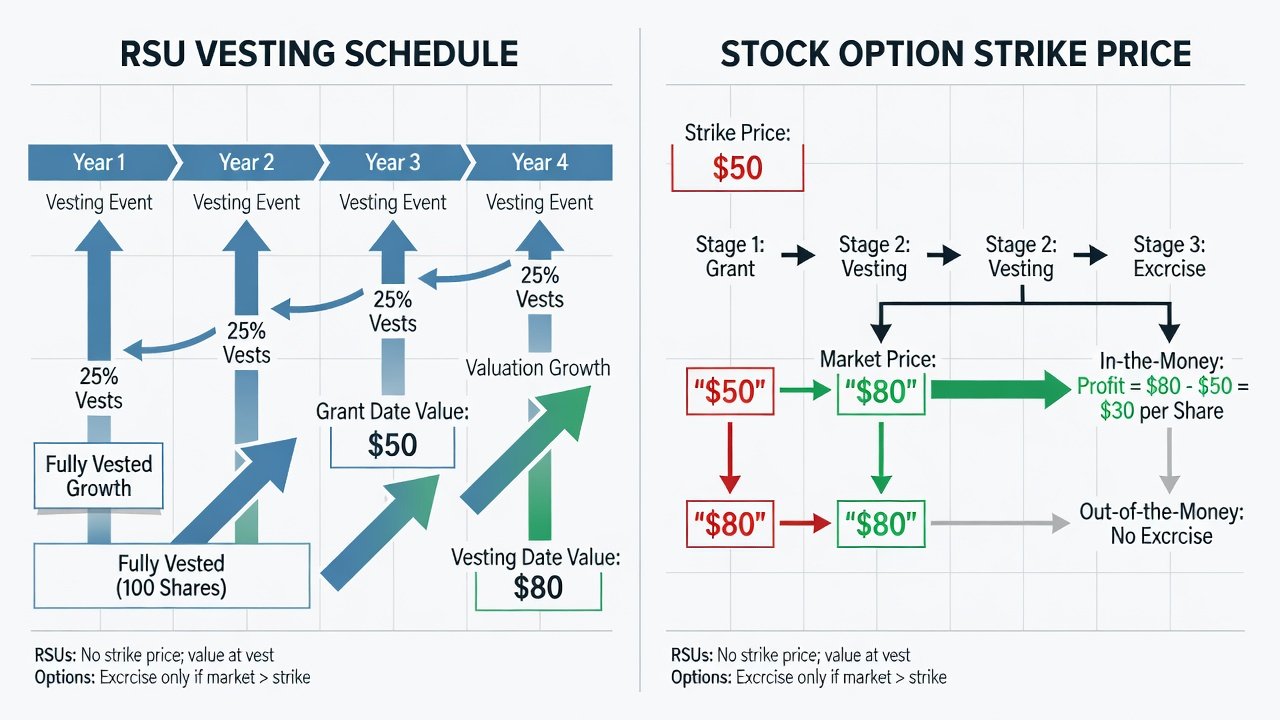
Walk through a sample calculation: assume a $50 strike price, $80 current FMV, 40% volatility, and four-year term. Apply the model to derive an estimated per-option value, then scale by the number granted. Factor in early exercise windows for ISOs to optimize capital gains treatment. Private company options require additional scrutiny of the latest capitalization table and any pending funding rounds.
Phantom Stock and Performance Bonuses
Phantom stock mimics equity ownership without actual shares. Value equals the appreciation in company value multiplied by units granted. Performance bonuses often tie to milestones and convert to cash or equity. Combine these with RSUs for diversified compensation. Always request the latest 409A or cap table details when evaluating private company offers. Phantom plans frequently include payout caps or change-of-control triggers that alter expected returns.
Performance bonuses may vest on revenue or EBITDA targets. Model multiple achievement scenarios to avoid over-optimism. These instruments suit companies that want to reward growth without issuing actual equity, yet they carry the same forfeiture risks as traditional grants.
Tax Implications Across Equity Types
RSUs trigger ordinary income tax at vesting based on FMV. Stock options may qualify for capital gains if holding periods are met. Phantom stock is taxed as ordinary income upon payout. Consult the IRS website for current rules on withholding and reporting. Public company employees often face immediate tax on RSU delivery, while private employees may defer until liquidity events.
Additional considerations include Medicare surtax on high earners, state tax variations, and alternative minimum tax exposure for ISOs. Early exercise of options can start the capital gains clock but requires careful cash flow planning. Review SEC investor resources for disclosure requirements that affect valuation transparency.
Vesting Schedules and Common Structures
Standard schedules include four-year vesting with a one-year cliff. Accelerated vesting occurs on change of control. Review exact terms in offer letters to model cash flow. Graded monthly vesting after the cliff provides steady equity realization, while performance-based schedules tie grants to measurable milestones. Double-trigger acceleration protects employees during acquisitions but may require negotiation.
- Four-year graded vesting: 25% after year one, then monthly
- Three-year cliff for senior roles
- Performance-based vesting tied to revenue targets
- Refresh grants every 12–18 months to maintain alignment
Negotiation Scripts for Private and Public Firms
Private firm script: "Based on the 409A valuation, the equity package represents a meaningful portion of total comp. Can we adjust the grant size or add a refreshers policy?" Public firm script: "The RSU grant at current FMV aligns with market data. Would the team consider front-loading the first-year vest or including a sign-on equity top-up?" Prepare multiple scenarios with supporting data from compensation surveys. Highlight retention risks and competing offers without revealing exact numbers. Ask about historical refresh grant patterns and any upcoming tender offers or liquidity windows.
Comparison Tables by Experience and Industry
Equity weighting varies widely. The table below illustrates typical ranges as a percentage of total compensation across levels and sectors.
| Level | Tech RSU Value | Finance Options | Startup Phantom |
|---|---|---|---|
| Entry | 20-40% of TC | 10-25% of TC | 15-30% of TC |
| Mid | 30-60% of TC | 25-45% of TC | 25-50% of TC |
| Senior | 40-70% of TC | 35-60% of TC | 30-65% of TC |
Tech roles often emphasize RSUs due to public market liquidity, while startups favor options or phantom units to conserve cash. Finance packages blend both with performance hurdles. Cross-reference these ranges with your specific geography and company stage for personalized modeling.
FAQs and Common Pitfalls
Q: How do I avoid overvaluing unvested equity? A: Apply a 30-50% discount for illiquidity and forfeiture risk, then model multiple scenarios including company failure or delayed exit. Q: What happens if the company goes public? A: Unvested RSUs convert to public shares; options may require early exercise review and updated tax planning. Additional pitfalls include ignoring dilution from future rounds and failing to track expiration dates on options. Always maintain personal records of grant agreements and 409A updates.
Actionable Checklists
- Request latest FMV or 409A report before accepting
- Model after-tax value over five years using multiple exit assumptions
- Compare total comp against industry benchmarks from reliable sources
- Negotiate refreshers, acceleration clauses, and severance equity treatment
- Review tax withholding elections and consider early exercise where beneficial
- Document all equity details in a personal spreadsheet with vesting reminders
Conclusion
Accurate equity valuation empowers better career decisions. Apply these methods to every offer and review to maximize compensation in 2026 and beyond. Revisit valuations quarterly as markets shift and company circumstances evolve. With disciplined analysis, equity can become a powerful wealth-building tool rather than an opaque promise.

No comments yet. Be the first!