 Jobboy

Introduction to Equity Refresh Negotiations in 2026
Mid-career professionals with 8 to 15 years of experience often face pivotal moments when equity refreshes are on the table. These negotiations can shape long-term financial outcomes in ways that base salary adjustments rarely match. In 2026, factors like fluctuating public markets, evolving remote work policies, and heightened competition for specialized talent make preparation essential. This playbook delivers in-depth guidance drawn from real-world scenarios, helping you approach discussions with data-backed confidence rather than guesswork. Equity refreshes serve as retention tools for employers while providing employees opportunities to realign compensation with current contributions and market realities.
Understanding RSU Valuation Updates for 2026
Restricted Stock Units continue to dominate compensation packages in technology, finance, and life sciences. Valuation depends on the prevailing stock price at grant, the vesting schedule, forfeiture risks, and overall company performance projections. Mid-career professionals should analyze recent 10-K and 10-Q filings to understand dilution effects and historical grant patterns. For instance, employees at mature tech firms might see refreshes calibrated against peer averages rather than peak valuations. Always cross-reference internal equity grants with external data sources to establish a realistic baseline before meetings. Ignoring vesting cliffs or acceleration clauses can lead to suboptimal outcomes during negotiations.
Timing Tactics Aligned with 2026 Market Conditions
Strategic timing remains critical amid 2026 economic signals such as shifting interest rates and sector-specific recoveries. Ideal windows often open during strong quarterly results or prior to major announcements like product launches or acquisitions. Conversely, periods following earnings shortfalls or leadership changes tend to limit leverage. Mid-career individuals at growth-stage companies can benefit from aligning requests with annual performance reviews in the first or third quarter. Broader indicators, including labor market tightness in key industries, provide additional context for when employers are most receptive to retention-focused adjustments. Documenting your role in recent successes strengthens the case regardless of exact calendar timing.
Tax Optimization Strategies
Tax implications of equity refreshes require careful planning to preserve value. Key approaches include spreading taxable events across calendar years, utilizing long-term capital gains rates where possible, and coordinating with other income sources. Professionals should review guidance from the IRS on restricted stock taxation and consider state-specific rules that may affect net proceeds. Another tactic involves pairing refreshes with charitable contributions or retirement account strategies. Real-world examples show that employees who model multiple sale scenarios in advance often reduce effective tax rates by 5 to 15 percent compared to impulsive decisions. Always involve a tax advisor familiar with equity compensation before finalizing any plan.
Email Templates for Equity Refresh Requests
Crafting a professional initial outreach sets the right tone. Use this template as a foundation and customize with specific achievements: Subject: Request for Equity Compensation Review Meeting. Dear [Manager], Over the past year I have led [project name] resulting in [measurable outcome]. Given current market benchmarks and my contributions, I would like to schedule time to discuss an equity refresh. Please let me know your availability next week. Regards, [Name]. Follow up with a second template if needed that includes supporting data points and proposed meeting agenda items. These communications should remain concise yet demonstrate preparation and business impact.
Benchmarks by Industry and Experience Level
Compensation benchmarks differ significantly across sectors. In software and internet companies, mid-career refreshes for individual contributors frequently target ranges that maintain total equity ownership near 0.1 percent after four years of service. Finance roles at bulge-bracket firms often tie refreshes to revenue targets with performance multipliers. Biotech professionals may encounter milestone-based grants that vest upon clinical or regulatory achievements. Experience level matters: those approaching 10 years typically command larger percentages than early-tenure peers due to institutional knowledge and leadership scope. Cross-reference multiple compensation surveys and internal leveling guides to build your case. Avoid relying solely on anecdotal peer data.
Refresh vs. New-Grant Scenarios: A Comparison
Choosing between an equity refresh and pursuing a new grant involves weighing predictability against potential upside. Refreshes generally feature accelerated vesting schedules and lower administrative friction, making them attractive for stability-focused professionals. New grants can deliver larger initial awards during high-growth periods but often require stronger negotiation leverage and may reset vesting clocks. Decision factors include your current unvested balance, company valuation trajectory, and personal cash flow needs. Many mid-career employees combine both approaches by accepting a modest refresh while exploring external opportunities for supplemental grants. Modeling net present value under different stock price assumptions clarifies the trade-offs.
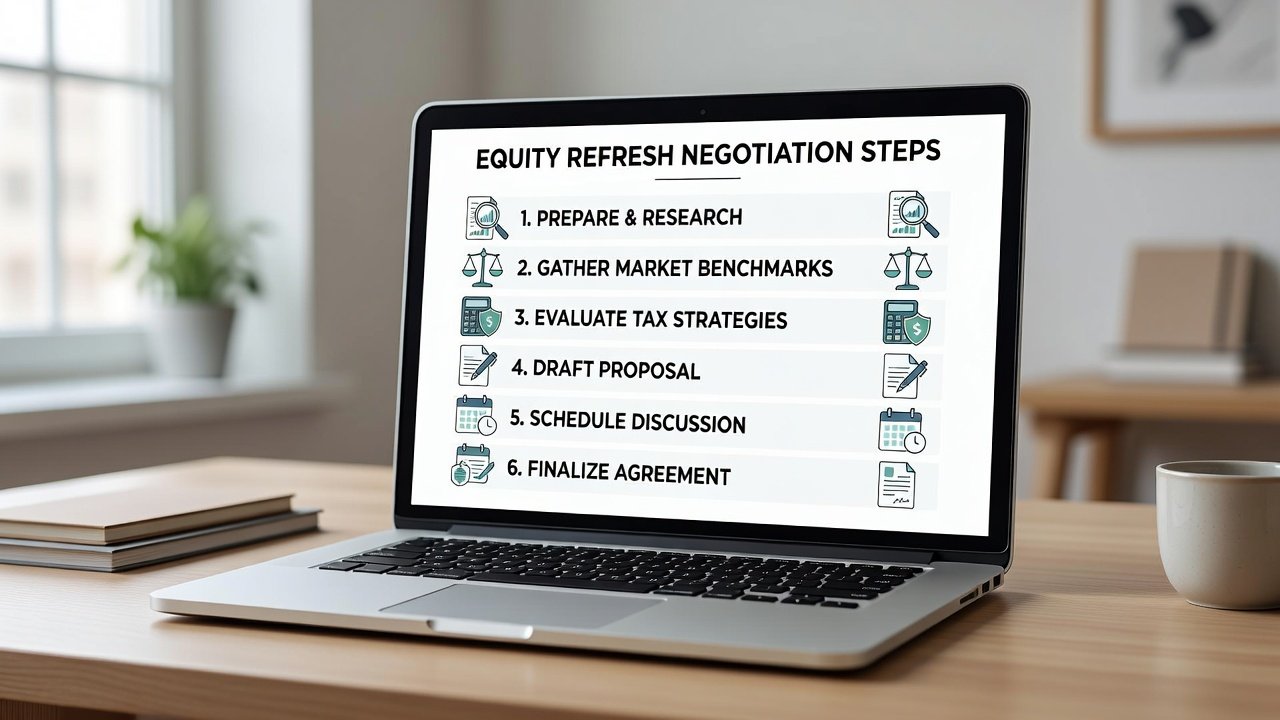
Step-by-Step Negotiation Checklist
- Compile three years of performance metrics and peer compensation data.
- Identify your target refresh size and alternative vesting structures.
- Schedule the conversation after a visible win or positive review cycle.
- Practice responses to common objections using the FAQ below.
- Request written confirmation of any verbal agreements within 48 hours.
- Engage a compensation consultant or financial planner for complex packages.
- Review all documents for hidden clauses before signing.
FAQ: Handling Common Employer Objections
What if leadership cites budget limitations? Respond by emphasizing retention economics—replacing a mid-career contributor often costs 1.5 to 2 times annual compensation in recruiting and ramp-up expenses. Provide internal examples where similar adjustments retained key talent.
How should I address concerns about internal equity? Frame your request around external market data and unique contributions rather than comparisons to colleagues. Offer to discuss team-wide calibration if appropriate.
Is mentioning outside interest advisable? Only when you have a genuine competing offer in hand. Position it as a retention discussion focused on long-term alignment rather than an ultimatum.
What happens if the initial offer falls short? Counter with a phased proposal that includes partial refresh plus performance milestones for additional grants within six months.
Should I negotiate other elements alongside equity? Yes, consider pairing equity requests with title adjustments or professional development budgets to create win-win outcomes.
Common Mistakes to Avoid During Negotiations
Many professionals undermine their position by entering discussions without quantified achievements or by accepting the first counteroffer too quickly. Another frequent error involves focusing exclusively on grant size while overlooking vesting acceleration or change-of-control protections. Mid-career candidates sometimes neglect to model tax consequences until after agreements are reached. Finally, failing to follow up in writing can lead to miscommunications that erode trust. Reviewing this checklist and practicing with a mentor reduces these risks substantially.
Conclusion
Equity refresh negotiations in 2026 reward preparation, data fluency, and professional persistence. Mid-career professionals who apply the valuation insights, timing strategies, tax considerations, and templates outlined here position themselves for stronger outcomes. Use the benchmarks and decision frameworks to evaluate refresh versus new-grant paths, then execute the checklist methodically. With these tools, you can navigate conversations confidently and secure compensation that reflects your sustained impact. Begin your preparation well in advance of your next review cycle for maximum effectiveness.

No comments yet. Be the first!