 Jobboy

Introduction to Equity Refresh Negotiations in 2026
Mid-career tech professionals frequently discover that base salary represents only a fraction of their overall compensation package. Equity refreshes, especially in the form of restricted stock units or RSUs, serve as a powerful mechanism to elevate total rewards and build long-term wealth. In 2026, companies across the technology sector continue to refine their equity programs amid shifting market dynamics, talent competition, and evolving regulatory landscapes. Mastering the art of negotiating these refreshes can transform career trajectories by adding substantial value beyond annual raises.
This comprehensive guide delivers in-depth insights tailored specifically for mid-career roles in software engineering, product management, data science, and related fields. It covers advanced RSU valuation techniques, precise timing strategies, complex tax implications, customizable email templates, and proven negotiation frameworks. Real-world case studies illustrate successful outcomes, while practical examples help readers apply concepts immediately. By the end of this article, you will possess the tools to approach equity discussions with data-backed confidence and maximize your compensation package.
Understanding RSU Valuation Methods
RSUs derive their value from the underlying company stock price at both the grant date and subsequent vesting milestones. Professionals must evaluate grants using multiple lenses: current market price, historical volatility, analyst projections, and sector-specific growth rates. For instance, a grant of 1,000 RSUs at a $150 share price equals $150,000 on paper, yet future appreciation or depreciation can dramatically alter the outcome. Performance-based RSUs may include multipliers tied to revenue targets or total shareholder return, requiring careful modeling of best-case and worst-case scenarios.
Advanced valuation also incorporates dilution effects from new share issuances and potential stock splits. Mid-career employees should cross-reference their offers against publicly available data in company proxy statements and annual reports. Authoritative resources like the U.S. Securities and Exchange Commission offer free access to these filings, enabling accurate benchmarking against peers at similar-sized firms. Additionally, consider consulting compensation surveys from reputable analysts to contextualize your grant size relative to experience level and location.
Timing Tactics for Equity Refreshes
Optimal timing dramatically influences refresh outcomes. Align requests with annual performance reviews, promotion cycles, or immediately following major company achievements such as successful product launches, funding rounds, or favorable earnings reports. Conversely, initiating discussions right after a stock price decline can result in smaller grants due to depressed valuation. Mid-career professionals gain an edge by maintaining a rolling 18-month calendar of personal vesting events and company milestones to anticipate gaps in equity coverage.
Another effective tactic involves leveraging external offers or market intelligence during periods of heightened hiring activity, such as post-earnings seasons when budgets reset. Document every contribution with metrics like revenue impact, user growth percentages, or efficiency gains to build an irrefutable case. Proactive preparation six to eight weeks before scheduled reviews allows time for multiple conversations and counter-offers.
Tax Implications of Equity Refreshes
Taxation of RSUs occurs primarily at vesting, when the fair market value becomes taxable as ordinary income subject to federal, state, and payroll withholding. Subsequent sale of shares may trigger short-term or long-term capital gains taxes depending on the holding period. Mid-career professionals often benefit from strategies such as selling a portion of vested shares immediately to cover tax liabilities or exploring tax-deferred accounts where employer plans permit. International assignees face additional complexities involving foreign tax credits and treaty provisions.
Staying current with regulations is essential. Official guidance from the Internal Revenue Service details reporting requirements, estimated tax payment rules, and safe harbor provisions for equity income. Planning ahead with a tax advisor can prevent surprises and optimize net proceeds from each refresh cycle.
Step-by-Step Negotiation Framework
Follow this detailed framework to structure your approach:
- Conduct thorough research using public filings, compensation databases, and peer networks to establish market ranges for your role, level, and geography.
- Compile a personalized impact summary with specific achievements, supported by data and aligned to company objectives.
- Initiate the conversation early by requesting a dedicated meeting outside of routine one-on-ones.
- Present a clear ask that includes target grant size, vesting schedule preferences, and fallback options such as sign-on equity or accelerated reviews.
- Listen actively to counter-proposals and negotiate holistically, incorporating base salary, bonus targets, and benefits when equity alone cannot meet expectations.
- Secure all terms in writing via follow-up email and confirm with human resources before accepting.
Each step benefits from rehearsal and contingency planning to handle pushback effectively.
Comparisons to Startup Equity
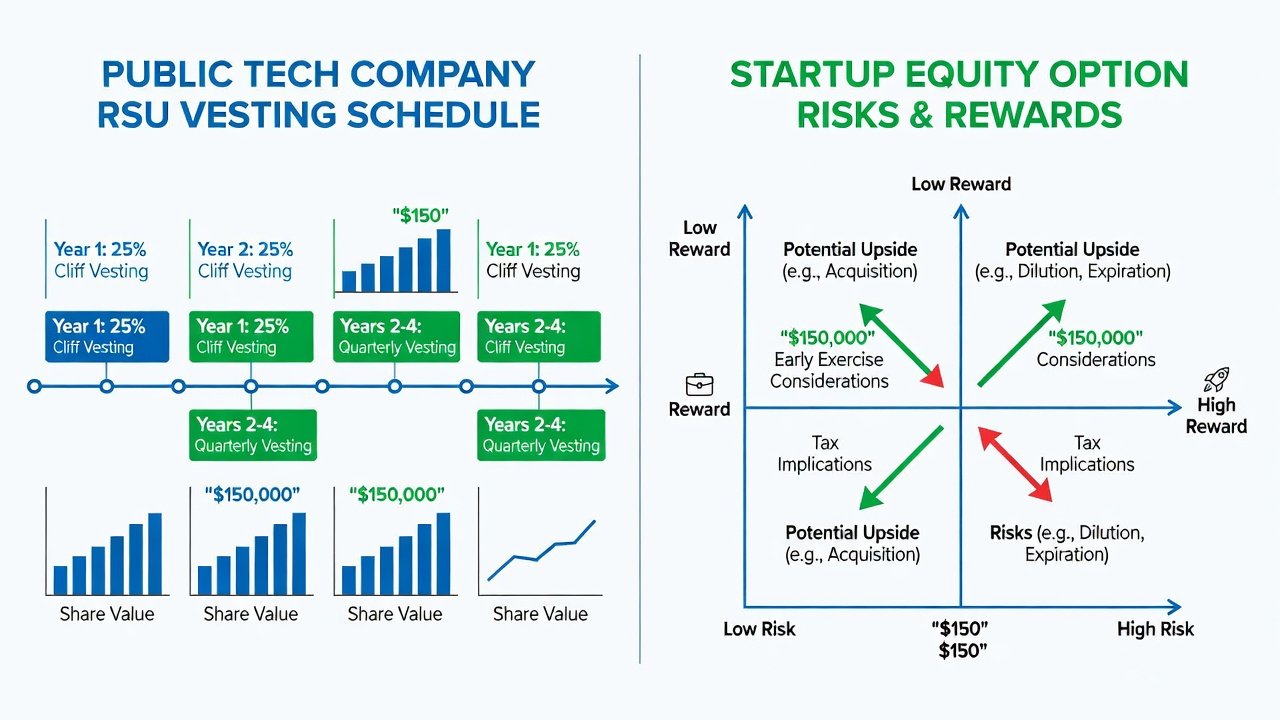
Public company RSUs offer liquidity and predictable vesting schedules, whereas startup equity typically involves stock options with four-year vesting, one-year cliffs, and significant illiquidity risk. Mid-career professionals moving between environments must recalibrate expectations: established firms provide clearer valuation benchmarks and immediate tax events, while startups demand deeper analysis of cap tables, liquidation preferences, and exit timelines. Hybrid situations, such as late-stage startups preparing for IPO, blend characteristics of both worlds and require hybrid negotiation tactics focused on both option exercise windows and refresh commitments post-IPO.
Email Script Examples for Refresh Requests
Here are three adaptable email templates for different scenarios.
Subject: Request for Equity Refresh Discussion – [Your Name]
Dear [Manager],
I hope this message finds you well. As we approach the upcoming review cycle, I would like to schedule time to discuss my current equity position and explore a refresh opportunity. Over the past 12 months, I have led initiatives resulting in [quantifiable impact]. Market data indicates that similar contributions at peer companies warrant an equity adjustment. Are you available for a 30-minute conversation next week?
Best regards,
[Your Name]
Additional variations can emphasize competitive offers or post-promotion timing.
FAQs on Vesting Cliffs
- What exactly is a vesting cliff? A vesting cliff represents the initial period, often one year, during which no equity vests, after which a lump sum becomes available.
- How do cliffs interact with refresh grants? New refreshes may introduce fresh cliffs, potentially creating uneven cash flow from equity sales.
- Are cliffs negotiable during refresh talks? Partial acceleration or pro-rated cliffs have been achieved in cases where the employee demonstrates exceptional retention value.
- What happens if I leave before a cliff? Unvested equity is typically forfeited, underscoring the importance of timing negotiations around personal career plans.
Real-World Case Studies
Case Study 1: A senior software engineer at a Fortune 500 tech company secured a 30% equity refresh by presenting a detailed spreadsheet comparing her grant to three peer firms and highlighting her role in a major platform migration. The negotiation concluded within two weeks with an accelerated vesting schedule.
Case Study 2: A product director at a mid-sized SaaS firm timed her request immediately after a successful funding round announcement, resulting in a grant valued at 1.5 times her prior refresh and inclusion of performance multipliers.
Case Study 3: An engineering manager transitioning from a startup successfully negotiated a public company RSU package that included a partial sign-on grant to offset forfeited startup options, demonstrating the value of cross-sector comparison skills.
Common Mistakes to Avoid
Many professionals undervalue their contributions or accept the first offer without countering. Others neglect to model tax impacts or fail to document verbal agreements. Avoiding these pitfalls requires preparation, patience, and a willingness to iterate through multiple discussion rounds.
Conclusion
Equity refresh negotiations represent a high-leverage opportunity for mid-career tech professionals to substantially increase total compensation in 2026. By applying rigorous valuation methods, strategic timing, tax awareness, and structured frameworks, individuals can achieve outcomes that compound over years. The combination of preparation, data, and clear communication consistently separates successful negotiators from those who leave value on the table. Begin applying these principles in your next review cycle to unlock greater financial rewards.
No comments yet. Be the first!