 Jobboy

Introduction to Equity and Bonus Valuation in 2026
Understanding how to value equity grants, performance bonuses, and profit-sharing is essential for anyone evaluating job offers in 2026. Total compensation extends far beyond base salary, and beginners often overlook the long-term potential—or risks—of these components. This guide breaks down simple valuation methods for restricted stock units (RSUs), stock options, and cash incentives, drawing on examples from tech and finance sectors. Equity and bonuses can represent 30 to 70 percent of total pay at growth-oriented companies, making accurate valuation critical for career decisions. Readers will learn to compare offers across company sizes while factoring in risk, vesting schedules, taxes, and market conditions. Whether you are a recent graduate entering the workforce or a mid-career professional switching industries, these practical frameworks turn complex packages into clear, actionable numbers that support better negotiation and long-term financial planning.
Understanding the Main Types of Equity Compensation
Restricted Stock Units (RSUs)
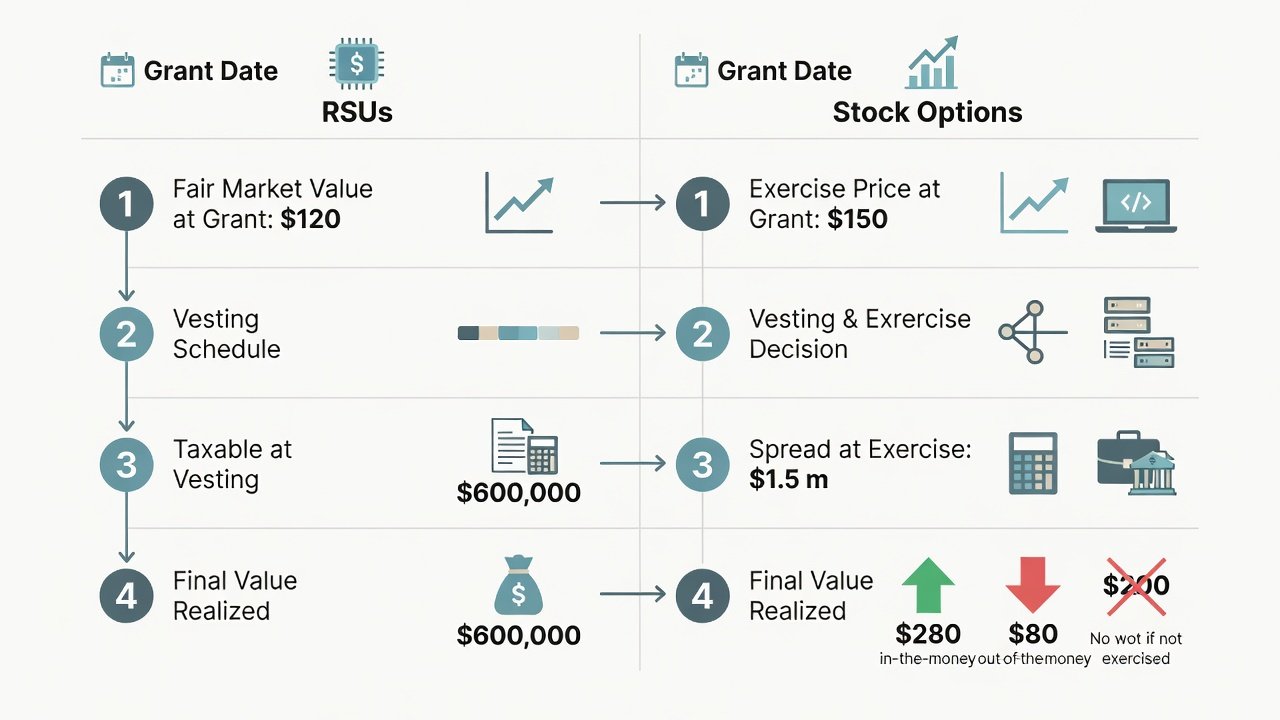
RSUs represent company shares granted to employees that vest over time. Once vested, they become taxable income at the fair market value on the vesting date. In 2026, valuing RSUs starts with multiplying the number of units by the current stock price, then adjusting for expected growth, dilution from new share issuances, and taxes. RSUs offer more certainty than options because they retain value even if the stock price drops, provided the company remains solvent.
Stock Options
Stock options give the right to buy shares at a fixed strike price. Their value depends on whether the company’s stock price exceeds the strike price at exercise. Beginners should use the Black-Scholes model or simplified online calculators for estimates. Non-qualified stock options and incentive stock options carry different tax treatments that affect net value.
Performance Bonuses and Profit-Sharing
These cash incentives tie to company or individual performance metrics. Valuation involves estimating payout probability based on historical data, revenue targets, and company outlook. Profit-sharing plans distribute a portion of company profits, often calculated as a percentage of annual earnings.
Step-by-Step Calculations for RSUs and Options
Follow these steps to value an RSU grant: 1) Note the number of shares and vesting schedule. 2) Multiply by today’s stock price. 3) Apply a discount for illiquidity or volatility. 4) Subtract estimated taxes using current IRS brackets. For options, calculate intrinsic value (current price minus strike price) and add time value. Always review the latest company 10-K filings on the SEC website for accurate share counts and dilution risks. Practice with sample numbers: a grant of 5,000 RSUs at a $120 stock price yields $600,000 pre-tax before applying a 25 percent volatility discount and 32 percent effective tax rate.
Real-World Examples from Tech and Finance
Consider a software engineer at a mid-size tech firm offered 10,000 RSUs vesting over four years plus a 15 percent performance bonus. At a $150 stock price, the RSU portion equals $1.5 million pre-tax, spread across vesting dates. In finance, an analyst might receive options with a $200 strike price; if the stock rises to $280, the gain per share is $80 before taxes. A startup example involves 0.5 percent equity with a four-year vest and one-year cliff; if the company exits at a $200 million valuation, the employee’s share could reach $1 million, but only after preferred shareholders receive returns. These scenarios highlight the importance of modeling best-case, base-case, and worst-case outcomes using conservative growth assumptions of 5 to 15 percent annually.
Comparing Total Rewards Across Company Sizes and Industries
- Startups: Higher equity percentages but higher failure risk; focus on liquidation preferences and participation rights.
- Public tech giants: More predictable RSU values with liquid markets and annual refreshers that maintain ownership levels.
- Finance firms: Mix of cash bonuses and deferred equity, often with stricter vesting and clawback provisions.
- Healthcare or manufacturing: Lower volatility but slower growth potential and smaller equity grants relative to base pay.
Use these comparisons to weigh stability against upside. Cross-reference industry data from the Bureau of Labor Statistics to benchmark your package against peers.
Factoring in Risk, Vesting Schedules, and Taxes
Vesting cliffs (e.g., one-year) delay value realization and increase forfeiture risk if you leave early. Risk factors include company performance, market crashes, and tax events. Consult IRS resources at IRS.gov for 2026 capital gains rates and AMT implications on incentive stock options. Early exercise strategies can reduce taxes but require cash outlay and carry forfeiture risk if employment ends.
Researching the Company Before Accepting Equity
Examine financial health through quarterly earnings, debt levels, and cash runway. Review leadership track record and competitive positioning. For private companies, request recent 409A valuations to understand fair market value. Public companies allow easier tracking via stock charts and analyst reports. This due diligence prevents overvaluing equity in declining businesses.
Negotiation Scripts and Tactics
Script example: “I’m excited about the role. To align total compensation with market benchmarks, could we increase the RSU grant by 20 percent or add a signing bonus equivalent to one year of vesting?” Practice timing these requests after receiving the initial offer. Prepare counteroffers that address both equity size and vesting acceleration upon change of control. Document all verbal agreements in writing before accepting.
Checklist for Spotting Undervalued Perks
- Review full vesting schedule and acceleration clauses.
- Compare equity value to peer offers using industry salary surveys.
- Check for refreshers or annual grants that prevent dilution over time.
- Evaluate 401(k) match and ESPP discounts as additional low-risk value.
- Assess change-in-control protections and severance tied to equity.
- Model tax withholding elections to avoid surprise liabilities.
FAQs: Common Beginner Mistakes
How do I handle volatile stock prices?
Use a 30-day average price instead of the latest quote to smooth fluctuations and create more realistic projections.
Should I accept options over RSUs?
RSUs provide guaranteed value once vested; options require the stock to rise above the strike price and carry higher risk of expiring worthless.
What if the company goes public during my vesting period?
Track lock-up periods and plan tax withholding in advance. Consider selling a portion immediately after the lock-up to lock in gains.
How do taxes affect net value in 2026?
Federal ordinary income rates can reach 37 percent plus state taxes; factor in these rates when comparing offers and explore tax-advantaged accounts.
Conclusion
Valuing equity and bonuses in 2026 requires methodical calculation, awareness of risk, and proactive negotiation. Apply the frameworks above to any offer and you will make informed decisions that maximize long-term rewards while avoiding common valuation errors.

No comments yet. Be the first!