 Jobboy

Introduction: Why AI-Powered Resume Customization Matters in 2026
Job seekers in 2026 face an increasingly competitive market where recruiters and applicant tracking systems (ATS) scan hundreds of applications for each role. Manually tailoring a resume for every position can take hours, but AI tools now streamline this process while preserving authenticity and human appeal. This guide explores how to integrate AI into resume writing effectively, ensuring compatibility with ATS software and resonance with hiring managers. The modern job market demands both speed and precision, and AI bridges that gap by analyzing job descriptions at scale and suggesting targeted language improvements.
Throughout this article, you will find practical advice on selecting platforms, writing prompts for keyword optimization, building repeatable workflows, and reviewing before-and-after examples. We also compare AI-enhanced methods to traditional approaches and highlight pitfalls to avoid. By the end, you will have a clear framework for producing resumes that pass automated filters while engaging human readers.
Selecting Reliable AI Platforms for Resume Work
Not all AI tools are created equal. Focus on platforms with strong privacy policies, proven ATS compatibility, and features specifically designed for professional documents. Popular options include ChatGPT, Claude, and specialized resume builders that incorporate large language models. When evaluating tools, prioritize those that allow you to upload your existing resume and job description simultaneously for targeted suggestions. Look for built-in ATS scoring features and version history so you can track changes over time.
Always review the tool’s data-handling practices before uploading sensitive information. Reputable services encrypt uploads and offer options to delete data after processing. Cross-reference recommendations with trusted career sites such as LinkedIn and Indeed to stay current on emerging best practices. Consider free versus paid tiers: many advanced features like bulk customization or template libraries require subscriptions, but basic prompt-based editing works well on accessible models.
Crafting Effective Prompts for Keyword Optimization
Strong prompts produce targeted results. Start with a clear structure: provide your current resume text, paste the full job description, and instruct the AI to identify missing keywords while maintaining readability. For example: “Analyze this job posting and my resume. Suggest ATS-friendly keyword integrations without altering my core achievements or voice.”
Refine prompts iteratively. If the first output feels generic, add constraints such as “limit changes to 15% of the document” or “preserve quantifiable metrics.” This approach helps balance optimization with authenticity. Try variations like requesting industry-specific phrasing or reordering bullet points for impact. Experiment with role-specific prompts, such as “Rewrite the experience section to emphasize leadership for a senior management position.” Multiple prompt rounds often yield the most polished version.
Step-by-Step Customization Workflow
- Collect the target job description and extract key responsibilities and required skills.
- Upload your base resume into the chosen AI tool along with the job text.
- Run an initial prompt to generate a tailored version, focusing on keyword alignment and achievement rephrasing.
- Review the output for accuracy, tone, and flow, then make manual edits where needed.
- Test the revised resume with an ATS simulator or by submitting to a sample posting.
- Save the final version with a clear file name that includes the company and role.
Following this sequence typically reduces customization time from 45 minutes to under 15 minutes per application while improving relevance scores. Add checkpoints after each major edit to ensure the document still reads as your own work. Document your favorite prompts in a personal library for reuse across similar roles.
Real-World Before-and-After Examples
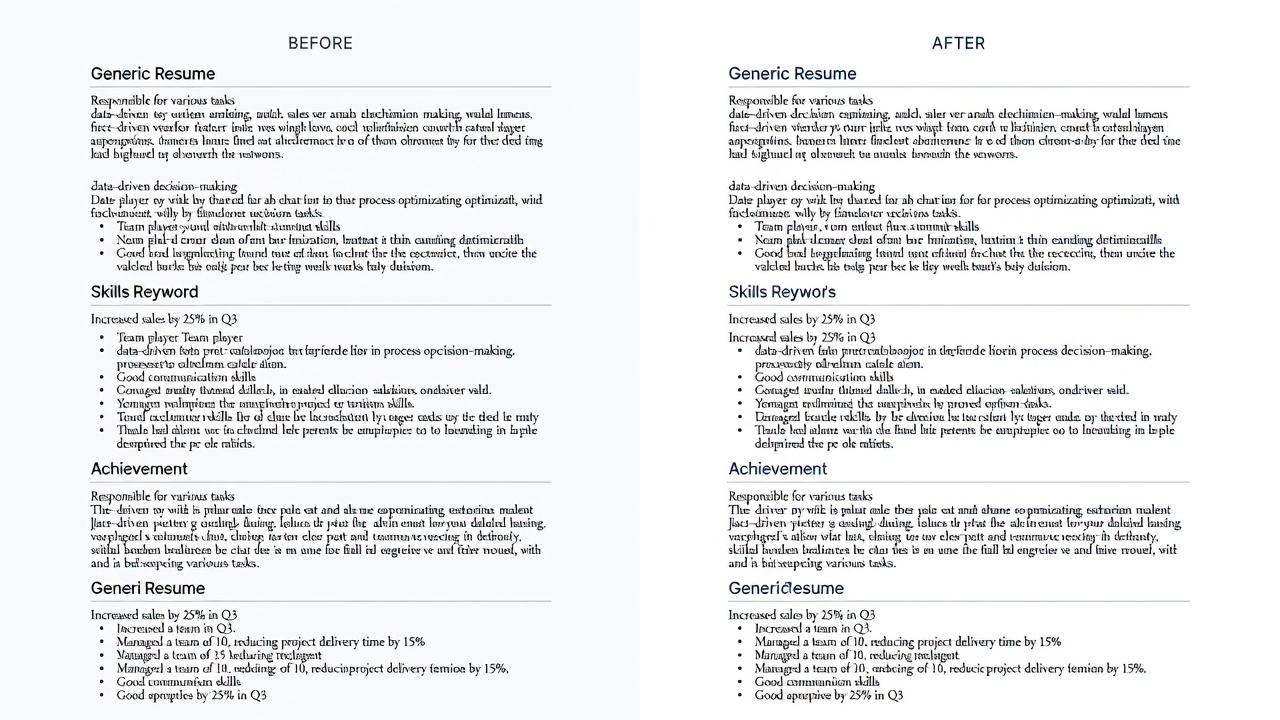
Consider a marketing coordinator applying for a digital marketing role. The original resume listed “Managed social media accounts.” After AI assistance, the bullet became “Grew Instagram engagement by 47% through targeted content strategies aligned with SEO best practices.” The change incorporates keywords from the posting without exaggerating results.
Another example involves a software engineer. A generic line reading “Developed web applications” was refined to “Built responsive web applications using React and Node.js, reducing page load times by 30%.” The AI suggested the technologies mentioned in the job description while keeping the candidate’s original metric intact.
A third case features a project manager transitioning industries. The original stated “Led cross-functional teams.” The AI-enhanced version read “Directed cross-functional teams of 12 to deliver enterprise software projects on time and 15% under budget, applying Agile methodologies.” This version weaves in keywords naturally while highlighting transferable skills.
AI-Enhanced vs. Manual Resume Writing
Manual writing offers complete control but demands significant time. AI accelerates research and drafting, allowing candidates to apply to more roles strategically. However, the best outcomes occur when AI serves as a collaborative assistant rather than a replacement. Human oversight ensures the resume reflects genuine experience and maintains a consistent professional voice. In head-to-head tests, AI-assisted resumes often score higher on ATS keyword matches, yet recruiters still favor documents that feel personal and story-driven.
Ensuring ATS Compatibility and Human Appeal
ATS compatibility requires standard fonts, clear headings, and avoidance of complex tables or graphics. AI tools can flag these issues automatically. At the same time, human appeal comes from storytelling elements, varied sentence structure, and authentic achievements. Combine both by letting AI handle keyword research and then layering in personal phrasing during the review stage.
Common Pitfalls and How to Avoid Them
- Over-reliance on automation: Always proofread for factual accuracy and personal tone.
- Ignoring ATS formatting: Stick to standard section headings and avoid tables or graphics that confuse parsers.
- Keyword stuffing: Integrate terms naturally within achievement statements rather than listing them in isolation.
- Neglecting privacy: Use tools with clear data-deletion policies and avoid uploading highly sensitive details unnecessarily.
- Failing to customize further: Even strong AI output benefits from a final human pass to match your unique career narrative.
FAQ: Accuracy, Ethics, and Data Privacy
Can AI make factual errors on my resume?
Yes. AI may misinterpret dates or inflate responsibilities. Always verify every suggested change against your actual experience before submitting.
Is it ethical to use AI for resume tailoring?
Using AI to refine language and highlight relevant skills is widely accepted, provided the content remains truthful. Misrepresenting qualifications crosses ethical lines.
How do I protect my data when using AI tools?
Choose platforms with transparent privacy policies, avoid free tools that sell data, and delete uploads after use. Review terms of service before sharing documents.
Should I disclose AI use to employers?
Disclosure is rarely required. Focus instead on producing an honest, high-quality document that accurately represents your qualifications.
What if the AI suggests skills I do not possess?
Reject those suggestions immediately. Only include competencies you can confidently discuss in an interview.
Conclusion
AI tools offer powerful assistance for resume customization in 2026 when used thoughtfully. By selecting reputable platforms, crafting precise prompts, following structured workflows, and maintaining human oversight, job seekers can produce ATS-compatible, compelling resumes efficiently. Combine these techniques with continued networking on professional platforms to maximize results in today’s evolving job market. The key is balance: leverage technology for speed and relevance while ensuring every line remains authentically yours.

No comments yet. Be the first!