 Jobboy

Introduction: Why Volunteer Leadership Matters in 2026 Career Transitions
Career changers in 2026 often face the challenge of bridging gaps between past paid roles and new industries. Volunteer leadership provides powerful proof of transferable skills like team management and event coordination. Recruiters value these experiences when presented strategically, especially on resumes targeting corporate roles. In today's competitive job market, where many professionals are pivoting due to industry shifts or personal growth, volunteer roles serve as credible evidence of ongoing development and leadership capability. They show initiative, community impact, and the ability to drive results without the structure of a traditional paycheck. This article explores proven 2026 tactics for mid-career pivots, including how to highlight these roles effectively with STAR examples, ATS-friendly phrasing, and quantifiable metrics. We will cover strategic placement options, reframing of transferable skills, before-and-after bullet transformations, recruiter perspectives on impact measurement, common pitfalls, an ATS compatibility checklist, and guidance on balancing volunteer entries with paid history. Real-world examples tailored to corporate transitions will illustrate these concepts, along with FAQs addressing short-term stints and other concerns.
Strategic Placement of Volunteer Leadership on Your Resume
Deciding where to place volunteer leadership requires careful consideration of your overall narrative. For mid-career changers, a dedicated "Volunteer Experience" section works well when the roles demonstrate skills directly relevant to the target position, such as project oversight or stakeholder engagement. Position this section after your core professional experience if the volunteer work is recent and substantial. Alternatively, create a combined "Professional and Leadership Experience" heading to integrate volunteer roles chronologically alongside paid positions, creating a seamless timeline that emphasizes continuity. If your volunteer leadership is older or less central, move it toward the end but ensure it still receives prominent bullet points. Always tailor placement based on the job description—analyze keywords and prioritize sections that align most closely with employer needs. This approach prevents volunteer entries from overshadowing paid work while reinforcing your qualifications for the new field.
Reframing Transferable Skills from Volunteer Roles
One of the most effective ways to showcase volunteer leadership is by translating everyday duties into business-oriented language that resonates with corporate hiring managers. For instance, coordinating a team of volunteers for a fundraising drive can be reframed as "Directed cross-functional teams of 12 members to execute revenue-generating initiatives, achieving targets 20% above projections." Event coordination becomes "Planned and executed multi-stakeholder events serving over 500 participants, optimizing logistics to reduce costs by 15%." Other transferable skills include conflict resolution, which maps to team mediation; resource allocation, which aligns with budget management; and public speaking, which translates to presentation and stakeholder communication. The key is to focus on leadership actions and business outcomes rather than simple participation. By identifying parallels between volunteer responsibilities and corporate competencies, you create a compelling bridge for career changers entering fields like marketing, operations, or human resources.
Using the STAR Method with Quantifiable Metrics
The STAR method remains a cornerstone for crafting impactful resume bullets in 2026. Begin with the Situation to set context, describe the Task you faced, detail the Actions taken, and conclude with measurable Results. A strong example for a community outreach role: Situation involved declining volunteer retention rates; Task was to redesign onboarding processes; Action included developing training modules and pairing new members with mentors; Result was a 45% increase in six-month retention. Incorporate specific metrics wherever possible, such as team sizes, budgets managed, percentages improved, or timelines met. Another example: "Led a volunteer committee of 8 in launching a digital awareness campaign that expanded reach from 3,000 to 22,000 impressions within four months." These quantified statements provide concrete evidence of your capabilities and help recruiters quickly assess your potential contributions.
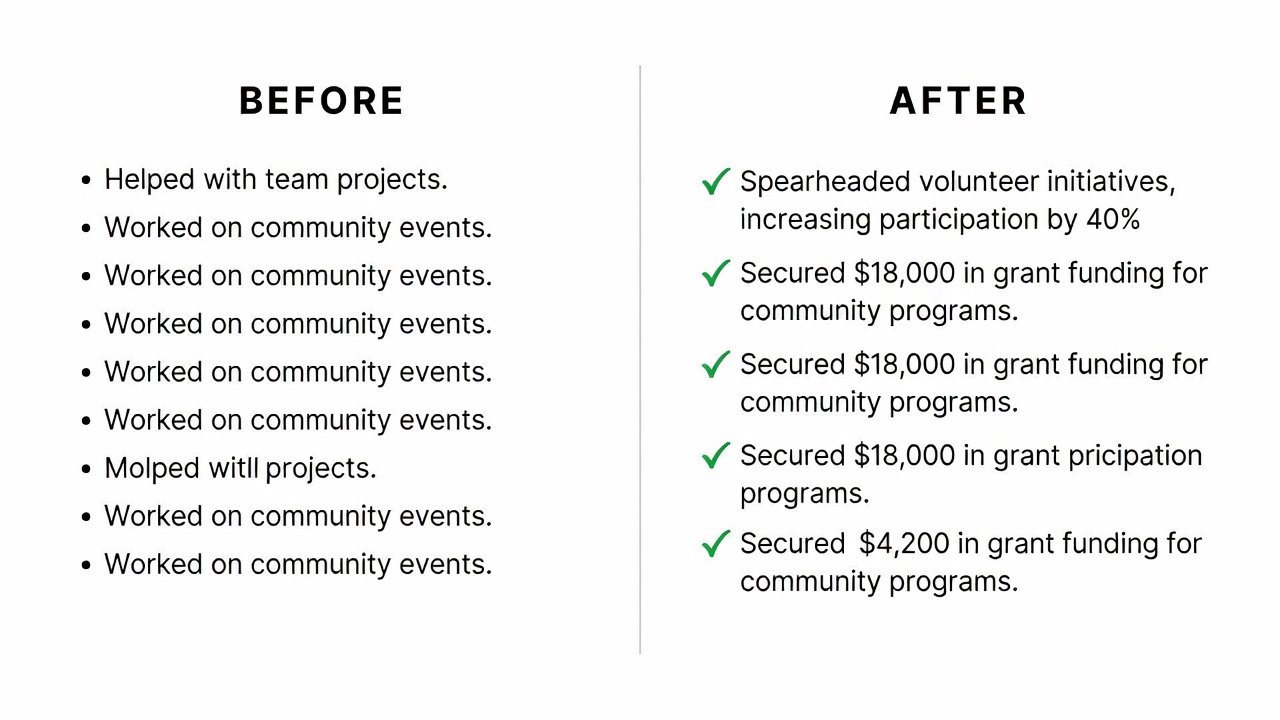
Before-and-After Bullet Transformations
Transforming weak bullets into strong ones dramatically improves resume effectiveness. Consider these examples: Before: "Organized community clean-up days." After: "Spearheaded monthly community clean-up initiatives engaging 75 volunteers, resulting in 12 tons of waste removed and partnerships with three local businesses." Before: "Ran meetings for the group." After: "Facilitated bi-weekly strategy meetings for a 25-person volunteer network, streamlining decision-making processes and accelerating project timelines by 30%." Before: "Helped with fundraising." After: "Managed donor outreach campaign that secured $18,000 in contributions, representing a 60% year-over-year increase." These transformations shift focus from duties to achievements, making your volunteer leadership more persuasive for corporate transitions.
Recruiter Insights on Impact Quantification
Recruiters consistently emphasize the importance of measurable impact when reviewing volunteer leadership on resumes. They look for evidence that candidates can deliver results at scale, whether through efficiency gains, growth metrics, or resource optimization. Insights from hiring professionals suggest prioritizing outcomes that mirror corporate priorities, such as revenue generation, process improvement, or team development. Avoid generic statements; instead, use data points like "Increased program participation by 55%" or "Reduced operational costs by $4,200 annually." This level of specificity builds credibility and differentiates your application in applicant pools heavy with career changers.
Common Pitfalls to Avoid
Several frequent mistakes can undermine the effectiveness of volunteer leadership sections. First, listing too many minor roles dilutes focus—select only those with clear leadership elements. Second, failing to quantify achievements leaves bullets vague and forgettable. Third, using overly casual language instead of professional terminology reduces perceived seriousness. Fourth, placing volunteer work above recent paid experience can signal a lack of professional progression. Fifth, neglecting to tailor entries to the target job description misses opportunities to align with ATS and recruiter expectations. Sixth, omitting dates or durations for short-term stints creates confusion about commitment level. Addressing these pitfalls ensures your volunteer experiences strengthen rather than weaken your overall profile.
ATS Compatibility Checklist
Applicant tracking systems require specific formatting for optimal parsing. Use standard headings such as "Experience" or "Volunteer Experience" rather than creative alternatives. Incorporate exact keywords from the job posting, such as "project management" or "team leadership," in context. Format bullets as simple text without special characters that may break parsing. Choose file formats like .docx for maximum compatibility, and proofread for consistent spelling of industry terms. Expand acronyms on first mention and avoid columns, tables, or embedded images that ATS cannot read accurately. Following this checklist maximizes the chances that your volunteer leadership details reach human reviewers.
Integrating Volunteer Experience Without Overshadowing Paid History
Maintaining balance is essential for career changers. Limit volunteer entries to two or three targeted bullets that highlight the most relevant leadership aspects. Position these roles after your two most recent paid positions to keep professional momentum front and center. Use consistent formatting and slightly condensed spacing if needed, while ensuring all content remains scannable. When volunteer work fills a critical skills gap, briefly reference it in your professional summary to reinforce relevance without shifting emphasis away from compensated experience.
Real-World Examples for Corporate Transitions
For professionals moving into marketing: "Directed social media strategy for a nonprofit chapter, growing engagement metrics from 1,500 to 12,000 followers and driving a 40% increase in event registrations." In operations transitions: "Optimized volunteer scheduling system for a regional health initiative, reducing scheduling conflicts by 65% and improving service delivery efficiency." For human resources pivots: "Developed and delivered leadership training to 30 volunteers, resulting in 85% of participants advancing to supervisory roles within the organization." These examples demonstrate how volunteer leadership directly supports corporate skill requirements.
FAQs on Handling Short-Term Volunteer Stints
How long must a volunteer role last to warrant inclusion? Even brief stints of three to six months qualify if they produced measurable leadership outcomes and align with target skills. Should unpaid board or advisory positions be listed? Absolutely—these demonstrate strategic oversight and governance experience valuable in corporate settings. How do you handle overlapping timelines with paid work? Note concurrent roles clearly with dates and emphasize distinct contributions from each. What if the volunteer work was remote or virtual? Frame it with the same metrics and actions, highlighting digital tools used for team coordination. Is it necessary to provide references from volunteer supervisors? Only if requested; otherwise, focus on results within the resume itself. These answers help career changers confidently incorporate diverse volunteer histories.
For additional guidance on resume optimization and career transitions, explore resources at LinkedIn, Indeed, and CareerOneStop.
Conclusion
Effectively showcasing volunteer leadership on 2026 career-changer resumes requires strategic placement, reframed skills, quantified STAR examples, and strict ATS adherence. By avoiding common pitfalls and integrating these experiences thoughtfully alongside paid history, professionals can present a complete picture of their leadership capabilities. Apply the checklists, transformations, and examples provided to strengthen your applications and accelerate successful pivots into new corporate roles.

No comments yet. Be the first!