 Jobboy
Introduction: Why Soft Skills Matter in 2026 ATS Systems
Applicant Tracking Systems (ATS) continue to evolve in 2026, scanning resumes for both hard and soft skills to match job descriptions. Job seekers often struggle to weave soft skills naturally without resorting to keyword stuffing, which can harm readability and ATS scoring. This guide provides practical strategies to balance technical abilities with interpersonal strengths like communication, leadership, and adaptability. In today's competitive job market, employers seek candidates who not only possess technical expertise but also demonstrate the ability to collaborate effectively, adapt to change, and lead teams through complex challenges. ATS platforms have advanced with better natural language processing, allowing them to evaluate context around skills rather than relying solely on exact keyword matches.
Modern hiring prioritizes candidates who demonstrate impact. Recruiters and ATS algorithms favor resumes that show results over generic lists. By focusing on achievement-based bullet points and strategic placement, you can create ATS-friendly resumes that also appeal to human readers. Understanding this dual audience is essential for success in 2026, where many organizations use hybrid screening processes that combine automated filters with human review.
Identifying Relevant Soft Skills for Your Target Role
Start by analyzing the job description for repeated soft skill keywords. Tools like job boards highlight terms such as "collaboration," "problem-solving," and "emotional intelligence." Match these to your experience without forcing unrelated skills. For example, a project manager role might emphasize "team leadership" and "conflict resolution," while a sales position highlights "persuasion" and "relationship building." A software developer position could prioritize "adaptability" and "mentorship," whereas healthcare roles often value "empathy" and "crisis management."
Review your past roles and map specific instances where you applied these skills. Create a master list of your experiences and cross-reference it against three to five target job postings. This targeted approach ensures relevance and prevents dilution of your core qualifications. Consider industry nuances: tech companies may value innovation and agility, while finance sectors emphasize precision and ethical decision-making. By tailoring your selections, you align your resume more closely with what hiring managers seek.
Integrating Soft Skills into the Professional Summary
The professional summary is prime real estate for introducing soft skills early. Instead of a generic statement, craft 3-4 lines that blend hard skills with soft ones. Example: "Results-driven marketing professional with expertise in data analytics and a proven ability to foster cross-functional collaboration, driving 30% campaign growth through adaptive leadership." Another variation for an operations specialist: "Operations expert skilled in process optimization and stakeholder communication, successfully streamlining workflows to enhance team efficiency and reduce operational bottlenecks."
This method signals both capability and personality to ATS parsers while maintaining flow for recruiters. Experiment with variations based on your career level—entry-level candidates might focus on eagerness to learn and teamwork, while senior professionals highlight strategic vision and influence. Always keep the summary concise, ideally under 150 words, to respect ATS parsing limits.
Using Achievement-Based Bullet Points with Soft Skills
Transform generic duties into quantifiable achievements that incorporate soft skills. Avoid standalone lists like "Strong communicator." Instead, embed skills in context: "Led cross-departmental workshops, enhancing team communication and reducing project delays by 25%." Incorporate the STAR method adapted for resumes: describe the situation briefly, your task, actions taken including soft skills, and measurable results.
Additional examples include: "Facilitated conflict resolution sessions among five departments, resulting in improved inter-team trust and a 40% increase in project completion rates." Or for educators: "Mentored new instructors in curriculum design, applying empathetic feedback techniques that boosted student satisfaction scores by 15%." Aim for four to six such bullets per role, varying sentence structure to keep the resume engaging.
Before-and-After Resume Snippets
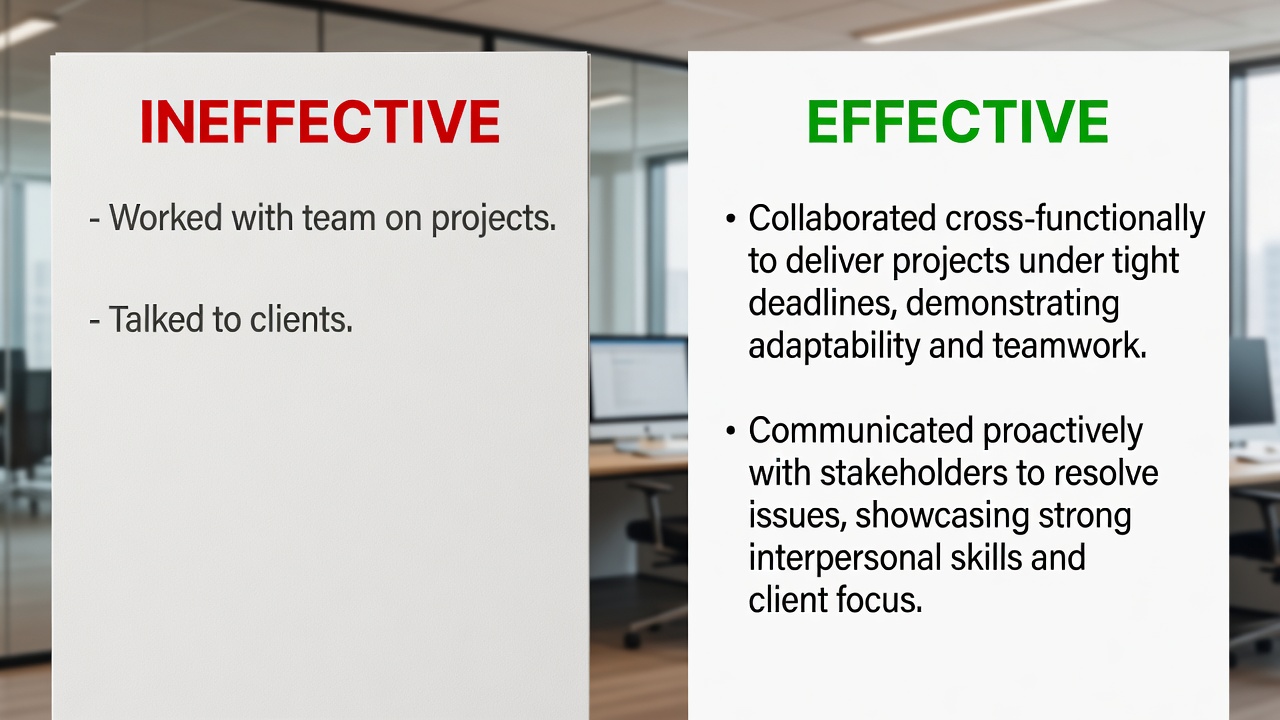
Ineffective: Managed team projects. Good at problem-solving.
Effective: Orchestrated a 12-member team on a product launch, applying strategic problem-solving to resolve supply chain issues and deliver the project two weeks ahead of schedule.
Repeat this pattern across roles for maximum impact. Another before-and-after: Ineffective version states "Handled customer complaints"; effective version reads "Resolved escalated customer issues through active listening and negotiation, converting 85% of complaints into long-term client relationships."
Step-by-Step Formatting Tips for ATS Compatibility
- Use standard section headings like "Professional Experience" and "Skills" to ensure proper parsing by most systems.
- Incorporate soft skills in context rather than a separate skills section overloaded with terms.
- Employ action verbs that imply soft skills, such as "facilitated," "negotiated," and "mentored."
- Keep formatting simple: standard fonts like Arial or Calibri, no tables or graphics that confuse ATS.
- Proofread for natural language flow after adding keywords, reading aloud to catch awkward phrasing.
- Test your resume by submitting it to free ATS simulators available online before final applications.
These steps maintain optimization while preserving readability. Pay attention to file formats—PDF or DOCX are generally safe, but confirm with the employer's instructions.
Effective vs. Ineffective Approaches: A Comparison
Ineffective resumes list soft skills in isolation or repeat them excessively, leading to ATS flags for stuffing. Effective versions integrate them into narratives that demonstrate value, improving both algorithmic matches and recruiter engagement. For deeper insights on labor market trends, refer to resources from the U.S. Department of Labor. Another comparison: Overusing buzzwords without evidence fails human review, while contextual examples succeed by showing measurable influence. Ineffective: "Team player with excellent leadership skills." Effective: "Guided a virtual team of eight through a company-wide transition, fostering collaboration that achieved 95% on-time deliverables."
Industry-Specific Applications of Soft Skills
Different sectors require unique blends. In creative fields like marketing or design, emphasize innovation and client empathy through examples such as "Collaborated with clients to refine campaign concepts, incorporating feedback that increased engagement metrics." In technical industries, highlight adaptability: "Adapted to new coding frameworks mid-project, mentoring junior developers to maintain team productivity." Government or nonprofit roles often value community building and ethical judgment. Customize accordingly to stand out.
Common Mistakes to Avoid in 2026
- Keyword stuffing without supporting achievements, which ATS increasingly penalizes for lack of context.
- Placing soft skills only in a skills cloud that ATS may ignore or misparse.
- Ignoring role-specific customization for each application, leading to generic submissions.
- Overlooking updates to ATS technology that now better detect context and penalize repetition.
- Failing to update older experiences with current soft skill terminology relevant to 2026 trends.
Addressing these ensures your resume stands out in competitive applicant pools.
Testing and Refining Your Resume
After drafting, use free tools from official sources to simulate ATS scans. Submit versions to multiple job postings and track response rates. Seek feedback from mentors or career coaches on how well soft skills come across naturally. Iterate based on results, focusing on clarity and impact.
Conclusion
Successfully weaving soft skills into ATS resumes in 2026 requires intentional placement, achievement focus, and readability. By following these strategies, job seekers can create documents that pass automated screens and impress hiring managers. Experiment with the examples provided and tailor them to your unique background for optimal results. Continuous refinement based on feedback will position you strongly in evolving hiring landscapes.
FAQ: ATS Parsing Concerns and Recruiter Preferences in 2026
How do ATS systems parse soft skills in 2026?
ATS tools now use advanced natural language processing to evaluate context around skills, favoring demonstrated usage over isolated mentions. Focus on integration within experience sections for better results.
Should I include a dedicated soft skills section?
Only if space allows and skills are highly relevant; otherwise, embed them naturally to avoid parsing issues and maintain flow for both machines and humans.
What do recruiters prioritize alongside ATS optimization?
Recruiters value authenticity and quantifiable impact. For additional career resources, explore CareerOneStop, an official U.S. government site.
Can soft skills boost ATS scores without hard skills?
Balance is essential. Pair soft skills with technical competencies for the strongest matches in most industries, as confirmed by labor analyses from Bureau of Labor Statistics.
How often should I update soft skill examples on my resume?
Review and refresh examples every six months or after major projects to ensure they reflect your most recent achievements and align with current job market demands.

No comments yet. Be the first!