 Jobboy
Introduction to Tech Resume Writing in 2026
Landing roles in software engineering, data science, and related fields requires resumes that speak directly to applicant tracking systems (ATS) and hiring managers who value technical depth. In 2026, the tech job market emphasizes adaptability to AI-driven workflows and distributed team environments, making it essential for candidates to demonstrate not just coding proficiency but also measurable contributions to scalable systems and collaborative processes. This guide focuses on industry-specific techniques for integrating keywords, showcasing projects with measurable results, and structuring sections for GitHub links and certifications. Readers will learn how to differentiate successful tech resumes from generic ones through concrete examples and comparisons, ensuring their applications stand out in competitive searches for mid-level and senior positions.
Optimizing for ATS Systems in 2026
Modern ATS platforms prioritize exact keyword matches from job descriptions while scanning for context and relevance. For tech positions, incorporate terms like "Python," "machine learning pipelines," "CI/CD automation," "Kubernetes orchestration," and "remote collaboration tools" naturally throughout the resume. Start by analyzing target job postings to extract primary skills and secondary tools, then mirror them in your experience bullets without forcing unnatural repetition. A 2026 trend is mentioning AI-assisted development tools such as GitHub Copilot or Cursor to demonstrate efficiency in code generation, automated testing, and debugging workflows. Use standard fonts and section headings like "Professional Experience" and "Technical Skills" to ensure clean parsing, and avoid columns or images that could disrupt text extraction algorithms.
Highlighting Technical Skills, Projects, and Quantifiable Impacts
Tech resumes succeed when skills sections list tools and frameworks with proficiency levels, followed by project bullets that quantify impact. For instance, instead of "Developed a web app," write "Built a React-based dashboard that reduced reporting time by 40% for a team of 15 engineers through optimized data queries and real-time visualizations." This approach emphasizes results over duties. Include 3-5 key projects per role, focusing on open-source contributions or internal tools that improved system performance, reduced latency, or enhanced scalability. Break down impacts into categories such as performance gains, cost savings, or user adoption rates. For data roles, highlight metrics like "Improved model accuracy from 78% to 94% by implementing ensemble methods and feature engineering on datasets exceeding 10 million records." Always tie projects back to business outcomes to show strategic thinking beyond pure technical execution.
Structuring Sections for GitHub Links and Certifications
Place a dedicated "Projects & Portfolio" section near the top after the summary to immediately showcase tangible work. Link directly to GitHub repositories with descriptive anchors, such as "github.com/username/ml-inference-optimizer – Optimized model latency by 60% using quantization techniques and achieved production deployment for 50,000 daily users." Ensure each linked repo includes a clear README with setup instructions, architecture diagrams, and results. Certifications like AWS Certified Solutions Architect or Google Professional Data Engineer should appear in a separate section with issue dates, credential IDs for verification, and brief descriptions of skills validated, such as "Validated expertise in designing fault-tolerant architectures handling petabyte-scale data." Update this section quarterly to reflect new credentials earned through ongoing professional development.
Traditional vs. Skills-Based Resume Formats
Traditional chronological formats work well for candidates with steady progression at established firms, listing roles in reverse order with detailed responsibilities and achievements under each. Skills-based formats, however, benefit career changers or those with non-linear paths by leading with a robust skills matrix and project highlights before briefly noting employment history. Compare the two: a traditional resume might list "Software Engineer at Company X, 2023–2025" with three bullets on daily tasks, while a skills-based version opens with "Expert in distributed systems and Kubernetes orchestration" followed by categorized skills and then a condensed experience timeline. Choose based on your background—use chronological for linear tech careers and skills-based when pivoting from adjacent fields like IT support to software development.
Step-by-Step Examples for Mid-Level Developers
Consider a mid-level backend developer targeting a senior role at a cloud-native company. Follow these steps to build the resume: First, craft a professional summary of 3-4 lines incorporating target keywords and 2026 trends, such as "Results-driven engineer with 5 years building scalable APIs and integrating AI tools, now seeking to leverage expertise in remote-first collaboration to drive system reliability improvements." Second, structure experience with 4-6 quantified bullets per position, starting with strong action verbs. Third, create a skills section divided into Languages, Frameworks, DevOps Tools, and AI/ML. An example bullet progression: "Refactored legacy Node.js services, cutting API response times from 800ms to 150ms and handling 2x traffic spikes without downtime." Fourth, add the projects section with GitHub links and metrics. Fifth, include education and certifications at the bottom unless they are highly relevant to the role.
Comparisons: Successful Tech Resumes vs. Generic Ones
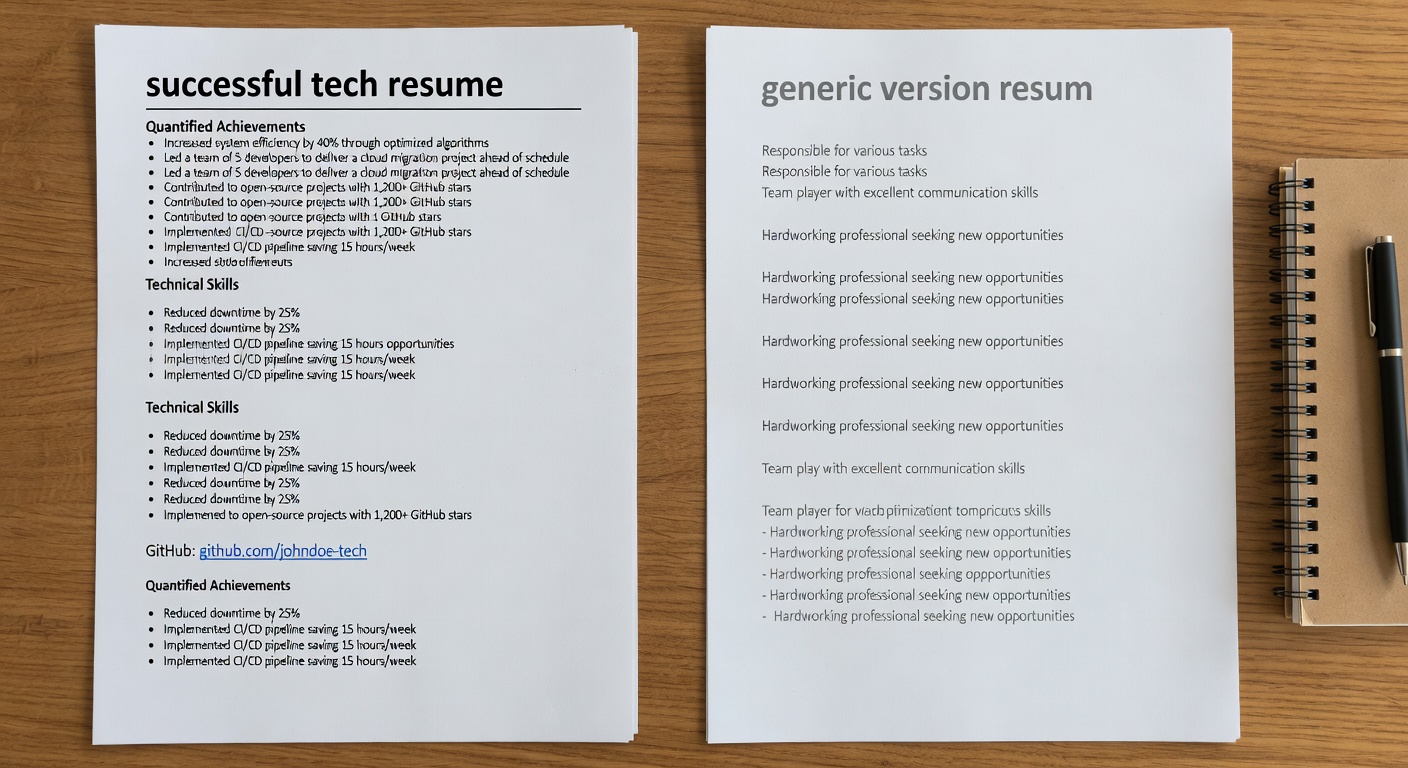
A generic resume might state "Responsible for coding and testing applications." A successful version specifies "Implemented automated testing suite in Jest that increased code coverage from 65% to 92%, preventing 200+ production bugs annually and accelerating release cycles by three weeks." The latter demonstrates technical rigor, tool proficiency, and business value through specific numbers. Another comparison involves project descriptions: generic might say "Worked on a mobile app," while successful reads "Developed cross-platform mobile app using Flutter that achieved 100,000 downloads in first quarter with 4.8-star rating, incorporating offline sync features for improved user retention." Review real examples on platforms like GitHub to see how top contributors format their project readmes for resume inspiration, focusing on clarity and measurable outcomes.
2026 Trends: AI Mentions and Remote Metrics
Incorporate AI fluency by noting experience with large language models for code review, automated documentation, or data augmentation tasks. For example, "Utilized AI code assistants to generate 30% of initial boilerplate code, allowing focus on complex algorithm optimization that improved overall system throughput by 25%." Remote metrics have gained prominence, such as "Coordinated async workflows across four continents using Notion and Miro, improving cross-functional alignment scores by 30% and reducing meeting time by 15 hours weekly." These elements signal adaptability in hybrid environments and familiarity with modern collaboration stacks essential for distributed engineering teams.
FAQ: Common Pitfalls in Tech Resume Writing
- Overusing buzzwords: Replace vague phrases like "synergize" or "leverage synergies" with specific actions and results; instead of "driving innovation," detail "Introduced microservices architecture that enabled independent deployments and reduced deployment failures by 70%."
- Ignoring ATS parsing: Use standard section headings and avoid tables, graphics, or special characters that break text extraction; always test your resume by pasting it into a plain text editor to verify readability.
- Neglecting GitHub hygiene: Ensure linked repos are public, well-documented with READMEs explaining architecture and results, and directly relevant to the target role rather than personal hobby projects.
- Omitting dates on certifications: Always include issue and expiration dates for credibility, and list only active or recently earned credentials to avoid appearing outdated.
- Failing to quantify impacts: Every bullet should include numbers where possible, such as percentages, time savings, or scale metrics, to provide concrete evidence of contributions.
Conclusion
Effective 2026 tech resumes combine ATS-friendly keywords, quantified achievements, clear links to portfolios, and demonstrations of AI and remote collaboration capabilities. By applying the structures, step-by-step processes, and examples above, job seekers can present compelling cases for software, data, and engineering positions. Tailor each application to the specific role while maintaining authenticity in your technical narrative. For further guidance on professional networking and job applications, explore resources at LinkedIn.
No comments yet. Be the first!