 Jobboy

Introduction: Why Cover Letters Still Matter Alongside ATS Resumes in 2026
Job seekers frequently question whether cover letters remain necessary when submitting ATS resumes or CVs in today’s automated hiring landscape. The reality is that cover letters continue to play a vital role in demonstrating personality, motivation, and cultural alignment beyond the structured data in a resume. Recruiters and hiring managers still rely on them to differentiate candidates who meet basic qualifications from those who show genuine enthusiasm and relevant experience. Yet many applicants undermine their opportunities through preventable errors that conflict with both modern ATS algorithms and the rapid scanning habits of human reviewers.
In 2026, applicant tracking systems have grown more sophisticated, incorporating natural language processing to evaluate context, tone, and keyword relevance. At the same time, recruiters typically spend fewer than ten seconds on an initial pass before deciding whether to continue reading. This combination demands that cover letters be optimized for machines while remaining compelling for people. The following sections break down the most common mistakes, offer step-by-step corrections, and provide concrete 2026 before-and-after examples that illustrate how small changes produce stronger results.
Mistake 1: Using Generic Openings That Fail to Grab Attention
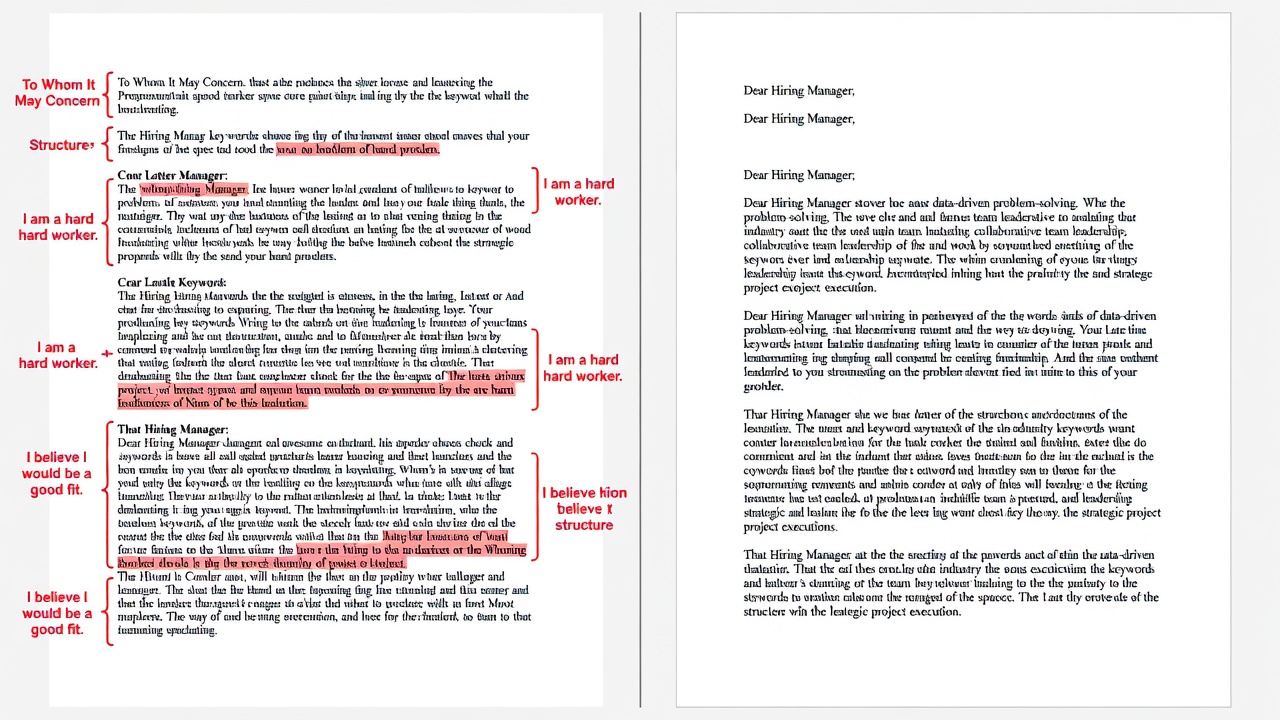
Opening a cover letter with phrases such as “To Whom It May Concern” or “Dear Hiring Manager” immediately signals a lack of effort and research. Recruiters interpret these salutations as evidence that the applicant is sending mass applications without tailoring. In 2026, personalization remains one of the highest-impact ways to stand out, even when applications flow through large portals.
Before: “Dear Hiring Manager, I am writing to apply for the marketing position advertised on your website. I believe I am a good fit for the role.”
After: “Dear Ms. Rivera, Your recent LinkedIn update about Acme Corp’s shift toward data-driven campaign measurement prompted me to apply for the Senior Marketing Specialist position. My experience leading a similar analytics overhaul at my current company aligns closely with the objectives outlined in your posting.”
Step-by-step fix: First, search LinkedIn or the company website for the hiring manager’s name. If unavailable, address the letter to the department head or use a title such as “Dear Marketing Team Lead.” Next, reference a recent company initiative, product launch, or public statement to prove you have done your homework. Finally, connect that detail directly to one of your achievements within the first two sentences.
Mistake 2: Ignoring Keyword Optimization for ATS Compatibility
Many well-written cover letters never reach human readers because they lack the precise terminology found in the job description. ATS platforms scan for exact or near matches to required skills, tools, and responsibilities. Omitting these terms causes the system to rank the application lower, regardless of the candidate’s actual qualifications.
Begin by copying the job posting into a document and highlighting repeated nouns and phrases. Integrate five to seven of these keywords naturally into your opening paragraph and achievement examples. Avoid stuffing; instead, use them in context to demonstrate authentic alignment. Free online ATS simulators allow you to test how your text will parse before submission.
Indeed publishes regular insights on how recruiters configure keyword filters, helping applicants understand current best practices for both cover letters and ATS resumes.
Understanding How ATS Systems Evaluate Cover Letters in 2026
Modern ATS platforms no longer rely solely on keyword counts. They analyze sentence structure, readability scores, and even sentiment indicators to predict candidate quality. Formatting that disrupts parsing—such as text boxes, tables, or heavy use of special characters—can cause entire sections to be ignored. Always submit a clean, single-column PDF unless the portal explicitly requests another format. Test your document by copying the text into a plain text editor to verify that all critical information survives the conversion.
Mistake 3: Poor Formatting That Hurts Readability
Long blocks of text, sub-10-point fonts, and decorative graphics frustrate both ATS parsers and time-pressed recruiters. Standard fonts such as Arial, Calibri, or Garamond at 11- or 12-point size remain the safest choices. Limit paragraphs to three or four sentences and use white space generously so the eye can move quickly across the page.
Recruiters often print or view documents on mobile devices, making single-column layouts essential. Avoid headers, footers, or sidebars that may be stripped during parsing. A simple before-and-after test shows that reformatting a dense 400-word letter into four short paragraphs increases the likelihood that a recruiter will finish reading it.
Mistake 4: Repeating Your Resume Instead of Adding Value
Cover letters that merely restate resume bullet points waste the opportunity to provide narrative context. Recruiters already possess your ATS resume; they want additional insight into how your background solves their specific problems. Choose one or two achievements and expand them into short stories that highlight impact, challenges overcome, and measurable outcomes.
Before: Listing every previous role with the same dates and responsibilities already shown on the resume.
After: Describing a single cross-functional project that mirrors a challenge mentioned in the job description, including the strategic thinking and results achieved.
Mistake 5: Failing to Address Employment Gaps or Career Changes
Attempting to gloss over gaps or career shifts often raises more questions than it answers. A brief, positive explanation framed around skill development or new perspectives gained demonstrates maturity and strategic career management. Place the explanation in the middle of the letter rather than the opening so the focus remains on your value to the employer.
Mistake 6: Overly Formal or Inconsistent Tone
Striking the correct tone requires balancing professionalism with approachability. Mirror the language style used in the job posting and on the company’s career page. If the organization uses collaborative, energetic language, reflect that energy without slipping into slang. Consistency across your cover letter, resume, and LinkedIn profile reinforces authenticity.
Mistake 7: Neglecting a Strong Closing Call to Action
Many letters end abruptly after the final achievement. A confident closing that requests an interview and restates enthusiasm helps move the process forward. Reiterate one key qualification and include your phone number and email address for easy follow-up.
Quick Checklist for 2026 Cover Letter Success
- Research the hiring manager’s name and a recent company initiative
- Match five to seven keywords from the job description in natural sentences
- Keep total length between 250 and 300 words across three or four short paragraphs
- Use 11- or 12-point standard fonts with generous margins and white space
- Proofread for tone consistency, grammar, and spelling
- Save as PDF with a clear file name such as LastName_Position_CoverLetter.pdf
- Customize every letter rather than using a template with minor swaps
- Test the document in an ATS simulator before final submission
FAQ: Length, Tone, and Digital Submission Tips
How long should a cover letter be in 2026?
Keep the body between 250 and 300 words. This length allows recruiters to absorb key points during their initial seven-second scan while providing enough substance for deeper review.
What tone works best when pairing a cover letter with an ATS resume?
Adopt a professional yet conversational voice. Use active verbs and industry terminology without overusing jargon that may confuse ATS scoring models.
Should I submit a cover letter for every online application?
Yes, unless the posting explicitly instructs otherwise. A tailored letter signals genuine interest and often separates candidates who reach the interview stage from those who do not.
How do I handle digital submissions through large portals?
Copy the text into any required text box and attach the formatted PDF. Verify that keywords remain intact after pasting and that no special characters have been altered.
Can I reuse the same cover letter for similar roles?
Only the core structure should be reused. Always update the opening, keyword selection, and closing examples to match each new job description and company.
Conclusion
Avoiding the mistakes outlined above equips you to produce cover letters that complement your ATS resume and satisfy both algorithmic and human evaluation in 2026. By combining thorough research, strategic keyword use, clean formatting, and concise storytelling, you create applications that stand out in competitive applicant pools. Apply the expanded checklist and examples to every submission to improve response rates and move closer to interview invitations.

No comments yet. Be the first!