 Jobboy

Introduction
In 2026, volunteer experience continues to serve as a powerful differentiator on resumes, particularly as employers place greater emphasis on candidates who demonstrate leadership, community impact, and adaptable transferable skills. With ATS technology advancing and recruiter preferences evolving toward data-backed achievements, mastering the art of showcasing volunteer roles can dramatically improve your chances of securing interviews. This comprehensive guide delves into fresh strategies that convert these experiences into compelling professional assets, covering everything from selection criteria to seamless integration with cover letters and keyword optimization.
Why Volunteer Experience Matters in 2026
Recruiters increasingly recognize volunteer work as concrete proof of initiative, resilience, and interpersonal abilities such as teamwork, project coordination, and creative problem-solving. Recent labor market analyses indicate that applications highlighting relevant volunteer contributions receive significantly higher response rates compared to those that omit them. For entry-level professionals and career changers alike, these roles fill experience gaps while illustrating practical application of skills in real-world settings. Moreover, in an era of hybrid work and global connectivity, volunteer experience signals cultural awareness and commitment to broader societal goals, qualities that align with many forward-thinking organizations.
Selecting the Right Volunteer Experiences
Strategic selection is essential because including every volunteer activity can dilute your resume's focus. Begin by evaluating each role against the target position's core requirements. Key criteria include direct relevance to job duties, sustained involvement of at least three to six months, and the presence of tangible outcomes. Leadership-oriented positions or those involving specialized skills such as grant writing, event coordination, or digital marketing should take precedence over routine tasks. Consider recency as well, favoring activities completed within the past five years. When multiple options exist, rank them by alignment strength and impact scale. This selective approach ensures your resume remains concise while maximizing relevance for both human readers and automated screening systems.
- Relevance: Map specific duties directly to language in the job posting.
- Duration and consistency: Highlight sustained commitments that show dedication.
- Measurable results: Prioritize roles where you can cite numbers or percentages.
- Skill development: Choose experiences that built competencies missing from paid work history.
Placement Options on Your Resume
Deciding where to position volunteer experience depends on your career stage and the role's demands. A standalone "Volunteer Experience" section works well when the work is highly relevant but distinct from professional roles. For entry-level applicants, integrate it near the top after the summary to compensate for limited paid history. Career changers often benefit from a functional or hybrid format that weaves volunteer achievements into a skills-focused narrative. Advanced professionals may list it briefly at the bottom if space allows. Always maintain consistent formatting with dates, organization names, and location details to preserve a polished appearance.
Quantifying Impact with Metrics
Replacing generic statements with quantified achievements transforms volunteer entries from filler into persuasive evidence. Start by reviewing your contributions for numbers: people served, funds raised, hours managed, or efficiency gains achieved. For instance, change "Assisted with community cleanups" into "Directed monthly neighborhood cleanup events engaging 75 volunteers and removing over 2 tons of waste annually." When exact figures are unavailable, use reasonable estimates supported by context or organizational reports. This metric-driven method appeals to data-oriented recruiters and helps ATS algorithms identify high-value candidates.
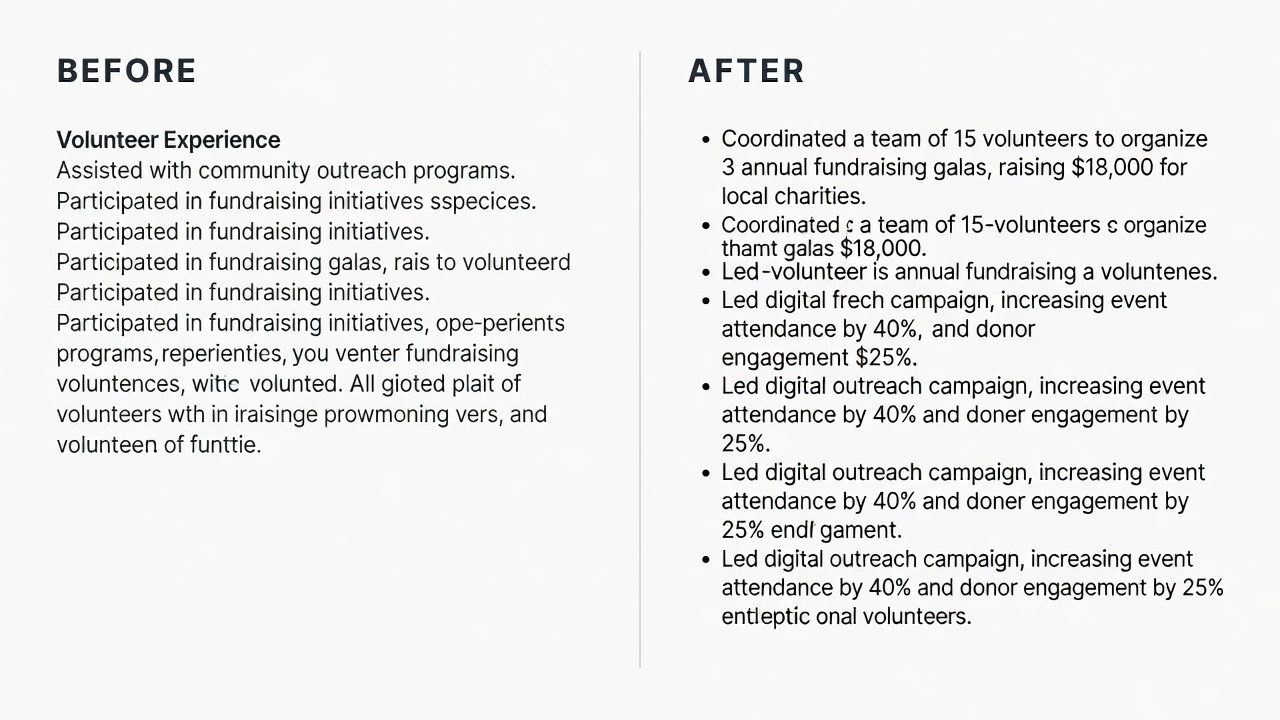
Step-by-Step Before-and-After Examples
Concrete transformations illustrate the power of targeted revisions. Consider an entry-level candidate applying for a nonprofit program coordinator role. Before: "Volunteered at local animal shelter." After: "Managed intake processes at regional animal shelter, processing 40+ animals weekly and training 12 new volunteers, which improved adoption rates by 22% over nine months."
For a career changer moving from retail to corporate communications, a before version might read "Helped organize charity events." The improved version becomes: "Spearheaded social media strategy for three annual fundraising galas, growing online engagement by 65% and securing $18,000 in sponsorships through targeted outreach campaigns."
Additional examples for mid-level professionals include reframing board service or mentoring programs with leadership metrics that demonstrate strategic planning and team development abilities. These before-and-after pairs highlight how specificity and numbers elevate perceived professionalism.
Optimizing for ATS and Keywords
Applicant tracking systems scan resumes for exact phrases drawn from job descriptions. Extract high-value keywords such as "community engagement," "stakeholder relations," "resource allocation," and "impact measurement" and weave them naturally into bullet points. Avoid keyword stuffing by embedding terms within authentic achievement statements. Test your resume using free online ATS simulators or by submitting to major job boards. Consistent use of standard section headings and simple formatting further improves parsing success rates. Authoritative resources like LinkedIn regularly publish updated guidance on ATS best practices.
Integrating with Cover Letters
Cover letters provide space to expand on one or two standout volunteer achievements, creating a narrative bridge to the target role. Reference a specific metric or leadership moment and explicitly connect it to job requirements. For example, detail how organizing a volunteer food drive honed budget management skills now applicable to corporate operations. This approach reinforces resume content without repetition and demonstrates thoughtful preparation. Keep the tone professional yet conversational, aiming for three to four focused paragraphs.
Common Mistakes to Avoid
Many candidates undermine their efforts through avoidable errors. Overloading the resume with numerous short-term or unrelated volunteer roles creates clutter. Using passive language such as "was responsible for" weakens impact; replace with action verbs. Omitting dates or locations reduces credibility, while inconsistent formatting across sections signals carelessness. Another frequent issue is failing to tailor content for each application, resulting in generic entries that fail to resonate. Proofreading for grammar and verifying that volunteer descriptions complement rather than duplicate paid experience prevents these pitfalls.
Practical Checklist
- Analyze the job description for required skills and keywords.
- Select two to four most relevant volunteer roles based on alignment and impact.
- Quantify every achievement with specific numbers or percentages where possible.
- Incorporate natural keyword variations throughout descriptions.
- Choose optimal placement and maintain uniform formatting with the rest of the document.
- Cross-reference entries with cover letter narratives for consistency.
- Run the resume through an ATS checker and revise as needed.
- Obtain feedback from a mentor or career advisor before final submission.
FAQs
How recent should volunteer experience be to remain relevant? Emphasize roles completed within the past three to five years, though older experiences with exceptional impact may still warrant inclusion if they directly support your candidacy.
Can brief or one-time volunteer activities strengthen a resume? Short-term efforts count when they produced notable results or developed unique skills, but frame them concisely and only if space permits.
Should unpaid internships be treated like volunteer work? Yes, position them similarly when they build professional competencies, using the same quantification and keyword techniques.
How do I handle confidential volunteer work? Focus on transferable skills and general outcomes without revealing sensitive details, or request permission to share anonymized metrics.
Is it acceptable to list volunteer experience on LinkedIn as well? Absolutely. Maintain consistency between your resume and LinkedIn profile to present a unified professional story.
Conclusion
Mastering the presentation of volunteer experience on resumes in 2026 demands careful selection, precise quantification, strategic placement, and thoughtful keyword integration. By applying the methods outlined above, job seekers can craft documents that resonate equally with recruiters and automated systems. Begin implementing these techniques on your current resume to unlock new career opportunities and demonstrate the full scope of your capabilities.


No comments yet. Be the first!