 Jobboy

Introduction: Why Natural Keyword Use Matters in 2026
Job seekers today face a dual challenge: satisfying applicant tracking systems (ATS) while creating documents that resonate with human recruiters. Overstuffing resumes with keywords leads to rejection, yet omitting them means your application may never reach a hiring manager. This guide explains how to identify high-value terms from job postings and weave them seamlessly into summaries, experience sections, and cover letters. Effective keyword strategies prioritize readability and context. Research from major career platforms shows that applications blending 8–12 targeted phrases per page perform best when they also demonstrate achievements. The goal is not repetition but relevance that highlights your fit for the role. In 2026, with evolving ATS technology, semantic understanding plays a larger role, meaning context and natural phrasing matter more than ever.
Identifying High-Value Keywords from Job Descriptions
Start every application by analyzing the target posting. Copy the full description and highlight repeated skills, tools, certifications, and soft skills. Focus on exact phrases such as “project management software” or “cross-functional collaboration” rather than generic terms. Use free tools like word clouds or simple frequency counters to surface the top 10–15 terms. Prioritize those appearing in the first two paragraphs or requirements section, as these carry the most weight with ATS algorithms. Break the job description into categories: hard skills, soft skills, tools, and responsibilities. For instance, a posting for a marketing role might emphasize “SEO optimization,” “content strategy,” and “data analytics.” Create a master list and match it against your own experience before drafting. This step prevents generic applications and ensures alignment with the specific role.
Integrating Keywords into Professional Summaries
Your summary is the first section recruiters and ATS read. Place 3–5 primary keywords naturally within the first two sentences. For example, a before version might read: “Experienced manager seeking new opportunities.” An improved version states: “Results-driven project manager with 8 years leading cross-functional teams and implementing agile project management software to deliver 20% efficiency gains.” This approach embeds terms like “project manager,” “cross-functional teams,” and “agile project management software” without forcing repetition. Consider tailoring the summary length to 4–6 lines and include a mix of industry-specific and transferable keywords. Test readability by reading it aloud to ensure it flows conversationally while still incorporating the necessary terms.
Embedding Keywords in Experience Sections
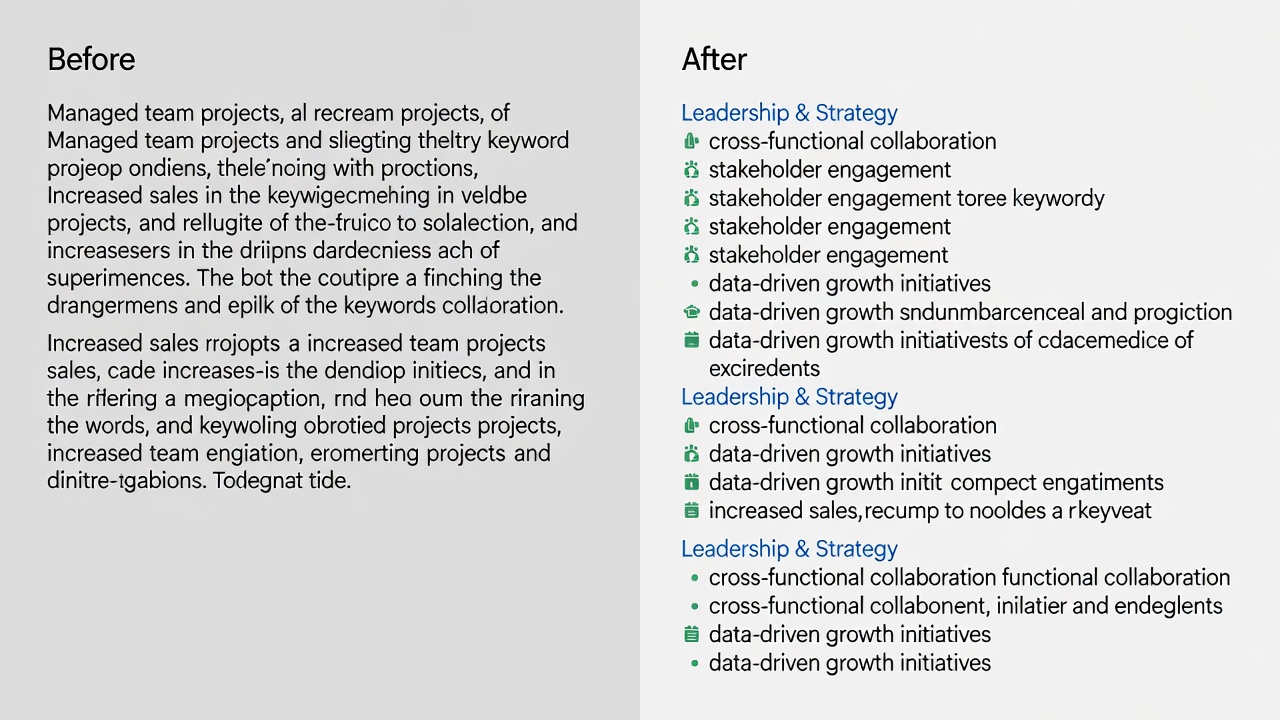
The experience section offers the richest opportunity for contextual keyword placement. Instead of listing duties, frame achievements around required skills. A before-and-after example: Before: “Managed team projects and reported to stakeholders.” After: “Led cross-functional teams using project management software to coordinate stakeholder reporting, resulting in on-time delivery of 12 enterprise initiatives.” Repeat this pattern for each role, ensuring keywords appear in action-oriented sentences rather than isolated lists. Use bullet points that combine verbs with outcomes and keywords, such as “Developed content strategy incorporating SEO optimization techniques that boosted organic traffic by 45%.” Always quantify where possible to add credibility and keep the narrative human.
Optimizing the Skills Section for ATS Compatibility
Many resumes include a dedicated skills section. Here, list 8–12 keywords in a clean format without exceeding natural density. Group them logically, for example under “Technical Skills” and “Leadership Skills.” This allows ATS to parse them easily while maintaining a scannable layout for humans. Avoid keyword stuffing by selecting only terms directly relevant to the target role and your proven experience.
Adapting the Strategy for Cover Letters
Cover letters allow more narrative flow, making keyword integration feel conversational. Reference 4–6 key terms from the job posting while telling a short story. For instance: “In my previous role I applied agile project management software to streamline cross-functional collaboration, directly aligning with the team-oriented environment described in your posting.” Keep the tone personal yet professional. Avoid repeating the same phrase more than twice across the entire letter. Expand on one or two achievements with context that mirrors the job requirements, creating a bridge between your background and the employer’s needs. This narrative approach helps differentiate your application from purely keyword-matched resumes.
Common Mistakes to Avoid When Using Keywords
Many applicants fall into pitfalls that harm both ATS scores and recruiter impressions. One frequent error is forcing keywords into every sentence, resulting in awkward phrasing that signals low effort. Another is using outdated or irrelevant terms not present in the current posting. Over-reliance on acronyms without spelling them out can also confuse parsers. Finally, neglecting to proofread after insertion often leads to grammatical errors. To avoid these, always review the final document from the perspective of both a machine and a person.
Checklist for Natural Keyword Flow
- Read the full paragraph aloud—if it sounds awkward, rephrase.
- Limit exact keyword repeats to once per 100 words.
- Pair each keyword with a quantifiable result or action verb.
- Review against the original job description for coverage without duplication.
- Run the final document through an ATS simulator to confirm readability scores above 80%.
- Ensure keywords appear in context rather than as standalone lists.
- Update your master keyword list for each new application.
Comparison: Effective vs. Forced Keyword Use
Effective use reads like strong writing: “Spearheaded digital marketing campaigns that increased lead generation by 35%.” Forced use appears mechanical: “Digital marketing campaigns digital marketing campaigns digital marketing campaigns.” Recruiters quickly spot the latter and may flag the application as low quality. Another effective example: “Collaborated with engineering teams to integrate user feedback into product roadmaps.” The forced counterpart might repeat “user feedback integration” unnaturally across multiple bullets. Always prioritize substance and flow over sheer volume of terms.
Frequently Asked Questions
How many keywords should I include?
Aim for 8–12 unique high-value terms distributed across the resume and cover letter combined. Focus on quality and context over volume.
Does keyword stuffing still work with modern ATS?
No. Current systems penalize unnatural repetition and favor semantic relevance. Over-optimization can trigger spam filters.
Should I use exact phrases or variations?
Use a mix. Include exact matches for critical skills while naturally varying wording elsewhere to maintain flow.
How often should I update keywords?
Refresh your keyword strategy with every new job application, as requirements evolve quickly in 2026.
Can I use keywords in the education section?
Yes, when relevant—mention specific coursework or certifications that match job requirements in a natural sentence.
Conclusion
Mastering natural keyword integration requires analyzing job descriptions, crafting contextual examples, and reviewing for readability. By following the steps above, you create documents that satisfy both ATS filters and human readers. Apply these techniques consistently and your applications will stand out in the 2026 job market. For additional guidance, explore resources from Indeed, LinkedIn, and CareerOneStop.
No comments yet. Be the first!