 Jobboy

Introduction: Why Transferable Leadership Matters for Career Changers in 2026
Mid-career professionals pivoting industries often face the challenge of proving leadership without relying on formal titles from their previous field. In 2026, hiring managers and applicant tracking systems (ATS) prioritize demonstrated impact over job titles. This guide explores proven methods to map past achievements to new roles, optimize for keywords, and avoid common pitfalls. Effective resumes in today's market translate cross-industry skills into language that resonates with target employers. According to resources from the U.S. Department of Labor, transferable competencies like team guidance and strategic decision-making remain highly valued across sectors. Career changers who master this approach stand out by focusing on results rather than responsibilities, creating resumes that tell a cohesive story of adaptable leadership.
Mapping Past Achievements to New Roles
Begin by auditing your experience through the lens of the target industry. Identify core leadership behaviors such as mentoring teams, driving process improvements, or managing budgets, then align them with job descriptions. Create a skills matrix that connects old accomplishments to new requirements. For example, a retail manager transitioning to tech might reframe staff scheduling as resource allocation and stakeholder coordination. This mapping ensures your resume speaks directly to the new context rather than listing generic duties. Consider a healthcare administrator moving into finance: past experience overseeing compliance audits can translate to risk management and regulatory leadership. Spend time reviewing multiple job postings in your target field to spot recurring themes like "driving cross-functional initiatives" or "building high-performing teams." Document specific metrics from your history, such as team sizes led or efficiency gains achieved, and rewrite them without industry-specific jargon.
Practical Exercise for Achievement Mapping
Start with a simple table exercise. List five major accomplishments on the left and target role requirements on the right. Draw lines connecting overlapping skills. This visual method reveals hidden transferable elements and prevents you from undervaluing experiences that seem unrelated at first glance.
ATS-Friendly Phrasing and Keyword Optimization
ATS software scans for exact matches to keywords from 2026 job postings. Incorporate terms like "cross-functional leadership," "change management," and "strategic initiative ownership" naturally throughout your document. Avoid jargon specific to your old industry; instead, use neutral, high-impact verbs such as "orchestrated," "facilitated," and "optimized." Place primary keywords in the professional summary, skills section, and the first bullet under each role. Tools like O*NET from the Department of Labor can help identify emerging phrases for your target occupation. In 2026, trends emphasize hybrid leadership involving remote collaboration tools and data-informed decision making, so weave in phrases such as "virtual team leadership" or "data-driven process improvement" where authentic to your background.
Quantifiable Impact Examples: Before-and-After Bullets
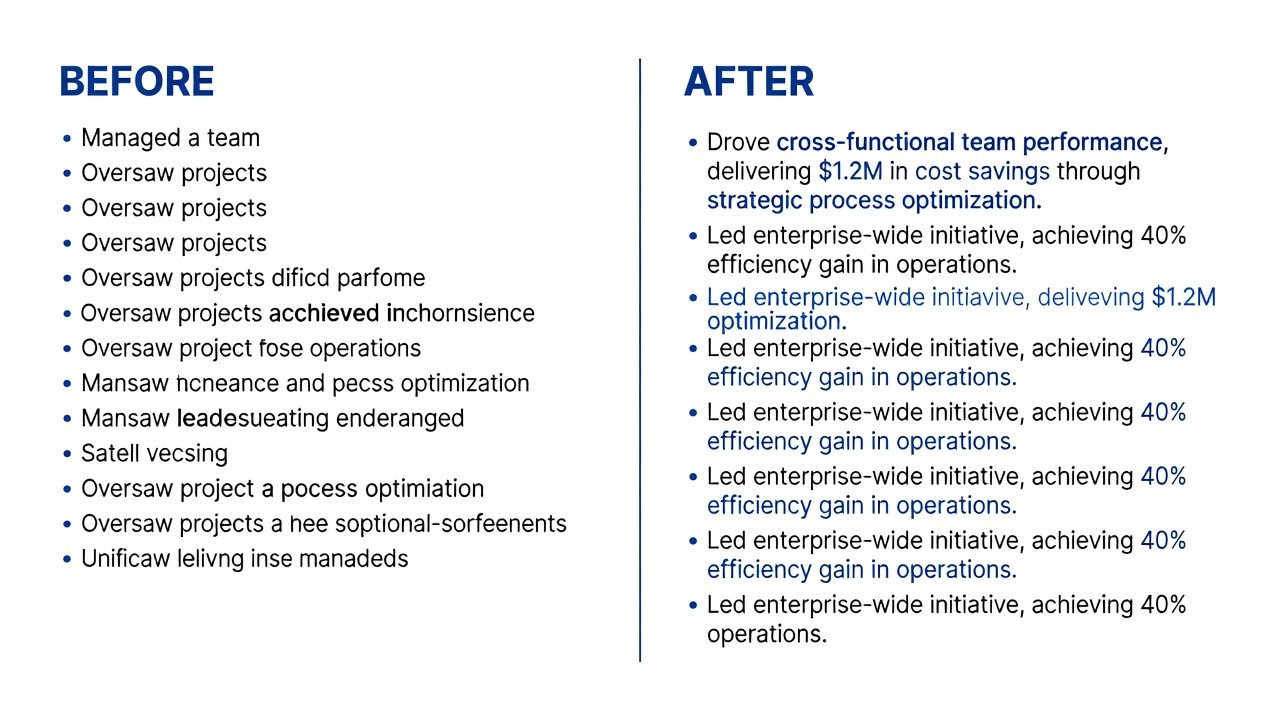
Strong bullet points always include metrics. Here are real transformations across industries:
- Before: "Led team meetings and handled customer issues." After: "Orchestrated weekly cross-functional meetings for a 12-person team, resolving 85% of escalations within 48 hours and improving retention by 22%."
- Before: "Managed projects and trained new staff." After: "Directed end-to-end project delivery across three departments, training 18 new hires and reducing onboarding time by 30% while achieving 95% on-time completion rates."
- Before: "Supervised inventory and vendor relations." After: "Led vendor negotiations and inventory optimization for a $1.2M annual budget, cutting costs by 18% and strengthening supplier partnerships through quarterly performance reviews."
- Before: "Coordinated community outreach events." After: "Spearheaded outreach campaigns engaging 500+ stakeholders annually, increasing program participation by 40% and securing three new corporate sponsorships."
These revisions shift focus from tasks to measurable leadership outcomes that transfer across industries. Always quantify where possible, even if estimates require conservative rounding.
Step-by-Step Framework for Highlighting Leadership
- Audit your top five achievements using the STAR method (Situation, Task, Action, Result). Expand each element with specific context from your career history.
- Translate each result into industry-agnostic language by removing acronyms and replacing them with universal terms.
- Quantify where possible with percentages, dollar amounts, or time savings, verifying numbers against old performance reviews.
- Integrate leadership keywords from target job postings by scanning five to ten recent listings and noting the most repeated phrases.
- Review for ATS compatibility by testing with free online scanners and adjusting formatting to avoid tables or graphics that confuse parsers.
- Iterate based on feedback from industry peers or career coaches, incorporating suggestions that strengthen the pivot narrative.
- Finalize by tailoring slightly for each application while maintaining a core version that highlights your leadership arc.
Apply this framework consistently across your resume to build a compelling narrative of portable leadership. Revisit the steps quarterly as your experience grows.
Common Pitfalls to Avoid
Many career changers make these errors: over-relying on old industry acronyms that confuse new readers, burying leadership examples in dense paragraphs instead of crisp bullets, or failing to address employment gaps proactively. Another frequent mistake is using passive language instead of action-oriented statements. Always lead with the outcome and keep bullets under two lines for scannability. Avoid listing every past responsibility; instead, curate only those that demonstrate leadership transferability. Do not downplay volunteer or side-project leadership, as these often provide powerful examples when formal titles are absent. Finally, resist the urge to copy generic templates without customization, which can make your resume blend in rather than stand out.
Integration with Cover Letters and 2026 Hiring Trends
Your cover letter should expand on one or two standout leadership examples from the resume, connecting them explicitly to the new role's challenges. In 2026, employers increasingly value adaptability and hybrid skill sets. Reference emerging trends such as AI-assisted decision making or remote team leadership to demonstrate forward-thinking capability. Use the cover letter to explain your pivot motivation briefly while emphasizing how past leadership equips you for success. For instance, describe how managing diverse teams prepared you for cross-industry collaboration. Link to authoritative guidance from Bureau of Labor Statistics for labor market insights that support your pivot narrative. Align your documents so the resume provides evidence and the letter provides context.
Handling Employment Gaps and Final Checklist
Address employment gaps by highlighting productive activities such as skill-building courses, freelance projects, or volunteer leadership roles. Frame gaps as periods of intentional preparation for your career transition. Download our free checklist covering resume audits, keyword lists, and gap explanations to streamline your process.
Frequently Asked Questions
How do I explain employment gaps on a resume? Focus on skill-building activities during the gap and frame them as intentional preparation for your career transition. Should I include volunteer leadership? Yes, when it demonstrates relevant competencies such as team coordination or project oversight. What if my leadership experience is limited? Emphasize informal leadership moments like mentoring colleagues or leading small initiatives within larger teams. How many leadership examples should appear? Aim for two to three strong examples per role, prioritizing quality and relevance over quantity.
Conclusion
Mastering the art of showcasing transferable leadership transforms career changer resumes into powerful tools for 2026 opportunities. By mapping achievements, optimizing phrasing, and following structured frameworks, you position yourself as a versatile leader ready for new industries. Apply these tactics consistently and refine based on feedback to achieve your pivot goals.

No comments yet. Be the first!