 Jobboy

Introduction: Why Mental Models Matter in 2026 Career Challenges
Mid-career professionals in tech and management frequently encounter setbacks including missed promotions, stalled projects, or unsuccessful networking attempts amid the rapid evolution of AI-driven workplaces and hybrid team structures in 2026. Traditional resilience advice such as maintaining a positive mindset or simply persisting often proves insufficient because it overlooks underlying cognitive biases like loss aversion and confirmation bias. Mental models drawn from decision science, including inversion, antifragility, and second-order thinking, offer structured frameworks to reframe these experiences into actionable insights. This comprehensive guide examines how these models enable professionals to rebound effectively, providing step-by-step frameworks, detailed real-world examples from tech environments, reflection exercises, and strategies for integration into daily career practices.
By applying these models, individuals can systematically debias their thinking and convert temporary obstacles into catalysts for long-term advancement. The focus remains on mid-career audiences seeking practical techniques rather than abstract theory.
Understanding Key Mental Models for Career Recovery
Inversion requires reversing the typical problem-solving direction by starting from the undesired outcome and working backward to prevent it. Antifragility refers to systems that not only withstand stress but actually improve because of it, a concept explored in depth at Farnam Street. Second-order thinking extends analysis beyond immediate effects to consider subsequent consequences and ripple impacts. These models address 2026-specific challenges such as rapid role changes due to technological disruption. For example, a missed promotion can activate loss aversion, causing overemphasis on the immediate loss while undervaluing emerging opportunities in adjacent skill areas.
Applying Inversion to Missed Promotions
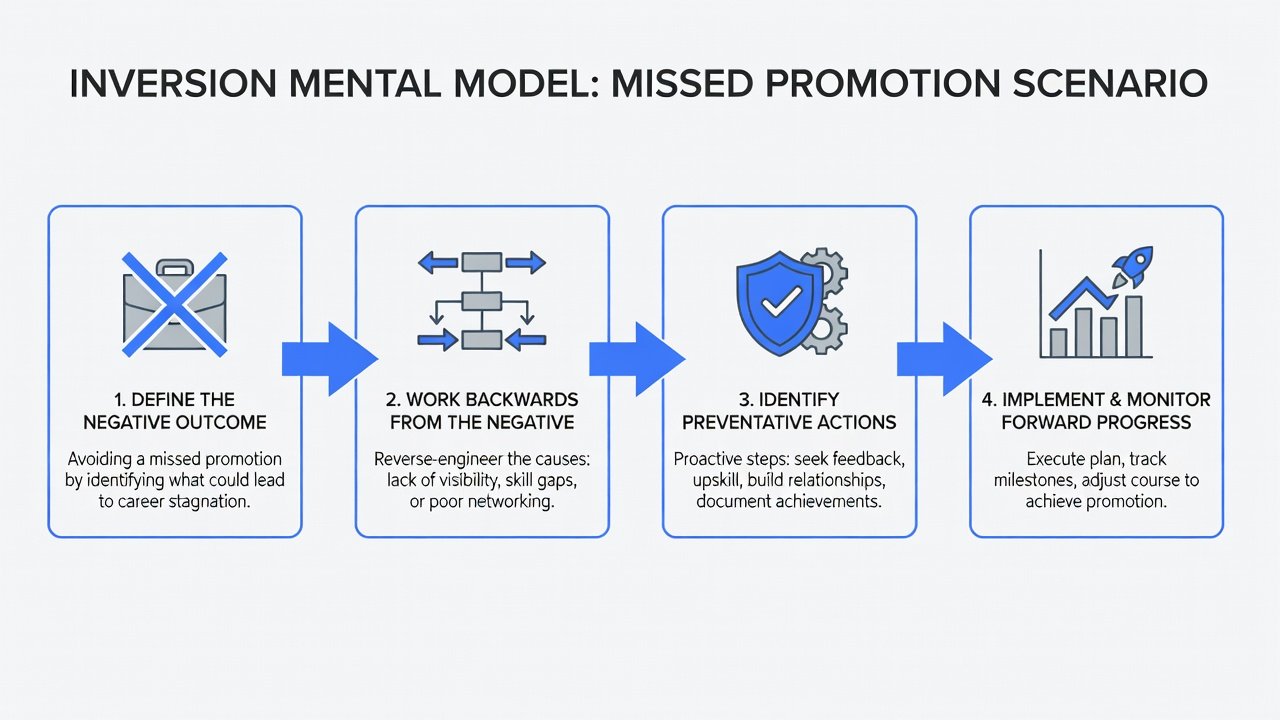
The inversion framework begins with clearly defining the desired end state, such as securing a senior leadership position within 18 months. Next, enumerate all plausible actions or inactions that would block this outcome, including insufficient executive visibility, neglecting cross-functional alliances, or failing to quantify impact in performance reviews. Finally, invert each blocker into positive countermeasures and prioritize them by feasibility. A detailed example involves a senior product manager at a mid-sized SaaS company who missed a director-level promotion. By inverting, she identified that 60 percent of her time was consumed by operational tasks rather than strategic initiatives. She then implemented a weekly audit process to reallocate time, resulting in three high-visibility projects completed over the next quarter and a successful promotion in the subsequent cycle. This method generates specific, testable actions that surpass generic resilience recommendations by focusing on prevention and optimization.
Building Antifragility After Failed Networking Attempts
Conventional approaches might encourage increasing outreach volume, yet antifragility emphasizes constructing networks that derive strength from rejection and variability. Begin by mapping existing connections and classifying them by interaction quality. Then design recurring value-creation mechanisms, such as hosting monthly virtual knowledge exchanges or contributing targeted insights to industry forums. Track outcomes over multiple quarters to identify which interactions compound into unexpected advantages. Consider the case of a mid-level engineering manager whose attempt to connect with a prominent venture capitalist at a 2026 industry event was ignored. Instead of repeated direct outreach, he established a small peer discussion group focused on emerging AI ethics topics. Within four months, two members introduced him to new opportunities, and the group itself became a resilient professional asset that continued generating leads even during market downturns. Resources like those at Harvard Business Review highlight similar network redesign principles for sustained career resilience.
Second-Order Thinking for Long-Term Career Planning
Second-order thinking requires pausing after an initial reaction to map layered consequences. Following a setback, the first-order response might involve immediately revising a resume or seeking new roles. The second-order layer examines how such actions influence perceptions among current colleagues, affect ongoing projects, or shape future negotiation leverage. A practical reflection exercise involves dedicating 20 minutes after each significant event to document three tiers of potential outcomes: immediate effects, medium-term shifts in reputation or skills, and long-term trajectory alterations. Professionals who adopt this habit report fewer reactive decisions and more deliberate career moves, particularly valuable in 2026's volatile tech hiring climate.
Debiasing Loss Aversion in Professional Contexts
Loss aversion often leads professionals to fixate disproportionately on what was not achieved. To counter this, implement a structured awareness exercise: after identifying the perceived loss, generate a parallel list of three equivalent or superior opportunities created by the same event, such as redirected time toward certifications or exploration of adjacent roles. Review both lists side by side during weekly planning sessions to recalibrate emotional weighting. Extended example: A data science lead who lost a team expansion budget reframed the situation by noting it freed capacity to pursue advanced machine learning training, ultimately leading to a more competitive profile for external opportunities.
Comparing Mental Models to Traditional Resilience Advice
- Traditional resilience emphasizes endurance and mindset adjustments such as daily gratitude practices, which can provide short-term emotional relief but rarely address systemic flaws.
- Mental models supply diagnostic precision by revealing root causes and enabling hypothesis-driven experiments for improvement.
- Traditional methods focus on individual persistence, while mental models promote redesign of personal systems so that future stressors yield net positive development.
- Combining both approaches accelerates recovery, yet mental models consistently deliver superior strategic depth according to decision-making research.
Common mistakes to avoid include applying inversion superficially without follow-through measurement or confusing antifragility with mere toughness rather than adaptive system building.
Integrating These Models Into LinkedIn Updates and Career Planning Sessions
Translate inversion insights into LinkedIn content by sharing threads that detail avoided pitfalls leading to recent wins, which positions the author as strategic rather than reactive. For antifragility narratives, document specific failures that prompted capability expansions and resulting opportunities. During quarterly career planning sessions, incorporate second-order prompts such as evaluating how a proposed skill investment might alter team dynamics or industry positioning over 12 months. These practices reinforce personal mastery while enhancing professional visibility and attracting aligned opportunities.
Conclusion
Mental models equip 2026 professionals with tools to convert career setbacks into structured learning and growth engines. Consistent application of inversion, antifragility, and second-order thinking fosters careers that strengthen through challenge rather than merely surviving it.
FAQ
How do I measure progress after applying these models?
Establish quarterly metrics including the number of completed inversion audits, documented antifragile network expansions, and second-order consequence reviews. Compare pre- and post-application networking success rates and promotion-related milestones over six- to twelve-month intervals to quantify advancement.
Can these models replace traditional coaching?
They function best as complements to coaching, adding analytical frameworks that coaches can help tailor to individual contexts for compounded effectiveness.
Are these techniques suitable only for tech roles?
The underlying principles apply broadly across management and professional fields where biases influence advancement, though examples here emphasize tech and management settings for relevance.
What common pitfalls occur when first adopting these models?
Over-analysis without action and neglecting to review past applications for refinement are frequent early errors; mitigate them by setting strict time bounds on reflection and scheduling periodic retrospectives.

No comments yet. Be the first!