 Jobboy

Introduction: Why First-Order Thinking Falls Short in 2026 Careers
Navigating career transitions in 2026 demands more than reacting to immediate opportunities like a quick promotion or salary bump. Second-order thinking encourages professionals to map out the chain of consequences that follow an initial decision. This approach reveals hidden risks and opportunities that first-order thinkers overlook, especially in fast-evolving fields like tech and management. In an era marked by rapid AI adoption and shifting workplace norms, reactive choices often lead to regret years later. Professionals who master this mindset position themselves for sustainable success rather than short-lived gains.
Many professionals chase surface-level wins without considering downstream effects. A job switch for higher pay might disrupt long-term skill development or network stability. By applying second-order thinking, you can build resilient career paths that align with emerging trends such as AI integration and hybrid work models. This framework becomes essential when evaluating internal mobility or upskilling investments that span multiple years.
What Is Second-Order Thinking?
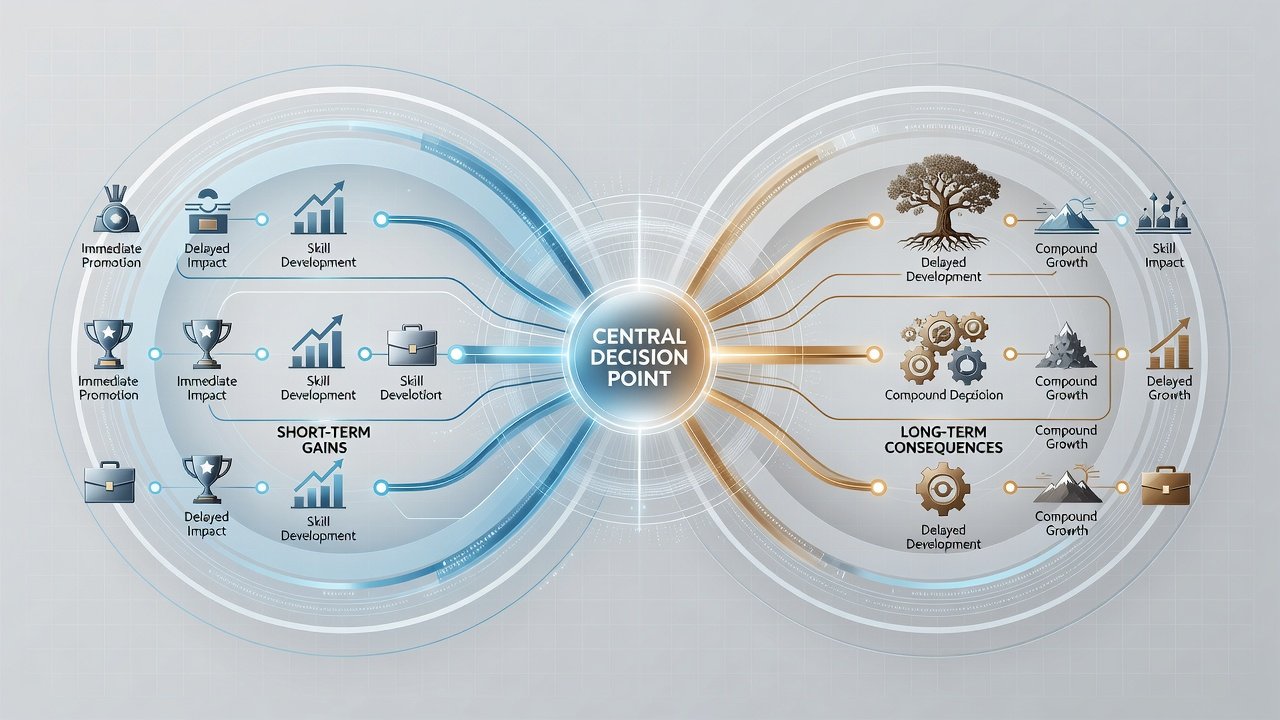
Second-order thinking examines not just the direct result of an action but the subsequent effects that ripple outward. First-order thinking stops at the obvious outcome, while second-order analysis asks, “And then what?” This framework draws from systems thinking and helps avoid unintended consequences in complex environments like corporate hierarchies or tech ecosystems. It encourages mapping both positive and negative chains across personal, professional, and market dimensions.
For example, accepting a management role might seem like a clear step up. Second-order thinkers consider how it affects work-life balance, future technical expertise, and team dynamics over three to five years. They also factor in how the role evolves as companies restructure or adopt new technologies. This depth prevents decisions that solve today’s problem while creating tomorrow’s larger issues.
Common First-Order Pitfalls in Career Decisions
Chasing quick raises often leads to burnout or stalled growth. Professionals may overlook how frequent job hops erode internal trust or limit access to high-visibility projects. In tech roles, jumping to a new startup for equity without evaluating market volatility can result in lost stability and diminished learning opportunities. Another common trap involves pursuing titles that inflate ego but reduce hands-on influence over time.
Management transitions carry similar traps. Moving into leadership without assessing long-term leadership fatigue or skill atrophy in core domains frequently backfires. These pitfalls highlight why reactive decisions rarely deliver sustained success. First-order thinkers also ignore how personal biases like recency effect amplify poor choices during uncertain economic periods.
Real-World Examples from Tech and Management Roles
Consider a software engineer in 2026 who accepts a senior role at a high-growth AI company. First-order thinking celebrates the title and compensation. Second-order analysis reveals potential isolation from cutting-edge coding work, increased meeting load, and vulnerability if the company pivots strategy. The engineer might later struggle to return to individual contributor paths after years focused on oversight.
In management, a mid-level leader might pursue an internal promotion to director. Second-order thinkers evaluate how this affects cross-functional relationships, future mobility to other industries, and the ability to maintain hands-on influence. They anticipate how team members might react to leadership changes and plan retention strategies accordingly. A third example involves a product manager switching industries: immediate excitement masks the learning curve and lost domain expertise that could delay future advancement.
Step-by-Step Exercises to Build Second-Order Thinking
- Identify the immediate decision and its obvious outcome, writing it down clearly.
- Map first-order effects, including short-term gains and losses across financial, skill, and relational areas.
- Project second-order consequences over 12–36 months, considering industry shifts and personal goals such as family or relocation plans.
- Extend to third-order effects if the decision creates systemic changes like altered career trajectories or network realignments.
- Stress-test assumptions with data from peers or market reports and revisit the map after one month.
Repeat this exercise quarterly when reviewing career plans. Journaling outcomes helps refine intuition over repeated cycles.
Decision Checklists for Career Moves
- Does this choice enhance skills that remain relevant beyond 2028?
- How might this affect my professional network and reputation in both positive and negative ways?
- What opportunity costs arise in terms of time, energy, or relationships that could compound?
- Are there hidden risks from market trends or company culture that second-order effects might amplify?
- Would this decision still feel right if conditions change in 18 months or if key stakeholders depart?
- Have I considered inversion by identifying what I want to avoid long-term?
Comparisons to Inversion and Opportunity Cost Models
Inversion thinking starts by identifying what to avoid, such as career stagnation or regret. Combined with second-order analysis, it strengthens risk assessment. Opportunity cost models quantify what you forgo by choosing one path. Second-order thinking adds depth by exploring how those forgone options evolve over time and interact with external variables.
Unlike pure opportunity cost calculations, second-order thinking incorporates qualitative factors like personal fulfillment and industry evolution. Professionals who blend these approaches make more robust decisions. Resources from Harvard Business Review and McKinsey & Company provide further frameworks for integrating these mental models effectively.
Practical Applications in Networking, Upskilling, and Internal Mobility
Networking benefits from second-order thinking when you prioritize relationships that compound value rather than immediate referrals. Focus on mentors who open doors years ahead and consider how each connection influences your reputation trajectory. In practice, this means attending fewer but more strategic events while nurturing existing ties through thoughtful follow-ups.
Upskilling investments require evaluating not just today’s in-demand tools but how skills like systems thinking or ethical AI will scale. Allocate time to courses that build foundational capabilities rather than chasing every certification trend. Internal mobility decisions improve when you weigh how a lateral move builds influence for future promotions and creates options across departments.
These applications help professionals stay ahead in competitive 2026 landscapes by turning everyday choices into strategic advantages.
Conclusion: Making Second-Order Thinking a Career Habit
Adopting second-order thinking transforms reactive career moves into strategic, future-proof choices. By consistently mapping ripple effects, you reduce regret and maximize long-term impact. Start small with one upcoming decision and expand the practice across your professional life. Over time, this habit distinguishes high-performing leaders from those who repeatedly face avoidable setbacks.
FAQs
How do I assess risk when using second-order thinking?
Begin by listing potential second- and third-order outcomes, then assign probability and impact scores. Consult trusted advisors for external perspectives to counter personal bias and revisit the assessment after new information emerges.
What biases commonly interfere with this framework?
Confirmation bias and short-termism often distort analysis. Counter them by deliberately seeking disconfirming evidence and extending your time horizon beyond two years. Regular reflection sessions further reduce these influences.
Can second-order thinking apply to job offers received during economic uncertainty?
Yes. Map how accepting or declining affects long-term market positioning, skill relevance, and financial runway. Consider how the role’s stability might shift if broader industry conditions deteriorate within 24 months.

No comments yet. Be the first!