 Jobboy
Introduction
In today’s competitive job market, awards and honors on a resume provide concrete evidence of your professional excellence, leadership, and dedication. As we move into 2026, recruiters and hiring managers continue to scan resumes quickly, often spending less than 10 seconds on an initial review. Strategically listing awards can immediately elevate your application by demonstrating peer recognition, industry impact, and measurable success. This comprehensive guide builds on established best practices for showcasing achievements such as patents, publications, and presentations, but applies them specifically to awards and honors. Whether you are a recent graduate or a seasoned executive, understanding how to present these accolades effectively can significantly improve your chances of landing interviews.
Why Awards and Honors Matter on Modern Resumes
Awards serve as third-party validation of your skills and contributions. In 2026, with increasing use of artificial intelligence in recruitment, employers value verifiable accomplishments that stand out from standard job descriptions. Including relevant honors helps you pass both human and automated screens by highlighting qualities like innovation, teamwork, and results orientation. Research from job platforms shows that candidates who quantify achievements through awards see higher response rates. However, simply listing every certificate you have ever received can backfire by making your resume appear cluttered or unfocused.
Strategic Placement Options on Your Resume
Choosing the right location for your awards section depends on your career level, the relevance of the honor, and the overall flow of your document. For entry-level candidates or those changing careers, creating a dedicated “Awards & Honors” section immediately after Education often works best because it draws attention to standout accomplishments early. Mid-level professionals may prefer embedding awards within their Professional Experience section to tie them directly to specific roles and outcomes.
Placement by Career Stage
- Entry-level and recent graduates: Place near the top, right after Education, to compensate for limited work history.
- Mid-career professionals (5–15 years experience): Integrate awards into individual job entries or create a concise “Selected Achievements” section at the bottom.
- Senior executives: Feature only the most prestigious national or international honors in a brief executive summary or dedicated leadership section.
- Industry switchers: Position awards that demonstrate transferable skills prominently, even if they come from a different field.
Always list the most impressive and recent awards first within any section to maximize impact.
ATS-Friendly Formatting Techniques
Applicant Tracking Systems remain a critical gatekeeper in 2026. To ensure your awards are parsed correctly, use standard section headings such as “Awards and Honors” or “Recognition.” Avoid tables, columns, text boxes, or special characters that ATS software may misread. Incorporate relevant keywords from the job description naturally, such as “industry award,” “national honor,” or specific award names that match employer language. Bullet points should be simple and start with action verbs or the award title itself.
Citation Styles and Consistent Formatting
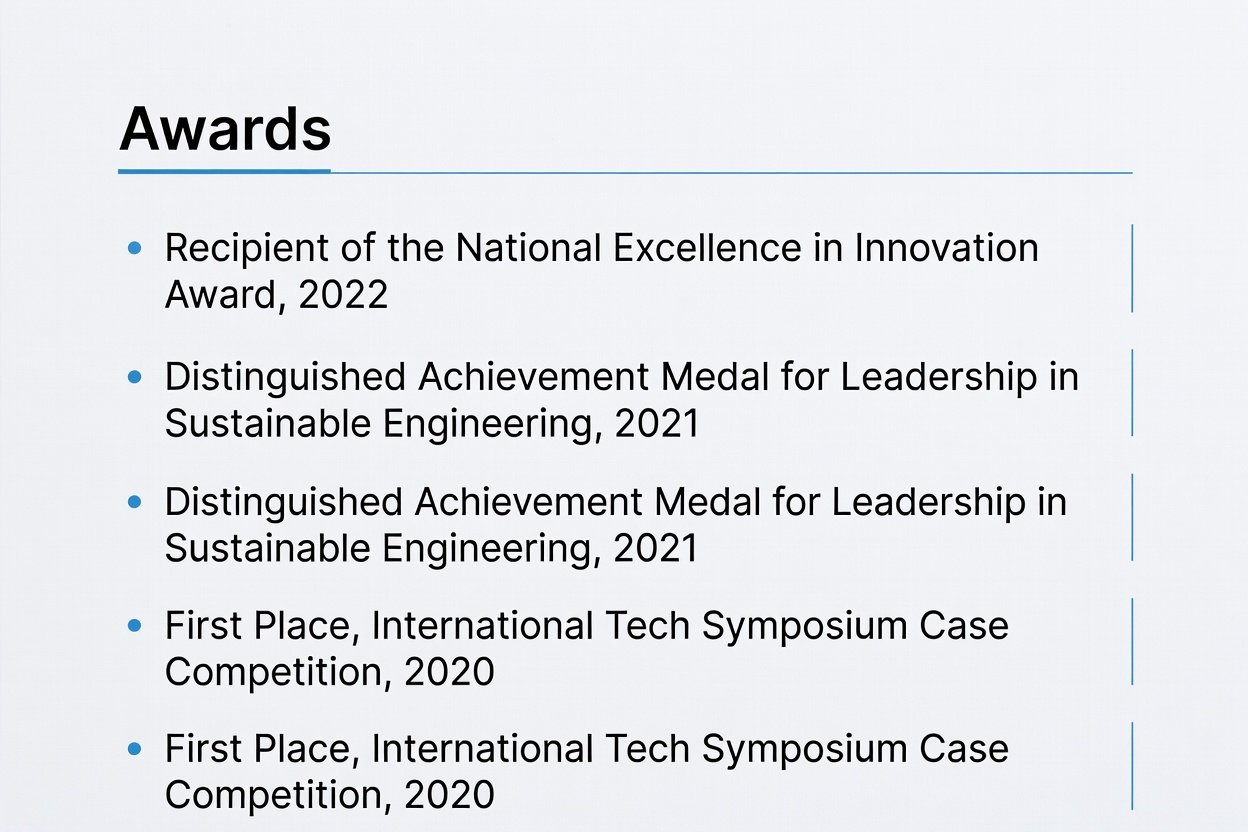
Consistency builds credibility. Use this reliable format for each entry: Award Name – Issuing Organization – Year – One-line impact statement. For instance: “Marketing Excellence Award – American Marketing Association – 2025 – Led campaign that increased brand engagement by 45% across digital channels.” If the award is highly prestigious, you may add a short parenthetical note about selection criteria, such as “selected from 2,000 nominees.” Never use abbreviations unless they are universally recognized in your industry.
Methods to Quantify Impact and Add Depth
The most compelling award listings go beyond the title by including measurable results. Replace vague statements with data-driven descriptions. Instead of “Received employee award,” write “Earned Top Performer Award for generating $1.2 million in new revenue in Q3 2025.” When exact numbers are unavailable, use relative metrics such as “ranked in top 5% of 500 employees” or “recognized among 200 global submissions.” This approach transforms a simple line into powerful evidence of your value.
Real-World Examples Across Major Industries
Technology: “Google Cloud Innovator of the Year – Google – 2025 – Developed AI solution adopted by 12 enterprise clients.”
Healthcare: “Nurse of Distinction Award – American Nurses Association – 2024 – Improved patient satisfaction scores by 28% through new care protocols.”
Finance: “CFA Society Leadership Award – CFA Institute – 2025 – Mentored 15 junior analysts, resulting in 90% certification pass rate.”
Education: “Teacher of the Year – National Education Association – 2025 – Designed curriculum used by 40 school districts nationwide.”
Creative Fields: “Cannes Lions Bronze Award – Cannes Lions International Festival of Creativity – 2025 – Campaign reached 50 million viewers and boosted client sales by 22%.”
Comprehensive Checklist for Selecting Which Honors to Feature
- Does the award directly relate to the target job’s required skills or values?
- Was the honor received within the last five to seven years?
- Is the issuing organization widely respected in your industry or region?
- Can you quantify the achievement with numbers or percentages?
- Does including it strengthen your overall narrative without repeating information already in your experience section?
- Have you verified the exact name, date, and spelling of the award?
- Would omitting it create a noticeable gap for someone familiar with your field?
Apply this checklist ruthlessly—most professionals should feature between three and six awards maximum.
Common Pitfalls and How to Avoid Them
One frequent mistake is over-listing minor or outdated honors, which dilutes the impact of truly significant achievements. Another error is using overly vague language such as “multiple awards” without specifics. High school or early college honors should almost never appear on a professional resume unless you are still a student. Finally, avoid listing awards that could be perceived as controversial or politically charged unless they are central to the role you are seeking. Always proofread for typos in award names, as these can undermine your credibility.
Advanced Tips for Mid-Career and Senior Professionals
At the mid-career stage, focus on awards that demonstrate leadership, mentorship, or strategic influence rather than individual task performance. Consider grouping honors into categories such as “Leadership Recognition” and “Technical Innovation.” Update your resume annually even if you have not won new awards; rephrase older entries to reflect long-term career impact. For executive resumes, some professionals add a short “Board and Industry Recognition” subsection that includes speaking invitations or judging roles tied to awards.
Frequently Asked Questions
Do ATS systems actually read awards sections? Yes. Modern ATS platforms scan for both keywords and section headings, so clear formatting helps your honors appear in recruiter searches.
How many awards should I include if I have won many? Limit yourself to the five most relevant and impressive. You can always mention “Additional honors available upon request” if space allows.
Should I include awards from volunteer or community work? Only if they demonstrate skills directly transferable to the position, such as leadership or project management.
What if my award is from a lesser-known organization? Provide brief context in parentheses, for example “Regional Innovation Award (selected from 150 companies in the Midwest).”
Conclusion
Listing awards and honors effectively in 2026 requires strategic thinking, precise formatting, and a focus on measurable impact. By following the placement guidelines, ATS best practices, and selection checklist outlined above, you can transform your resume into a compelling document that captures attention. Remember to review your awards section with fresh eyes each time you apply for a new role, ensuring every entry adds meaningful value. For additional career resources, visit Indeed, LinkedIn, and CareerOneStop.

No comments yet. Be the first!