 Jobboy

Introduction to Internal Talent Marketplaces in 2026
Internal talent marketplaces have become a cornerstone of modern HR strategy, enabling organizations to match employees with opportunities across the company rather than relying solely on external hiring. In 2026, HR teams are under increasing pressure to demonstrate clear return on investment (ROI) through measurable outcomes. This guide explores the metrics that truly matter, drawing from ATS and HRIS data to track mobility, efficiency, and long-term impact. As companies navigate evolving workforce dynamics, these platforms help retain top talent by offering personalized career paths without the delays of traditional recruitment processes.
By focusing on the right KPIs, recruiters can optimize existing initiatives, reduce costs associated with turnover, and foster a culture of internal growth. Whether you're refining a pilot program or scaling across a mid-size enterprise, understanding these metrics provides the foundation for better decision-making. The shift toward internal mobility is driven by competitive labor markets, where external hiring often proves slower and more expensive than leveraging existing employee skills.
Core Metrics for Measuring Success
Effective measurement starts with defining the right indicators. Here are the primary metrics HR professionals should prioritize, each explained with calculation methods and practical applications:
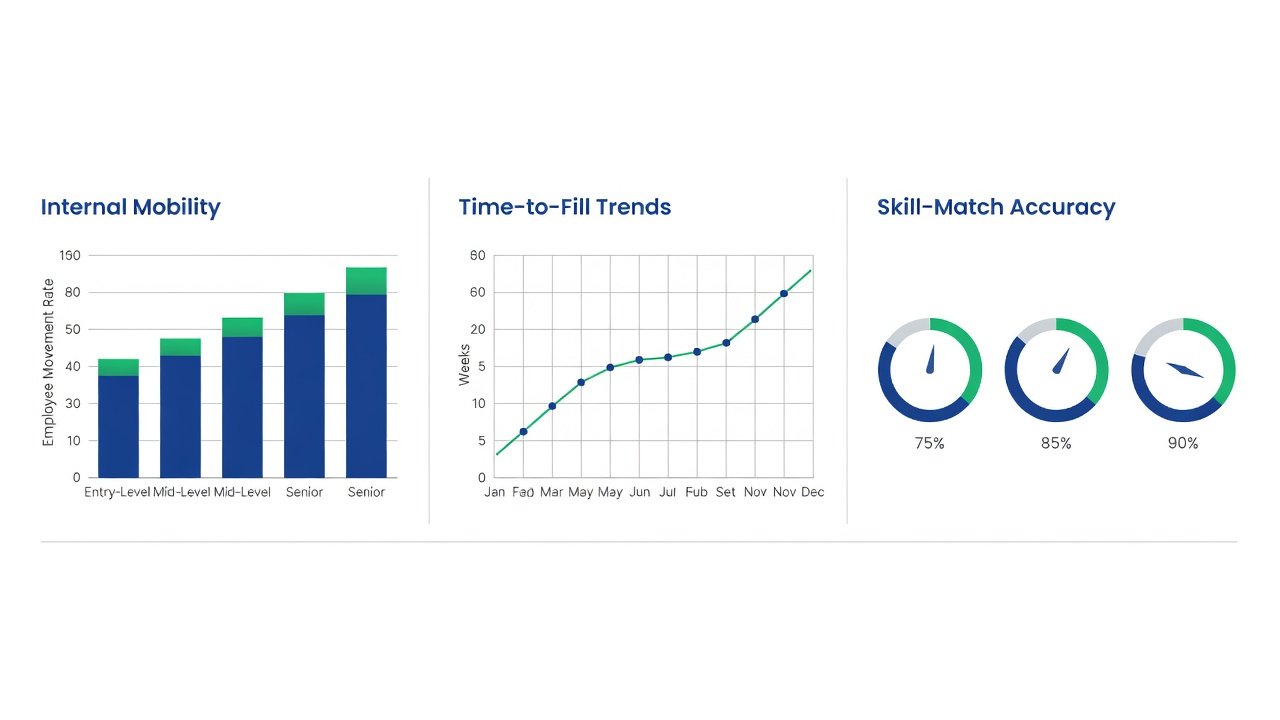
- Mobility Rates: Track the percentage of employees moving into new roles internally. Calculate this by dividing internal moves by total headcount over a period, then multiply by 100. This reveals how well the marketplace facilitates career progression and can highlight departments with strong internal pipelines versus those needing intervention.
- Time-to-Fill for Internal Roles: Measure the average days to fill positions posted internally versus external benchmarks. Shorter times indicate efficient matching processes, while longer durations may point to skill shortages or poor visibility of opportunities.
- Retention Impact: Analyze turnover rates among participants compared to non-participants. A lower rate among marketplace users demonstrates the program's value in engaging employees through new challenges and development.
- Skill-Match Accuracy: Evaluate how closely employee skills align with role requirements using data from HRIS integrations. This involves scoring matches based on predefined competencies and reviewing post-placement performance reviews for validation.
These metrics, when combined, paint a holistic picture of program health. For deeper context on talent strategies, refer to resources from SHRM.
Building Effective Dashboards
Creating a centralized dashboard is essential for real-time visibility. Integrate data from your ATS and HRIS to visualize trends over time. Key elements to include are automated alerts for declining mobility rates and comparative charts showing pre- and post-implementation performance. Begin by auditing your current systems for compatibility, then select visualization tools that support custom reporting such as drag-and-drop widgets for key indicators.
This setup allows teams to spot issues early and adjust strategies accordingly. Practical steps include defining user roles for dashboard access, setting refresh frequencies daily or weekly, and incorporating filters for department-specific views. Mid-size companies often start with basic spreadsheets before advancing to dedicated HR analytics platforms for scalability.
Setting Benchmarks and Interpreting Trends
Benchmarks provide context for your metrics. Compare internal mobility rates against industry standards and track year-over-year changes. For example, a mid-size company might aim for a 15-20% increase in internal fills after implementing a marketplace. Sources like government labor statistics or professional associations can help establish realistic targets based on company size and sector.
Interpreting trends involves looking beyond raw numbers. A spike in time-to-fill could indicate skill gaps rather than process issues. Use quarterly reviews to correlate data points and refine algorithms for better skill matching. Consider external factors like seasonal hiring patterns or organizational changes that might skew results, and always cross-reference with employee satisfaction surveys for qualitative depth.
Integrating Data from ATS and HRIS Systems
Seamless data integration forms the backbone of accurate metric tracking. Start by mapping fields between your applicant tracking system and human resources information system to ensure consistent skill and experience data flows. This prevents discrepancies that could undermine skill-match accuracy calculations. In practice, many organizations use API connections or middleware tools to automate updates, reducing manual errors.
Once integrated, test the flow with sample datasets to verify mobility rates reflect true internal movements. This step is crucial for mid-size firms transitioning from fragmented systems, as it enables comprehensive reporting that supports strategic planning.
Real-World Examples from Mid-Size Companies
Consider a manufacturing firm that implemented an internal talent marketplace in late 2025. Before the program, internal mobility stood at 8%. After six months, it rose to 22%, with retention improving by 12% among active users. The company attributed this to targeted skill development recommendations generated by the platform.
Another tech company used skill-match data to reduce external hiring needs by focusing on upskilling paths identified through the platform. Their time-to-fill dropped from 45 days to 28 days internally. A healthcare provider tracked retention impact and found participants had 18% lower turnover, leading to expanded program funding. These before-and-after results highlight the value of consistent measurement and iteration across diverse industries.
Common Pitfalls in Measurement
Many organizations fall into traps like over-relying on vanity metrics or failing to account for external factors such as economic shifts. Avoid siloed data by ensuring ATS and HRIS systems communicate seamlessly. Another frequent mistake is neglecting qualitative feedback, which can explain quantitative anomalies like sudden drops in mobility despite strong dashboard numbers.
Additional pitfalls include inconsistent data definitions across teams, ignoring small sample sizes in early program stages, and failing to update benchmarks as the business evolves. To mitigate these, establish clear metric ownership and conduct regular data audits. Comparing against peers through networks like those at Harvard Business Review can also provide perspective.
Practical Steps to Implement Metrics Tracking
To get started, audit existing data sources for completeness. Next, define calculation formulas for each KPI and document them in a shared guide. Train HR staff on dashboard usage, then pilot the system with one department before full rollout. Monitor initial results closely and gather feedback to refine the approach, ensuring the metrics align with overall business objectives.
Quarterly Review Checklist
- Review mobility and retention data for the past quarter, breaking it down by department and role type.
- Assess time-to-fill trends and identify bottlenecks, such as approval delays or unclear job postings.
- Validate skill-match accuracy through employee surveys and performance data post-placement.
- Update benchmarks based on new internal and external data from reliable sources.
- Document insights and adjust program features, including any algorithm tweaks for better recommendations.
- Prepare a summary report for leadership highlighting ROI and recommended actions.
This structured approach ensures ongoing optimization and accountability.
Conclusion
Tracking the right metrics in internal talent marketplaces empowers HR teams to prove value and drive meaningful improvements. By focusing on mobility, efficiency, and retention in 2026, organizations can build more agile workforces. Start by auditing your current data sources and implementing the dashboard strategies outlined here for sustained success. Consistent application of these practices will lead to data-backed decisions that enhance both employee satisfaction and business outcomes. For additional HR insights, explore Gartner.

No comments yet. Be the first!