 Jobboy

Introduction to Equity Compensation in 2026
Equity compensation remains a cornerstone of total rewards packages at tech and growth companies. Professionals evaluating offers must understand the nuances between Restricted Stock Units (RSUs) and stock options to maximize long-term value. This guide delivers step-by-step valuation techniques, tax considerations, vesting impacts, dilution risks, and practical negotiation approaches tailored to 2026 market conditions. Whether you are a mid-level engineer or a senior leader, mastering these distinctions helps align your personal financial goals with company performance.
Core Differences Between RSUs and Stock Options
RSUs grant shares outright after vesting, providing immediate ownership once restrictions lift. Stock options give the right to purchase shares at a fixed strike price, potentially creating value only if the stock price rises above that level. Both instruments tie employee outcomes to company performance but differ significantly in risk profile and upside potential. RSUs offer more certainty but less leverage in high-growth scenarios, while options can deliver outsized returns if the company succeeds dramatically. Understanding these trade-offs is essential before accepting any offer in the current competitive talent market.
Step-by-Step Valuation Methods
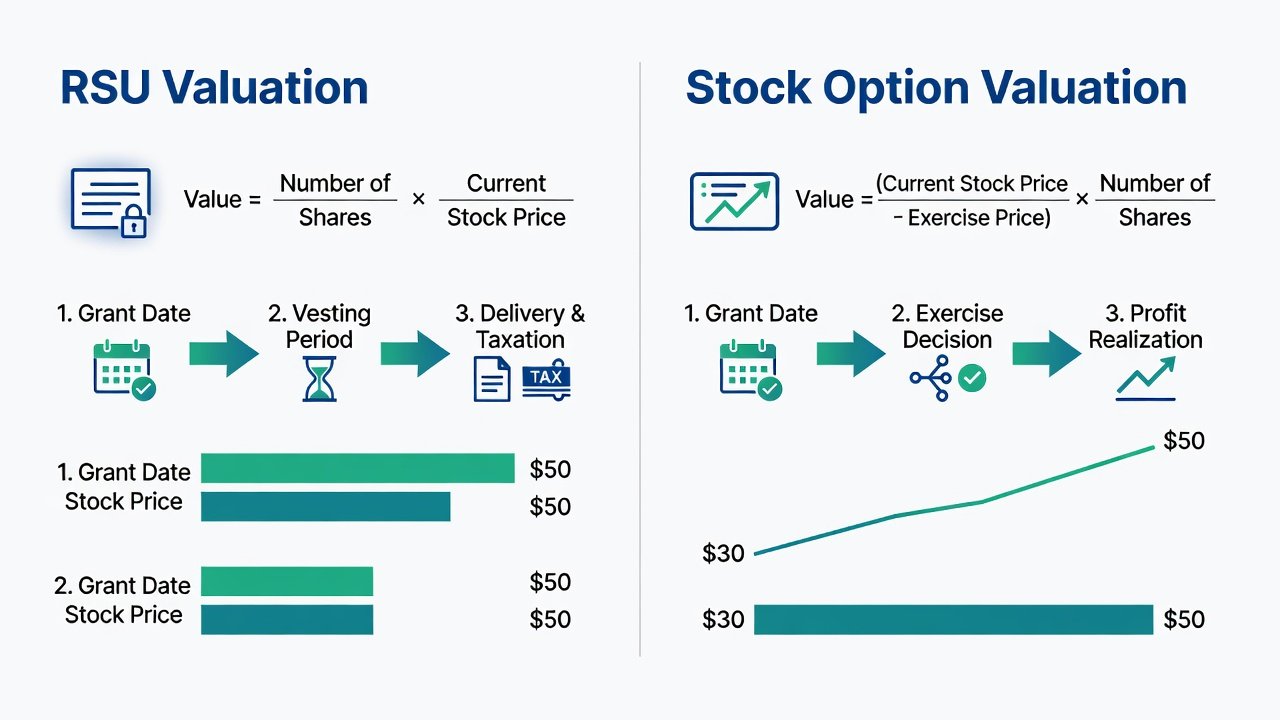
Begin by determining the current fair market value of the company’s shares through recent funding rounds or public comparables. For RSUs, multiply the number of units by the current share price and discount for expected forfeiture rates or taxes. For options, apply the Black-Scholes model or a binomial lattice approach that factors in volatility, time to expiration, dividend yield, and risk-free rate. Advanced scenarios incorporate Monte Carlo simulations when modeling liquidity events such as IPOs or acquisitions. Follow these practical steps for accurate modeling:
- Collect the latest 409A valuation report from the company.
- Estimate expected holding period based on your career timeline.
- Apply appropriate discount rates for illiquidity.
- Run sensitivity analysis on key variables like volatility.
- Compare net present value across both equity types.
These steps provide a repeatable framework for both beginners and experienced professionals.
Tax Implications in Detail
RSUs are taxed as ordinary income upon vesting at the fair market value on that date. Subsequent sales trigger capital gains treatment depending on holding periods. Stock options may qualify for incentive stock option (ISO) treatment if holding periods are met, potentially converting gains to long-term capital gains. Early exercise of options can trigger alternative minimum tax considerations. Always review withholding requirements and plan cash reserves accordingly. Consult the IRS website for current filing requirements and the SEC website for disclosure obligations on equity awards. State tax rules can further complicate calculations, especially for remote workers across multiple jurisdictions.
Vesting Schedules and Dilution Risks
Standard vesting spans four years with a one-year cliff, though some companies offer monthly vesting after the initial period. Early exercise provisions on options can accelerate tax planning but introduce forfeiture risk if employment ends prematurely. Dilution from future funding rounds reduces ownership percentage; model this by projecting share counts after each Series round. Real-world examples show that a 1% stake can shrink to 0.6% after three additional raises. A simple comparison appears below:
| Factor | RSUs | Stock Options |
|---|---|---|
| Ownership Certainty | High after vesting | Conditional on exercise |
| Downside Risk | Tax liability on vest | Strike price payment required |
| Dilution Impact | Direct share reduction | Potential strike adjustment |
| Liquidity Timing | Post-vest sale possible | Exercise then sale |
Negotiation Scripts and Tactics
When presented with two packages, open with: “I value the equity component highly. Could we discuss shifting 20% of the option grant into RSUs to reduce personal risk while maintaining upside?” For remote candidates, reference cost-of-living adjustments by noting: “Given my location’s lower housing costs, I propose increasing the equity portion by 15% to align total compensation parity.” Document all conversations and request written confirmation of any changes. Prepare multiple scenarios in advance and practice delivering them confidently during offer discussions.
Remote Work COL Adjustments
Remote roles require recalibrating equity value against local living expenses. Professionals in lower-cost regions can negotiate higher equity grants to offset salary reductions. Factor in state tax differences, healthcare costs, and currency fluctuations when modeling net present value of each equity type. Companies increasingly use location-based bands, so prepare data showing how your proposed equity adjustment maintains equivalent purchasing power.
Advanced Liquidity Event Scenarios
In an acquisition, RSUs typically convert to cash or acquirer stock based on deal terms. Options may receive accelerated vesting or cash-out at the spread between strike and deal price. Model both outcomes using probability-weighted scenarios to compare expected value under optimistic, base, and pessimistic exit multiples. Consider secondary sale windows that some late-stage companies now offer, which can provide partial liquidity before a full exit event.
Beginner-Friendly Calculations with Examples
Assume a grant of 1,000 RSUs at a $50 share price: immediate post-tax value approximates after standard withholdings. For 1,000 options at $30 strike with current price $50, intrinsic value equals the spread before volatility adjustments. Update models quarterly using public company comparables and revisit assumptions after major company milestones. Track these numbers in a personal spreadsheet that includes vesting tranches and projected tax events.
Common Mistakes to Avoid
Many candidates overlook post-termination exercise windows on options, which can lead to forfeited value. Others ignore the impact of multiple funding rounds on ownership dilution. Failing to model tax withholding timing or assuming all equity will be liquid at the same time creates unrealistic expectations. Always build conservative scenarios alongside optimistic ones to prepare for various outcomes.
Conclusion
Choosing between RSUs and stock options depends on risk tolerance, time horizon, and company trajectory. Apply the valuation frameworks, negotiation tactics, and real-world examples outlined to secure packages that align with personal financial objectives and career plans.
FAQ
How do liquidity events affect RSUs versus options? RSUs typically convert directly while options require exercise decisions at exit, often with accelerated vesting provisions.
Should remote employees always prefer RSUs? Not necessarily; options may suit those comfortable with higher volatility for greater potential upside after careful modeling.
What vesting mistakes should I avoid? Ignoring acceleration clauses and failing to model post-termination exercise windows are common pitfalls that reduce realized value.
How often should I revalue my equity grants? Review at least quarterly or after any major company announcement such as a new funding round or leadership change.
Can I negotiate equity type after accepting an offer? Rarely; most adjustments occur during initial offer discussions, so prepare thoroughly before signing.

No comments yet. Be the first!