 Jobboy

Introduction to Equity Compensation in Remote Non-Tech Roles
Equity compensation has evolved into a critical element of total rewards for remote professionals working in non-tech sectors such as healthcare and finance. As remote arrangements continue to dominate in 2026, professionals are increasingly offered RSUs, stock options, and phantom stock as ways to align personal success with company performance. This beginner-friendly guide walks through equity valuation methods specifically tailored for these roles, helping readers move beyond base salary to understand full compensation potential. Readers will find step-by-step calculations, tax considerations, vesting impacts, and cost-of-living adjustments supported by practical examples. By the end of this article, professionals will be equipped to evaluate offers, negotiate effectively, and avoid common pitfalls that reduce the value of remote equity packages.
Many remote workers in healthcare administration or financial analysis overlook equity because it feels complex or tech-centric. However, with proper valuation techniques, these instruments can significantly boost long-term wealth. The focus remains on accessibility, using real-world scenarios to illustrate concepts without requiring advanced financial expertise.
Understanding Key Equity Types: RSUs, Options, and Phantom Stock
Restricted Stock Units, or RSUs, represent a promise to deliver company shares after a vesting period. They are popular in healthcare organizations because they provide straightforward ownership without requiring upfront payment. Stock options grant the right to buy shares at a predetermined price, offering upside if the company grows. Phantom stock, meanwhile, delivers cash payouts equivalent to share value appreciation without issuing actual equity, making it ideal for private finance firms concerned about ownership dilution.
Each type carries distinct advantages and risks for remote employees. RSUs provide immediate value at vesting but are subject to income tax. Options require the stock price to exceed the exercise price to become profitable. Phantom stock avoids share issuance but may lack voting rights or dividend eligibility. Understanding these differences allows remote workers to compare offers across industries accurately.
Step-by-Step Calculations for Equity Valuation
Begin by identifying the grant date fair market value of the equity. For RSUs, multiply the number of units by the current share price, then discount for expected forfeiture rates based on historical company data. For options, apply models such as Black-Scholes to estimate present value, incorporating volatility and time to expiration. Phantom stock valuation follows similar principles but converts to cash equivalents at payout dates.
Next, incorporate vesting schedules into projections. Divide the total grant across years and apply probability adjustments for continued employment. Factor in company performance milestones common in finance roles, such as revenue targets that accelerate vesting. Finally, adjust the net present value for inflation and personal discount rates reflecting liquidity needs. These calculations help remote professionals quantify equity beyond headline grant sizes.
Practical tip: Create a simple spreadsheet tracking annual vesting tranches and apply conservative growth assumptions. Revisit valuations quarterly as market conditions shift.
Tax Implications in 2026
Tax treatment varies significantly by equity type and worker location. RSUs are taxed as ordinary income upon vesting, with withholding often required at the federal and state levels. Stock options may qualify for capital gains treatment if holding periods are met, but early exercise can trigger alternative minimum tax considerations. Phantom stock payouts are generally taxed as supplemental wages.
Remote workers spanning multiple states must navigate sourcing rules for equity income. International remote arrangements add treaty considerations to prevent double taxation. Professionals should review resources on the IRS website and consult cross-border tax experts. Timing elections, such as 83(b) for options, can materially affect after-tax outcomes in healthcare and finance contexts.
Vesting Schedules and Their Impact
Typical schedules span four years with a one-year cliff, meaning 25 percent vests after the first year. Some remote finance roles include performance-based acceleration tied to individual or company metrics. Healthcare organizations may offer retention grants with back-loaded vesting to encourage long-term commitment. Understanding these structures helps workers assess the true present value and negotiate modifications, such as pro-rated vesting upon voluntary departure.
Cost-of-Living Adjustments for Remote Workers
Equity grants are frequently location-adjusted in remote settings. A professional based in a lower cost-of-living area might receive a reduced grant size compared to headquarters peers. To normalize, apply cost indices from government data sources. This ensures fair comparison when evaluating offers from national employers. The Bureau of Labor Statistics provides regional data useful for these adjustments.
Real Examples from Healthcare and Finance
Consider a remote healthcare compliance officer receiving RSUs that vest over four years. The valuation process involves projecting share price appreciation while accounting for potential role changes or company events. In finance, a remote analyst might receive a mix of options and phantom stock. Detailed modeling shows how phantom units provide downside protection through cash settlement while options capture upside in strong markets. These examples highlight the need for personalized modeling rather than generic rules of thumb.
Comparison: Equity vs Cash Compensation
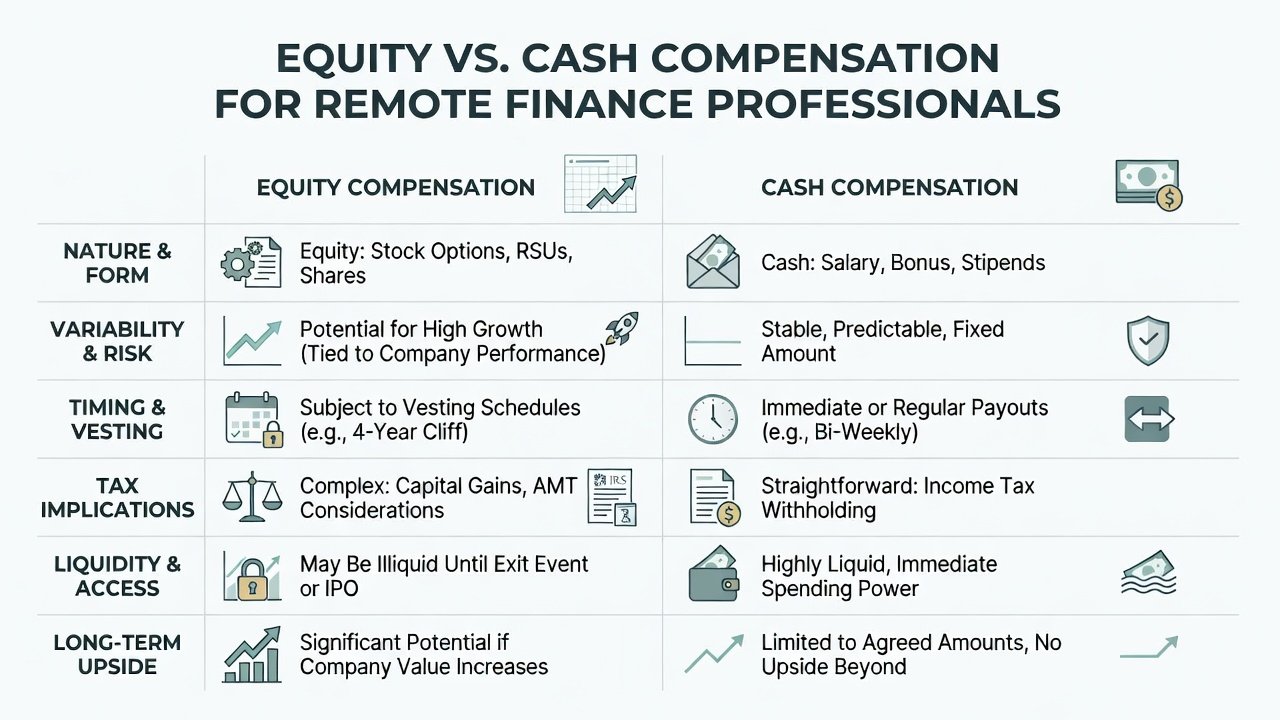
- Equity delivers potential for substantial growth but introduces market and company-specific risk.
- Cash compensation offers immediate spending power and lower volatility.
- Hybrid structures often combine both, allowing remote workers to balance liquidity needs with long-term upside.
- Decision factors include personal risk tolerance, time horizon, and diversification of existing assets.
Tables comparing scenarios across different vesting periods and growth assumptions help clarify trade-offs for professionals evaluating 2026 offers.
Negotiation Scripts for 2026 Offers
Effective negotiation begins with data. A sample opening: "Reviewing equity components in comparable remote roles, I suggest increasing the RSU allocation to better reflect my contributions in healthcare operations." Follow up by proposing specific vesting adjustments or sign-on equity grants. Prepare supporting analysis of total compensation and remain open to creative solutions such as refreshed grants in later years.
Practical Checklists for Valuing Total Compensation
- Inventory all equity grants including type, quantity, and strike prices where applicable.
- Model vesting timelines and apply retention probability factors.
- Calculate tax liabilities using current withholding rates and filing status.
- Adjust values for cost-of-living differentials and remote work expenses.
- Compare equity upside scenarios against guaranteed cash alternatives.
- Document assumptions and revisit annually or upon major life events.
Risks, Mitigation Strategies, and Common Mistakes to Avoid
Key risks include company underperformance rendering options worthless, liquidity constraints in private firms, and unexpected tax bills at vesting. Mitigation involves diversifying equity holdings, maintaining emergency cash reserves, and using collar strategies for large positions. Common mistakes include ignoring state tax nuances, overestimating growth rates, and failing to model early departure scenarios. Remote professionals should also watch for changes in company valuation methodologies that affect phantom stock payouts.
Tools, Resources, and Future Trends
Free resources from the SEC website provide investor education on equity instruments. Spreadsheet templates and financial planning software can automate projections. Looking ahead to 2026 and beyond, expect greater use of performance-linked equity in remote finance roles and continued emphasis on tax-efficient structures for healthcare workers.
FAQs on Common Pitfalls
Q: What happens to unvested equity if I leave a remote role? A: Most plans require forfeiture, though some allow limited continuation for good leavers.
Q: How should I handle underwater stock options? A: Focus on company fundamentals and consider negotiating new grants at current valuations.
Q: Are phantom stock plans more tax-efficient? A: They simplify reporting but still generate ordinary income, requiring careful cash flow planning.
Conclusion
Mastering equity valuation empowers remote non-tech professionals to maximize 2026 compensation packages. By applying structured calculations, understanding taxes and vesting, and using negotiation strategies, workers in healthcare and finance can confidently evaluate and enhance their total rewards. Regular review and professional advice ensure these opportunities translate into lasting financial benefits.

No comments yet. Be the first!