 Jobboy

Introduction to Equity Refreshes in Non-Tech Sectors
Equity compensation has expanded beyond Silicon Valley, offering non-tech professionals in finance, healthcare, manufacturing, retail, and professional services meaningful ownership stakes that can significantly enhance long-term wealth. In 2026, equity refresh strategies serve as critical tools for retaining experienced talent amid shifting economic landscapes and competitive labor markets. This comprehensive guide explores tailored approaches specifically for non-tech roles, covering detailed RSU and option valuation techniques in private firms, step-by-step methods for assessing complex vesting schedules, intricate tax implications, and multiple real-world examples that illustrate total compensation impact.
Professionals outside technology frequently encounter equity through private companies, family-owned businesses, or hybrid public-private structures where liquidity events are less predictable. Mastering these instruments not only boosts immediate financial positioning but also supports broader career development and retirement planning. By the end of this article, readers will possess actionable frameworks to evaluate, negotiate, and optimize equity offers effectively.
Valuing RSUs and Options in Private Firms
Restricted stock units (RSUs) and stock options demand rigorous valuation, particularly in private companies where daily market prices do not exist. Begin with the most recent 409A valuation performed by qualified independent appraisers, which establishes the fair market value for tax and accounting purposes. Supplement this baseline with forward-looking projections derived from recent funding rounds, revenue forecasts, and comparable company analyses.
Private firm equity often incorporates illiquidity discounts ranging from 20 to 35 percent, reflecting the challenges of converting shares to cash before an IPO or acquisition. For instance, a supply chain analyst at a mid-sized private manufacturing company might receive RSUs priced according to the latest 409A report. Professionals should also examine secondary market transactions if available, or request sensitivity analyses showing value under optimistic, base, and pessimistic exit scenarios. Always insist on receiving the full valuation methodology and any underlying assumptions during initial discussions.
Step-by-Step Methods for Assessing Vesting Schedules
Vesting schedules dictate the timeline and conditions under which equity converts to personal ownership. Follow this expanded evaluation process to avoid surprises:
- Examine the grant notice for the core schedule, typically a four-year period with a one-year cliff followed by monthly or quarterly increments.
- Model the precise number of shares vesting each period and calculate cumulative ownership at key milestones such as year two and year four.
- Identify any performance-based or milestone-driven accelerators tied to company revenue targets or individual KPIs common in non-tech environments.
- Simulate departure scenarios, including voluntary resignation, termination without cause, and change-of-control events that may trigger full or partial acceleration.
- Compare the proposed schedule against industry norms for similar non-tech positions to identify negotiation opportunities.
Non-tech roles frequently feature hybrid vesting that blends time-based and project-specific elements, such as successful implementation of enterprise systems. 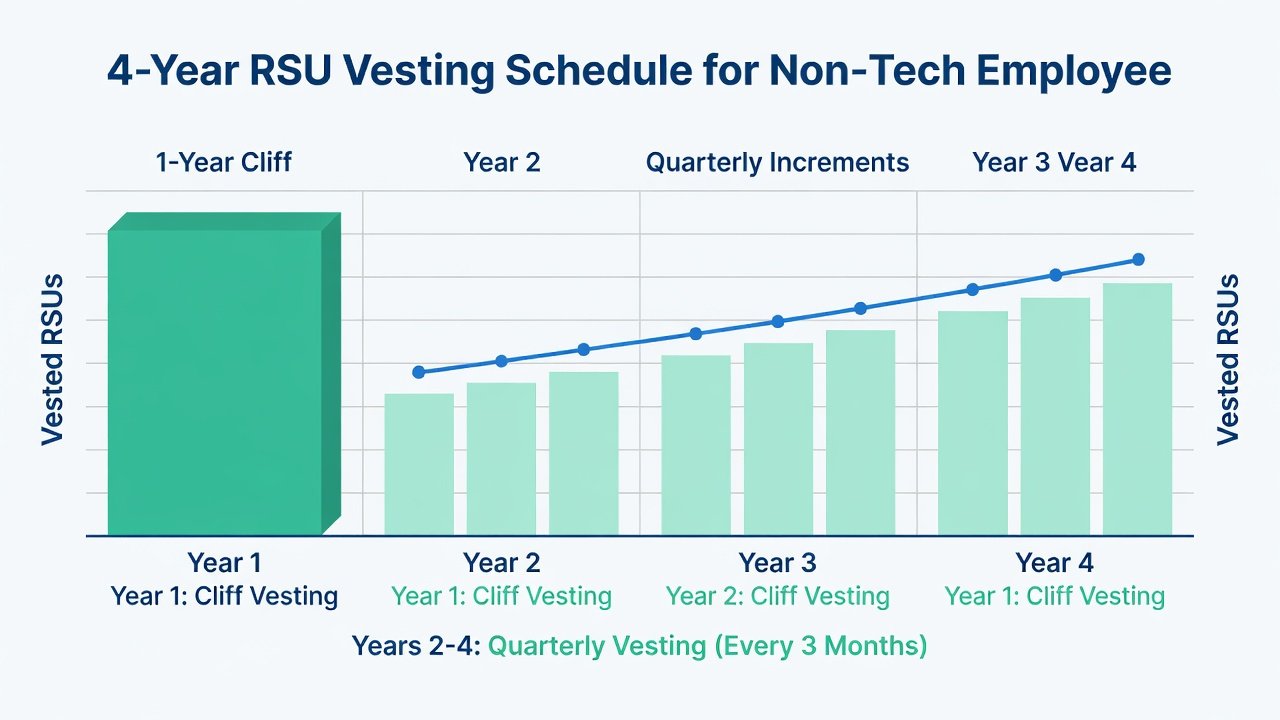
Tax Implications of Equity Compensation
Tax treatment profoundly influences net proceeds and requires proactive planning. RSUs are generally taxed as ordinary income at vesting based on the fair market value on that date, creating immediate withholding obligations. Stock options present more complexity: non-qualified stock options trigger ordinary income tax at exercise, while incentive stock options may qualify for preferential capital gains rates if holding periods are satisfied. Non-tech employees should also account for state income taxes, potential alternative minimum tax exposure, and Medicare surtaxes on high earners.
Integrate equity tax projections into annual financial models and consider strategies such as tax-loss harvesting or deferral elections where permitted. Consulting resources from the IRS provides foundational guidance, while the SEC offers additional context on disclosure requirements for public companies that may influence private firm practices.
Total Compensation Impact with Real Examples
Understanding equity within the full compensation picture prevents over- or under-valuation. Consider a human resources manager at a private healthcare services firm offered a $165,000 base salary, 10 percent annual bonus, and 12,000 RSUs over four years. Using the current 409A price, this equity could represent 25-40 percent of total comp depending on exit valuation. Another example involves a facilities director at a logistics company receiving options with a strike price set at the most recent 409A, allowing modeling of breakeven points and upside scenarios across multiple liquidity timelines.
These examples demonstrate how equity can close compensation gaps compared to pure cash offers and highlight the importance of running personalized Monte Carlo simulations or consulting compensation analysts for precise forecasting.
Tech vs Non-Tech Equity Package Comparisons
Technology sector packages typically feature larger initial grants and more frequent refresh cycles every 12 to 18 months, driven by rapid growth and high competition for engineering talent. In contrast, non-tech equity programs emphasize longer-term retention with grants sized to operational stability and often include performance hurdles tied to cost efficiency or customer retention metrics. Vesting in non-tech environments tends to be more predictable, with fewer instances of dramatic acceleration or clawback provisions seen in high-velocity tech firms.
Negotiation dynamics also diverge: non-tech professionals gain advantage by emphasizing cross-functional impact, regulatory compliance achievements, and process improvements rather than user growth metrics.
Negotiation Scripts for Equity Refreshes
Effective negotiation begins with preparation and data. Use these expanded scripts during compensation conversations:
- "Over the past year I led the enterprise resource planning implementation that reduced operational costs by 18 percent. Given this contribution, I propose we explore an equity refresh that aligns with current benchmarks for my role and experience level."
- "I value the stability and mission of this organization. To ensure long-term alignment, could we discuss incorporating a modest equity component into my compensation package with a vesting schedule that rewards sustained performance?"
- "Before finalizing my renewal, I would like to review the equity refresh eligibility criteria and explore options for partial acceleration upon achievement of department-specific targets."
Support each request with documented accomplishments and external market data.
Common Pitfalls to Avoid
Several recurring errors undermine equity outcomes. First, accepting offers without updating 409A valuations can lead to mispriced grants. Second, overlooking tax withholding timing creates cash flow issues at vesting. Third, failing to negotiate acceleration clauses leaves value on the table during acquisitions. Fourth, ignoring the interplay between equity and other benefits such as 401(k) matching reduces overall optimization. Fifth, neglecting to model multiple exit timelines results in unrealistic expectations. Finally, entering discussions without quantifiable performance evidence weakens bargaining position significantly.
Leveraging Performance Data for Better Offers
Compile a portfolio of achievements supported by metrics, stakeholder testimonials, and before-after comparisons. Present this evidence during review cycles while explicitly linking accomplishments to equity requests. Schedule dedicated conversations separate from standard salary discussions to keep focus on long-term incentives. Update your personal compensation tracker quarterly to maintain readiness for opportunistic refresh opportunities.
FAQs on Timing Requests and Pay Integration
When should I request an equity refresh?
Optimal timing coincides with annual performance reviews, completion of major initiatives, or following positive company milestones. Monitor internal promotion cycles and avoid periods of organizational restructuring.
How do I integrate equity into pay raise discussions?
Position equity as one element within a holistic total rewards conversation. Provide a written summary comparing current compensation against proposed structures including salary, bonus, equity, and benefits.
What documentation should I prepare?
Gather your current grant agreements, recent 409A reports, performance reviews, and market compensation data from reputable sources.
Can equity refreshes be negotiated mid-year?
Yes, particularly after significant contributions or when market conditions shift, though success depends on company policy and budget cycles.
How do private company refreshes differ from public ones?
Private refreshes often involve greater valuation uncertainty and longer liquidity horizons, requiring deeper scenario analysis.
Conclusion
Equity refresh strategies enable non-tech professionals to capture substantial long-term value in 2026. Through thorough valuation analysis, careful vesting evaluation, tax foresight, strategic negotiation, and performance-backed advocacy, individuals can construct compensation packages that reflect their full contributions and support enduring financial security.

No comments yet. Be the first!