 Jobboy

Introduction: Crafting Resumes That Focus on Value, Not Age
In today's competitive job market, mature professionals over 50 often bring decades of expertise, leadership, and problem-solving abilities that younger candidates may lack. However, unconscious bias can creep into hiring processes when resumes inadvertently signal age through outdated formatting or excessive historical detail. This comprehensive guide provides actionable resume tips to emphasize recent achievements, relevant skills, and forward momentum while reducing any signals that might trigger age-related assumptions. By 2026, applicant tracking systems (ATS) have evolved to prioritize skills matching, quantifiable impact, and recent accomplishments over exhaustive timelines or lengthy career narratives. Whether you are re-entering the workforce after a career break, seeking advancement in your current field, or pivoting to a new industry, the goal remains the same: create a concise, achievement-driven document that positions you as a high-value candidate ready to tackle current business challenges. Research from labor market analyses shows that experienced workers who strategically update their resumes see significantly higher callback rates when they focus on relevance rather than tenure.
Throughout this article, we will break down each component of an effective 2026 resume with step-by-step guidance, real-world before-and-after examples, and practical checklists you can apply immediately.
Choosing Modern Resume Formatting for 2026
Outdated templates featuring dense text blocks, multiple columns, or decorative graphics can hinder both human readability and ATS parsing. Instead, select clean, single-column layouts using widely compatible fonts such as Arial, Calibri, or Garamond at 10-12 point size for body text and 14-16 point for headings. Limit the entire resume to two pages maximum, devoting the majority of space to the last 10-15 years of professional experience. This streamlined approach improves ATS compatibility while keeping recruiter attention squarely on your most relevant and recent contributions. Incorporate subtle visual elements such as thin horizontal lines to separate major sections and bold section headings for rapid scanning. Never include photos, headshots, personal details like marital status, or excessive color that may not render correctly across different devices and software versions.
Strategic Handling of Dates to Reduce Bias
Listing every position dating back to the 1980s or 1990s can unintentionally highlight age and invite bias. The recommended approach is to include only roles from the past 15 years in full detail, summarizing any earlier experience in a concise “Earlier Career” or “Additional Experience” section that lists company names and titles without dates. Similarly, omit graduation years from your education section and instead highlight recent certifications, professional development courses, or licenses earned within the last decade. This technique keeps the narrative centered on current capabilities and ongoing professional growth rather than total years in the workforce.
Emphasizing Recent Achievements Over Career History
Recruiters and hiring managers want to see measurable impact rather than simply the length of your career. For each position, structure bullet points using the proven formula of Action verb + Specific result + Quantifiable metric whenever possible. For instance, replace a vague statement such as “Responsible for managing sales team” with “Spearheaded regional sales strategy that grew revenue from $4.2 million to $6.1 million within 18 months while expanding the team from 7 to 14 representatives.” Prioritize the most recent five years of experience with 4-6 detailed bullet points per role, then reduce earlier positions to 2-3 bullets focused on transferable skills. This forward-looking emphasis demonstrates that you remain an active contributor rather than resting on past accomplishments.
Selecting Powerful Action Verbs
Strong action verbs immediately convey leadership, innovation, and results. Replace passive or generic phrases with dynamic alternatives such as: accelerated, architected, championed, cultivated, engineered, executed, fortified, galvanized, harnessed, innovated, leveraged, orchestrated, pioneered, revitalized, streamlined, transformed, and unified. Create a personal verb bank tailored to your target roles—for technical positions favor “engineered” and “optimized,” while client-facing roles benefit from “cultivated” and “negotiated.” Review each job description and naturally incorporate 3-5 matching verbs throughout your bullets to improve both ATS keyword matching and human engagement.
Highlighting Tech Proficiency and Adaptability
Many hiring managers assume older candidates may struggle with emerging technologies, so proactively demonstrate comfort with modern tools. Create a dedicated “Technical Skills” or “Core Competencies” section that lists specific software, platforms, methodologies, and certifications relevant to 2026 roles, such as Microsoft 365 Copilot, Salesforce Einstein, advanced Tableau or Power BI analytics, cloud migration using AWS or Azure, and AI-assisted project management platforms. For each skill, you may optionally note the context in which you applied it recently. Additionally, mention any self-directed learning, online courses completed in the past two years, or participation in professional webinars to underscore continuous adaptation.
Optimizing for ATS Systems Popular in 2026
The majority of Fortune 500 companies and mid-sized employers now rely on sophisticated ATS platforms that scan for exact keyword matches, skills alignment, and clean formatting. To maximize your score, copy key phrases directly from the job posting into your resume where they accurately reflect your background, use standard section headings such as “Professional Summary,” “Professional Experience,” and “Education,” and submit files in the requested format—typically .docx or PDF. Before submitting, run your resume through at least two free ATS simulators available online to identify and correct any parsing issues. Maintain consistent date formatting (e.g., Month Year) and avoid tables, text boxes, or special characters that can confuse automated systems.
Common Mistakes to Avoid
Many mature professionals unintentionally weaken their resumes by including the following: an objective statement instead of a modern professional summary, references to outdated software like Windows XP or Lotus Notes, lengthy paragraphs instead of concise bullets, and personal hobbies that do not relate to the target role. Another frequent error is using chronological gaps without brief positive framing, such as noting freelance consulting or board service during a transition period. Review your draft against this checklist before finalizing.
Before-and-After Resume Examples
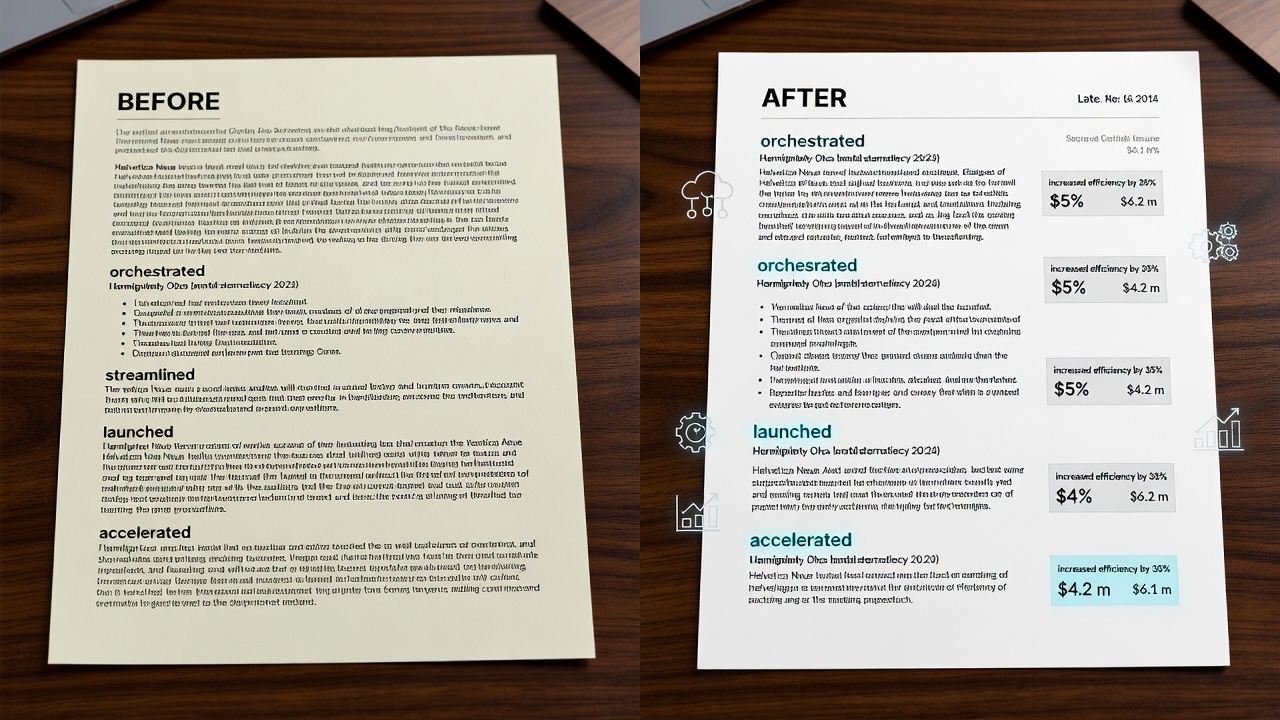
Before: “Employed at Acme Corporation 1998–2025. Handled marketing and supervised staff.”
After: “Director of Marketing, Acme Corporation (2019–Present)
• Orchestrated integrated campaign across digital and traditional channels that increased qualified leads by 47% year-over-year in 2025.
• Mentored five junior team members, resulting in two internal promotions and a 30% improvement in campaign ROI.”
Apply this transformation consistently across all recent roles to shift emphasis from duration to demonstrated value.
Tailoring Content for Specific Industries
Customize your resume for each application by mirroring industry-specific terminology. In healthcare, emphasize compliance, patient outcomes, and regulatory knowledge. In technology, highlight agile methodologies, cybersecurity awareness, and cross-functional collaboration. In finance, focus on risk mitigation, regulatory reporting, and process automation. Always align your professional summary with the job title and company mission statement to create immediate relevance.
Short FAQ for Professionals Over 50
- Should I include a LinkedIn profile link? Yes, provided your profile is fully optimized with the same keywords and recent achievements featured on your resume.
- How do I address employment gaps? Frame them positively by briefly noting productive activities such as consulting projects, volunteer leadership, or upskilling courses completed during that period.
- Is a skills-based resume better than chronological? A hybrid format—strong skills summary at the top followed by reverse-chronological experience—offers the best balance for most experienced professionals.
- How many references should I list? Omit references entirely from the resume itself; prepare a separate document and provide it only when requested.
- Can I use color on my resume in 2026? Limited, professional use of one accent color for headings is acceptable if it remains ATS-friendly and prints clearly in black and white.
Conclusion: Position Yourself for Success
By implementing modern formatting, strategic date handling, achievement-focused content, powerful action verbs, clear technology demonstrations, and ATS optimization techniques, you create a resume that showcases your expertise without inviting age bias. Update your document regularly, tailor it for each opportunity, and consider having a trusted colleague or career coach review it for fresh perspective. For additional resources on labor market trends and job search best practices, consult authoritative platforms such as LinkedIn, Indeed, and BLS.gov. With these strategies, mature professionals can confidently compete and thrive in the 2026 job market and beyond.

No comments yet. Be the first!