 Jobboy

Introduction: Why One-Page Resumes Matter in 2026
Job seekers today face intense competition, with recruiters spending an average of just seven seconds scanning each resume. A concise one-page format cuts through the noise by highlighting your strongest qualifications without overwhelming the reader. This guide explores modern hiring trends, when brevity outperforms detail, and step-by-step methods to condense your experience while preserving impact. Many professionals mistakenly believe longer resumes demonstrate more value. However, research from major job platforms shows that hiring managers prefer focused documents, especially for mid-level and entry roles. Understanding the balance between brevity and substance is key to standing out in a market where applicant volumes continue to rise.
The shift toward one-page resumes reflects broader changes in recruitment technology and attention spans. With applicant tracking systems processing thousands of submissions daily, clarity and relevance have become essential. Job seekers who master this format often see higher response rates because their documents respect the time constraints of hiring teams while still delivering compelling evidence of their capabilities.
Brevity Versus Detail: Understanding Search Intent
Search queries around one-page resumes frequently reveal confusion between wanting brevity and fearing the loss of critical achievements. Candidates worry that reducing content will make them appear less experienced. In reality, effective condensation involves ruthless prioritization rather than simple deletion. The goal is to retain only those elements that directly address the target role’s requirements, creating a narrative of focused excellence instead of scattered history.
When a One-Page Resume Works Best
One-page resumes shine in specific scenarios. They suit applicants with under 10 years of experience, career changers, or those targeting roles at startups and fast-paced companies. In contrast, multi-page resumes remain appropriate for senior executives, academics, or professionals with extensive publications and projects. Consider your target industry and role level. Tech and creative fields often reward brevity, while government or legal positions may expect more detail. Test your document by asking: Does every line directly support the job description? If not, trim aggressively. For example, a software engineer applying to a Silicon Valley startup benefits from a single page that spotlights recent coding projects and impact metrics, whereas a tenured professor may need additional space for research grants and publications.
Prioritizing Resume Sections for Maximum Impact
Start with a strong professional summary that captures your value proposition in three to four lines. Follow with a skills section tailored to the job posting, then your most recent and relevant experience. Education and certifications come next, with optional sections like volunteer work only if they add unique value. Never lead with an objective statement; replace it with achievements. Use reverse chronological order and limit each role to three to five bullet points focused on results rather than duties. Within the experience section, allocate the most space to your current or most recent position, progressively shortening older entries. This visual hierarchy guides the reader’s eye toward your strongest contributions first.
Using Powerful Action Verbs and Quantifiable Achievements
Replace weak phrases like "responsible for" with dynamic verbs such as "spearheaded," "optimized," or "generated." Pair each verb with metrics: instead of "managed a team," write "Led a 12-person team that increased quarterly revenue by 34%." This approach transforms generic entries into compelling proof points. Review every bullet for specificity. Vague language dilutes your message and reduces ATS scoring potential. Incorporate industry-specific terminology where relevant to improve both human and algorithmic evaluation.
Step-by-Step Guide to Condensing Your Resume
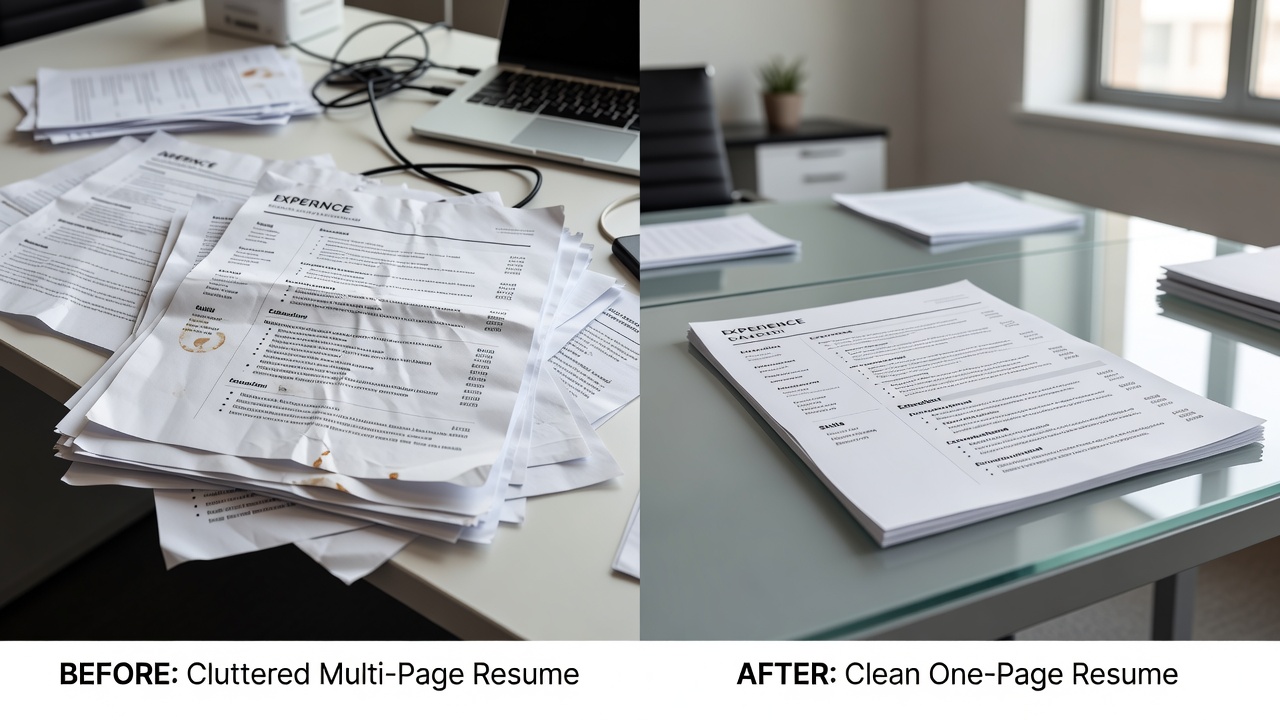
Begin by printing your current resume and highlighting every line that directly matches keywords from the job posting. Next, rewrite each highlighted bullet to start with an action verb and end with a measurable outcome. Then, eliminate any role older than ten years unless it demonstrates irreplaceable expertise. Consolidate multiple similar positions into a single summary line when possible. Finally, adjust margins to 0.5–0.7 inches and font size to 10–11 points while maintaining readability. This systematic process typically reduces a two-page document to one page within two to three iterations.
Real-World Before-and-After Examples
Consider a marketing professional's original entry: "Managed social media accounts and created content." The condensed version reads: "Grew Instagram following from 5K to 42K in 18 months by developing a content strategy that boosted engagement rates by 210%." The revision is shorter yet far more persuasive. Another example involves a project manager. Before: "Oversaw multiple projects and coordinated with stakeholders." After: "Directed 8 cross-functional projects valued at $2.3M, delivering all on time and 15% under budget through enhanced stakeholder communication protocols." A third case from an operations specialist shows similar improvement. Original: "Handled inventory and supplier relations." Revised: "Streamlined supply chain processes for 14 vendors, reducing lead times by 28% and cutting annual procurement costs by $175,000." These transformations demonstrate how specificity and results create immediate credibility.
ATS Compatibility Checks and Formatting Best Practices
Modern applicant tracking systems favor clean layouts. Use standard fonts like Arial or Calibri at 10-12 point size. Avoid tables, graphics, and columns that can confuse parsers. Incorporate exact keywords from the job description naturally throughout your summary, skills, and experience sections. Save and submit your resume as a PDF to preserve formatting, but also keep a Word version for easy edits. Run your document through free ATS simulators available on major career sites before applying. Additionally, test your resume by copying the text into a plain text editor; if the content flows logically without formatting artifacts, the ATS will likely parse it correctly.
Checklist for Trimming Fluff and Redundant Content
- Remove all personal pronouns and articles that add no value.
- Eliminate duties that are obvious for the role level.
- Consolidate older positions into one line if they are more than 10 years old.
- Cut any skills listed in multiple places.
- Limit contact information to name, phone, email, LinkedIn URL, and city.
- Ensure every bullet starts with an action verb and ends with a result.
- Proofread for repetition across sections.
- Verify that every remaining item supports the specific job target.
Common Mistakes to Avoid When Creating One-Page Resumes
One frequent error is cramming too much information using tiny fonts or narrow margins, which reduces readability. Another mistake involves including irrelevant early-career roles that dilute focus. Candidates also sometimes forget to customize the document for each application, leaving generic language that fails to connect with the role. Finally, many overlook the importance of white space, which helps recruiters scan quickly; a dense block of text often gets skipped entirely.
Short FAQ: Common Concerns About One-Page Resumes
How do I handle extensive experience on one page?
Focus only on the last 10-15 years and summarize earlier roles briefly. Prioritize achievements aligned with the target position.
Is a one-page resume suitable for senior roles?
Generally no for C-suite positions, but yes for director-level roles when experience is highly relevant and recent.
Should I include references?
No. Provide them only when requested, saving precious space for your accomplishments.
What if the job posting asks for a detailed work history?
Submit the one-page version initially and offer to provide additional details during the interview process or via a separate attachment if requested.
Conclusion
Mastering the one-page resume requires intentional editing and a focus on relevance. By prioritizing impact, using strong verbs, and verifying ATS compatibility, you create a document that respects recruiters' time while showcasing your strengths. Apply these 2026 strategies consistently and update your resume for each application to maximize interview opportunities. For additional guidance, explore resources from CareerOneStop, Indeed, and U.S. Department of Labor.


No comments yet. Be the first!