 Jobboy

Introduction: Why Resume Strategies Matter for 2026 Career Pivots
Mid-to-late stage professionals face unique challenges when switching industries. In 2026’s competitive job market, a targeted resume that highlights transferable skills can make the difference between landing interviews and being overlooked. This guide provides practical, results-oriented advice tailored to experienced professionals pivoting from fields like finance or education into marketing or tech. Career transitions at this stage often involve navigating perceptions of overqualification or outdated experience, yet they also present opportunities to leverage decades of proven expertise. By focusing on strategic reframing, professionals can position themselves as high-value assets in new sectors where their leadership and problem-solving abilities are in demand.
Identifying and Quantifying Transferable Skills
Start by mapping your current expertise to the target role through a structured self-assessment process. Begin with a thorough review of past job descriptions, performance reviews, and project outcomes to extract core competencies. For example, project management in finance translates directly to campaign oversight in marketing, while curriculum design in education aligns with product development workflows in tech. List skills such as data analysis, stakeholder communication, budgeting, team leadership, and process optimization. To quantify them effectively, attach specific metrics and outcomes wherever possible: “Managed $2M portfolios, improving ROI by 25%” becomes powerful evidence of impact regardless of industry. Use tools like skill inventories from professional associations or online career platforms to cross-reference your abilities against 2026 job postings. This quantification step transforms vague responsibilities into compelling proof points that hiring managers can immediately understand and value.
Practical Steps for Skill Mapping
- Collect 5-10 recent job postings in your target field and highlight recurring requirements.
- Match each requirement to 2-3 examples from your career history.
- Convert each match into a quantified statement using numbers, percentages, or scale indicators.
- Organize skills into categories such as technical, leadership, and strategic to create a balanced resume narrative.
Reframing Employment Gaps with Achievement Language
Gaps are common during transitions and should never be hidden or apologized for. Instead, reframe them using achievement-oriented language that emphasizes growth and initiative. For instance, replace “unemployed” with “Completed professional certification in digital marketing while consulting on freelance strategy projects for three mid-sized firms.” This positions time away as proactive development. Additional strategies include highlighting volunteer leadership roles, personal projects, or continuing education that built relevant competencies. In 2026, employers increasingly value adaptability, so demonstrating how gaps were used for upskilling strengthens your candidacy. Consider including brief context in a dedicated “Professional Development” section if the gap exceeds six months, always tying activities back to the target role’s needs.
Integrating ATS-Friendly Keywords Without Stuffing
Review target job descriptions and incorporate natural phrases such as “SEO strategy,” “cross-functional collaboration,” or “Agile methodologies.” Place them in context within achievements rather than isolated lists. Overuse can trigger ATS filters negatively, so integrate keywords organically in the professional summary, experience bullets, and skills section. Tools from CareerOneStop can help validate keywords for 2026 roles, while resources at Department of Labor provide labor market insights to inform keyword selection. Test your resume by pasting it into free ATS simulators to ensure readability scores remain high.
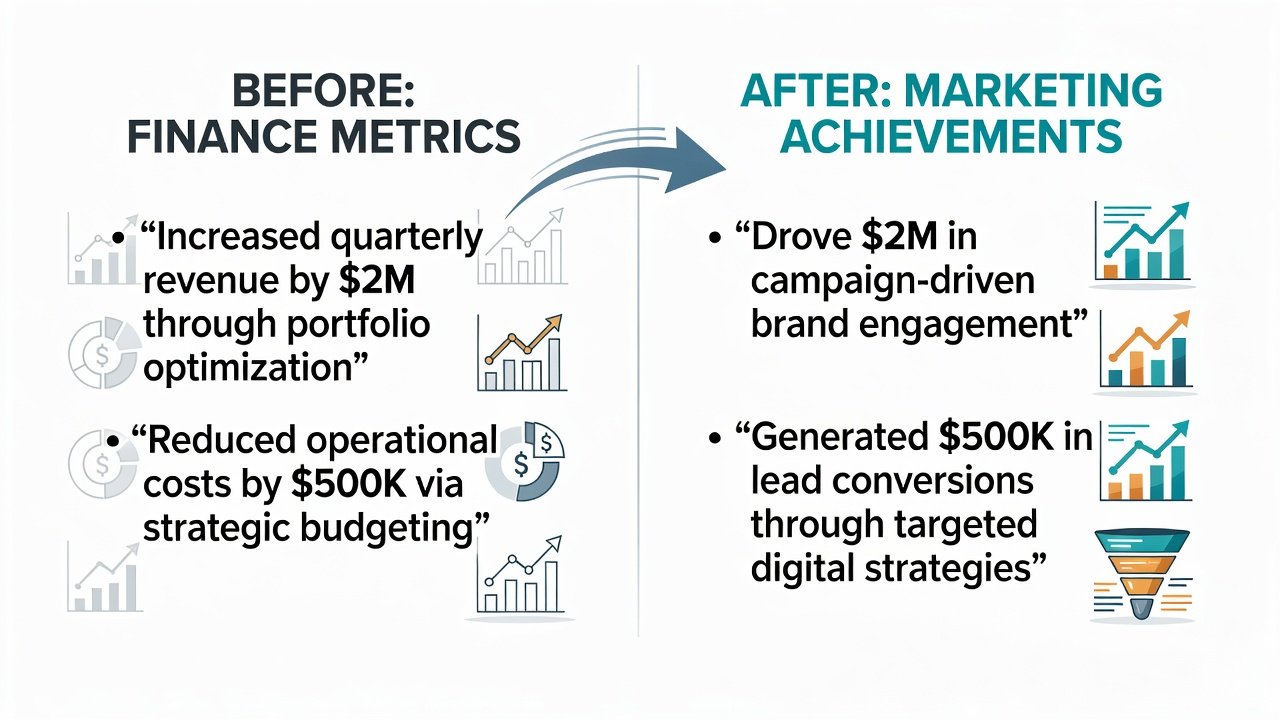
Finance-to-Marketing Transition: Step-by-Step Rewrite Example
Original bullet: “Analyzed financial reports for quarterly reviews.”
Rewritten: “Leveraged data analytics to interpret market trends, driving a 30% increase in campaign targeting efficiency for new product launches.” This reframes analytical skills for marketing impact. Expand further by adding context on tools used and stakeholder outcomes to create a full narrative arc across multiple bullets.
Before-and-After Bullet Points
- Before: “Handled client accounts in banking.” After: “Developed client acquisition strategies that expanded market share by 18% through targeted outreach campaigns, resulting in 45 new high-value accounts over 18 months.”
- Before: “Prepared budgets.” After: “Optimized marketing budgets of $500K+, achieving 22% cost reduction while increasing lead generation by 40% through data-driven allocation.”
- Before: “Led quarterly reviews.” After: “Facilitated cross-departmental performance reviews that informed marketing ROI models, improving forecast accuracy by 35%.”
Education-to-Tech Transition: Step-by-Step Rewrite Example
Original: “Taught curriculum to 150 students annually.”
Rewritten: “Designed and delivered scalable training programs adopted by 150+ learners, improving skill proficiency rates by 40% using learning management systems.” Extend this by incorporating specific technologies and measurable learning outcomes to appeal directly to tech hiring teams.
Before-and-After Bullet Points
- Before: “Managed classroom operations.” After: “Implemented process improvements in educational technology platforms, enhancing user engagement metrics by 35% and reducing administrative time by 25%.”
- Before: “Collaborated with parents.” After: “Coordinated cross-functional teams of educators and developers to launch edtech tools used by 2,000+ users, increasing adoption rates by 50%.”
- Before: “Developed lesson plans.” After: “Created modular training content aligned with Agile sprints, accelerating team onboarding by 30% in a SaaS environment.”
Common Mistakes to Avoid in Career-Change Resumes
Many professionals inadvertently weaken their applications by retaining industry-specific jargon, listing every past role chronologically without prioritization, or failing to customize the resume for each application. Another frequent error is under-emphasizing soft skills that are highly transferable, such as negotiation or change management. To avoid these pitfalls, always tailor the top third of your resume to the new industry and seek feedback from mentors in the target field.
Checklist for Aligning Cover Letters with Your New Narrative
- Open with a one-sentence pivot statement linking past experience to the target role and explaining your motivation for the switch.
- Highlight 2-3 quantified transferable achievements that match job requirements, using the same language as the job posting.
- Address gaps briefly with forward-looking language about recent upskilling or consulting work.
- Close by expressing enthusiasm for the industry shift and specific company goals, referencing one or two recent company achievements.
- Proofread for consistent keywords from the resume and job posting while maintaining a confident, forward-focused tone.
- Keep the letter to three-quarters of a page, ensuring every sentence advances the career-change story.
Short FAQ: Handling Salary History Questions During Industry Switches
Q: Should I disclose previous salary in applications?
A: Many 2026 job markets have salary transparency laws; focus responses on target range research from sources like BLS occupational data rather than past figures.
Q: How do I explain a potential pay cut?
A: Emphasize value alignment: “I’m prioritizing roles offering growth in emerging tech over prior compensation levels.”
Q: What if asked during interviews?
A: Redirect: “My compensation expectations are based on the responsibilities of this position and current market rates for similar mid-career pivots.”
Q: Can I negotiate effectively without revealing history?
A: Yes—anchor discussions to the value you will bring, supported by research on comparable roles and your quantified achievements.
Conclusion
Implementing these resume strategies positions mid-to-late career professionals for successful 2026 industry transitions. By quantifying skills, reframing narratives, and aligning supporting documents, you create a compelling story that resonates with hiring managers across sectors. Start revising today to open new career doors and leverage your extensive experience in fresh, impactful ways.

No comments yet. Be the first!