 Jobboy
Introduction
Mid-career professionals frequently deliver talks at conferences, webinars, and industry events, yet many struggle to feature these experiences effectively on their resumes. In 2026, highlighting speaking engagements can differentiate your application by demonstrating expertise, thought leadership, and communication skills. This guide focuses exclusively on strategic placement and formatting for speaking roles, avoiding overlap with general presentation advice. As the job market evolves with increased emphasis on personal branding and visibility, professionals who effectively document their public speaking contributions stand out during initial resume screens and interviews. Recruiters at top firms note that these entries provide tangible proof of industry influence, making them particularly valuable for roles in technology, marketing, consulting, and education sectors.
Proper integration with your work history ensures these achievements enhance rather than duplicate your professional narrative. With applicant tracking systems becoming more sophisticated, understanding how to present speaking engagements in an ATS-optimized format is essential for maximizing visibility. This comprehensive approach covers every aspect from initial selection to final formatting, ensuring your resume reflects current 2026 best practices.
Why Speaking Engagements Boost Resume Credibility
Speaking at events signals that peers and organizers value your insights. According to insights from LinkedIn, professionals who list public speaking see higher engagement from recruiters scanning for leadership potential. These entries also help quantify soft skills through measurable audience reach, which is increasingly important as hiring teams prioritize candidates who can influence and educate others. In 2026, with remote and hybrid work models persisting, the ability to engage audiences virtually or in person has become a key differentiator. Speaking engagements demonstrate your capacity to synthesize complex information and present it compellingly, traits that translate directly to client-facing and team leadership responsibilities.
Furthermore, these experiences often lead to networking opportunities that can accelerate career growth. When listed strategically, they create a narrative of continuous professional development and external recognition, which internal achievements alone may not convey as powerfully.
Strategic Placement on Your Resume
Place speaking engagements in a dedicated "Speaking Engagements" or "Professional Development" section if you have multiple entries. For fewer items, integrate them under the relevant job role in your experience section. Position this section after your core work history but before education to maintain focus on career progression. Consider your overall resume length and the relevance of each engagement to the target role when deciding placement. For example, if you are applying for a senior marketing position, prioritize talks related to digital strategy over unrelated topics. This targeted approach ensures recruiters quickly identify the value you bring beyond day-to-day responsibilities.
ATS-Friendly Formatting Tips
Applicant tracking systems prioritize clean text. Use standard section headings like "Speaking" and bullet points with keywords such as "keynote," "panel," and "webinar." Avoid tables, graphics, or special characters that may confuse parsers. Spell out acronyms on first use for better scanning. Incorporate industry-specific terms naturally, such as "thought leadership," "audience engagement," or "content delivery," to align with common search queries used by recruiters. Test your formatted resume by copying it into a plain text editor to verify readability. Many systems now incorporate AI-driven parsing, so consistency in date formats and bullet structure further improves success rates.
Citation Styles with Real Examples
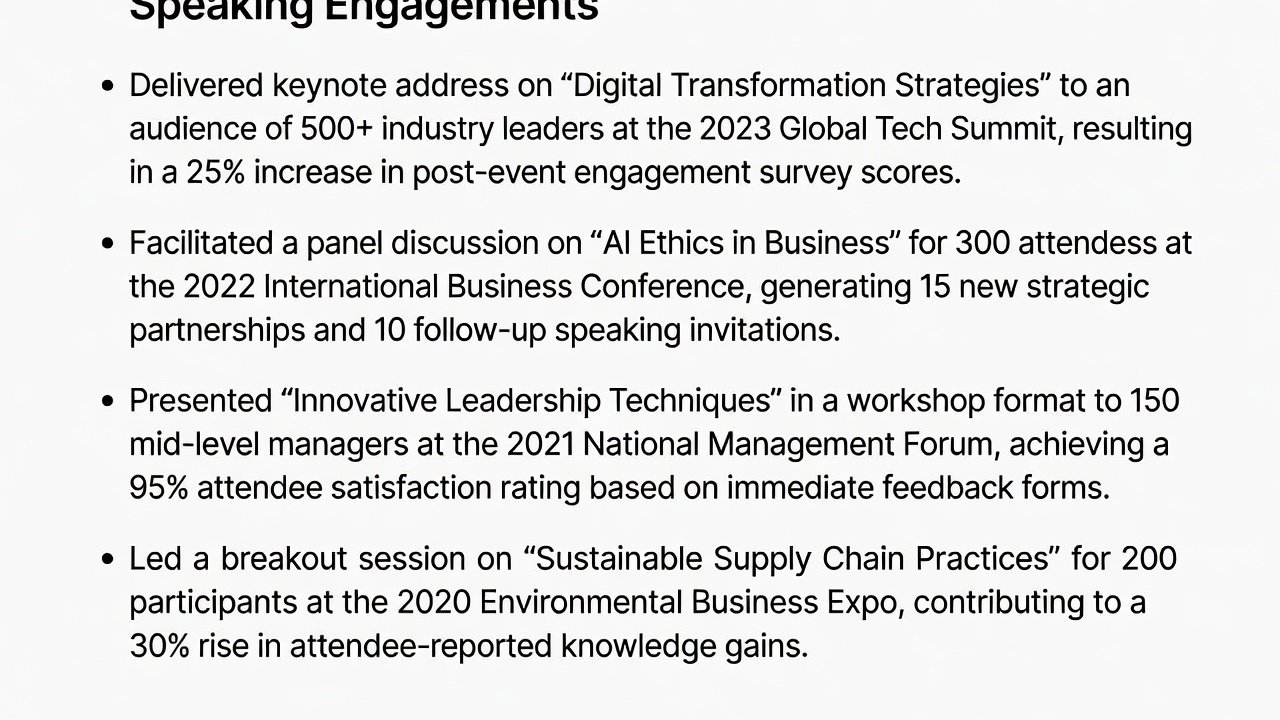
Format each entry consistently: Event name, date, location or platform, and your role. Example: "Keynote Speaker, Global Tech Summit 2025, San Francisco, CA – Delivered session on emerging AI trends to 450 attendees." Another example for a panel discussion: "Panelist, Future of Work Conference, October 2025, Virtual – Moderated discussion on remote team dynamics with four industry experts."
Before-and-after bullet points demonstrate impact: Weak version: "Spoke at conference." Strong version: "Presented to 1,200 virtual attendees at the 2025 Digital Marketing Summit, resulting in 35% increase in post-event inquiries." A third example for internal or smaller events: "Guest Speaker, Regional Sales Summit 2024, Chicago, IL – Trained 85 sales professionals on negotiation techniques, contributing to a 22% rise in quarterly close rates." These transformations show how adding context and results turns generic statements into compelling evidence of expertise.
Quantifying Audience Impact
Include metrics like attendee numbers, engagement rates, or follow-up outcomes when available. For webinars, note platform reach or recording views. These details help recruiters understand scale without needing external verification. When exact numbers are unavailable, use ranges or qualitative descriptions supported by outcomes, such as "addressed over 500 professionals" or "generated follow-up interest from 30% of participants." Track these figures through event organizer reports, registration data, or post-event analytics to ensure accuracy. In 2026, many platforms provide detailed dashboards that make quantification straightforward, allowing you to highlight both breadth and depth of influence.
Common Mistakes to Avoid
- Listing every minor talk without selectivity, which can dilute the impact of your strongest entries
- Omitting dates or audience size, leaving recruiters without context for the achievement
- Duplicating content already covered in job descriptions, which wastes valuable resume space
- Using inconsistent formatting across entries, which creates a disorganized appearance
- Failing to tailor entries to the target job, missing opportunities to align with employer priorities
- Overstating audience size or outcomes, which can be verified during background checks or references
Checklist for Integration with Work History
- Review your last five years of events and compile a master list including dates, topics, and outcomes
- Select 3–5 most relevant talks that best support your current career goals and the job description
- Align each with current career goals by emphasizing transferable skills like leadership or innovation
- Verify dates and metrics for accuracy using original event materials or correspondence
- Proofread for ATS keywords and ensure language mirrors terminology in the job posting
- Test formatting in plain text and multiple document formats to confirm compatibility
- Update the section quarterly to reflect new engagements and maintain freshness
Recruiter Insights on Credibility
Hiring managers at leading firms value speaking experience because it reflects current industry knowledge. A well-placed entry can spark conversation in interviews and position you as a subject-matter expert. Insights from Indeed highlight that candidates with documented speaking roles often advance faster through screening stages. Recruiters also appreciate when these entries are tied to measurable business outcomes, as this demonstrates practical application of knowledge rather than theoretical expertise alone. In competitive applicant pools, such details provide the edge needed to secure interviews.
FAQ: Virtual vs. In-Person Events
How should I format virtual speaking engagements?
Treat them identically to in-person events, noting the platform (e.g., "Zoom webinar") and reach metrics. Include "virtual" only if it adds clarity about delivery method.
Does audience size matter more for in-person or virtual?
Both benefit from numbers. Virtual events often allow precise tracking of registrations and views, which strengthens the entry and provides verifiable data.
Should older speaking roles be included in 2026?
Focus on the past 3–5 years unless an older talk directly supports a target role. Prioritize recent, high-impact engagements that showcase ongoing relevance.
What if my speaking role was as a moderator rather than presenter?
Frame it as facilitation experience: "Moderated panel discussion featuring five experts, guiding audience Q&A for 300 participants and synthesizing key takeaways."
Conclusion
Strategic listing of speaking engagements in 2026 elevates your resume by showcasing expertise and reach. Follow the formatting, quantification, and checklist guidance above to maximize ATS visibility and recruiter interest. Update your document regularly as new opportunities arise to maintain a competitive edge in today's dynamic job market.

No comments yet. Be the first!