 Jobboy

Introduction
Job interviews in 2026 demand more than memorized responses. With evolving hiring practices influenced by AI screening tools, hybrid work models, and emphasis on measurable results, candidates must deliver structured, evidence-based answers. This comprehensive guide equips job seekers with frameworks for the most frequently asked questions, explaining recruiter intent and providing practical templates, industry examples, and strategies to differentiate yourself in competitive markets.
Whether targeting entry-level positions or senior leadership, preparation focused on authenticity combined with data-driven storytelling increases success rates significantly.
Understanding the 2026 Job Market Context
The employment landscape continues to shift with greater integration of remote technologies and skills-based hiring. Recruiters prioritize adaptability, digital fluency, and cultural alignment. According to resources from the U.S. Bureau of Labor Statistics, sectors like technology, healthcare, and renewable energy show sustained growth, making targeted preparation essential.
The STAR Method: Mastering Behavioral Responses
The STAR framework provides a reliable structure for answering situational questions. Begin with the Situation to establish context, outline your Task, detail specific Actions taken, and conclude with measurable Results. This method prevents rambling while highlighting impact.
Applying STAR in Practice
For a project management role, a candidate might describe leading a delayed product launch: Situation involved a cross-functional team facing supply chain issues; Task was to realign timelines; Actions included implementing agile sprints and stakeholder meetings; Result achieved on-time delivery with 25% cost savings.
Common Question 1: Tell Me About Yourself
This question tests your ability to summarize relevant experience concisely. Limit responses to 60-90 seconds and connect past roles directly to the position.
Strong Response Example from Marketing
“With over six years in digital marketing, I have specialized in performance campaigns for consumer brands. Most recently at a mid-sized agency, I led a team that boosted client engagement metrics by 62% through targeted content strategies. I am drawn to this role because your company’s expansion into emerging markets matches my experience with international SEO optimization.”
Strong Response Example from Tech
“As a software engineer focused on backend systems, I have developed scalable APIs for fintech applications. At my previous startup, I optimized database queries resulting in 40% faster load times. This opportunity appeals to me due to your emphasis on secure cloud infrastructure, aligning with my recent AWS certification work.”
Common Question 2: What Are Your Greatest Strengths and Weaknesses?
Strengths should pair with proof. Weaknesses require honesty paired with improvement plans. Avoid clichés like perfectionism.
Example strength: “My strength lies in analytical problem-solving. In a recent logistics project, I identified inefficiencies that reduced delivery times by 18%.”
Example weakness: “I sometimes overcommit to details. I now use prioritization frameworks and weekly reviews to maintain balance across projects.”
Common Question 3: Why Do You Want to Work Here?
Demonstrate research by referencing recent company news, values, or initiatives. Generic answers fail here.
Link to authoritative career guidance via USA.gov career resources for deeper employer research techniques.
Common Question 4: Describe a Challenge You Overcame
Use STAR to narrate resilience. Include team dynamics and personal growth.
Common Question 5: Where Do You See Yourself in Five Years?
Align aspirations with company growth paths. Show ambition without implying immediate departure.
Incorporating Quantifiable Achievements Across Industries
Numbers build credibility. In sales, cite revenue increases; in operations, mention efficiency gains; in education, reference student outcome improvements. Always verify data accuracy and prepare supporting stories.
Real-world examples include a healthcare administrator who reduced patient wait times by 35% through process redesign, or an engineer who cut production errors from 12% to under 3% via new protocols.
Handling Follow-Up Probes and Role-Specific Adaptations
Follow-ups test depth. Prepare variations of core stories. For tech roles, emphasize coding decisions and scalability. Healthcare interviews often explore compliance and empathy scenarios. Marketing positions may probe campaign ROI analysis.
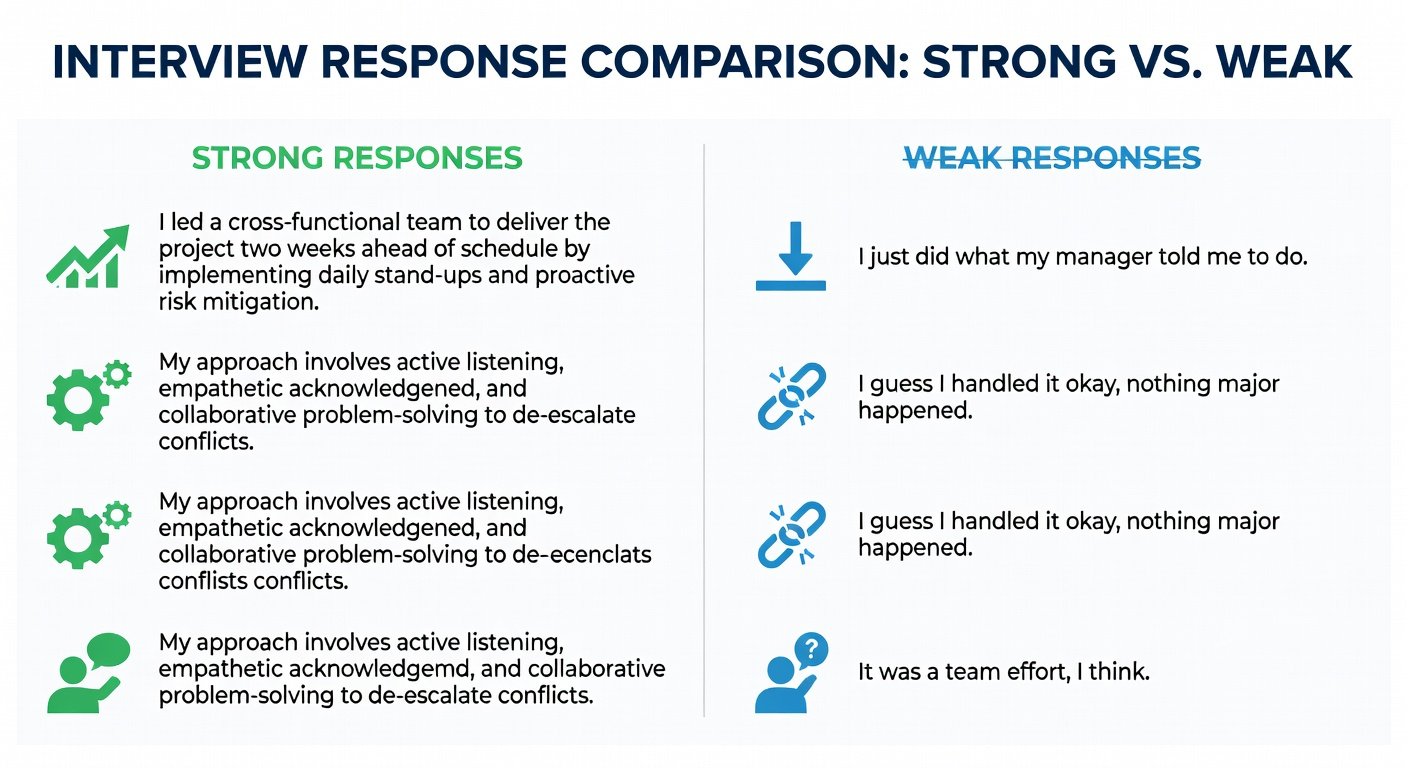
Strong Versus Weak Responses: Detailed Comparisons
- Leadership question: Strong includes team size, obstacles, and 30% productivity lift. Weak offers only “I motivate people well.”
- Conflict resolution: Strong details mediation steps and positive resolution outcome. Weak generalizes without specifics.
- Innovation example: Strong quantifies time saved or revenue generated. Weak describes ideas without execution results.
Common Pitfalls and How to Dodge Them
- Providing answers longer than two minutes without structure.
- Ignoring the job description keywords in responses.
- Overlooking remote collaboration skills critical in 2026 hybrid settings.
- Failing to ask thoughtful questions at the end.
Managing Interview Anxiety Effectively
Preparation reduces nerves. Conduct mock interviews, practice mindfulness breathing, and visualize successful outcomes. Record yourself to refine delivery and pacing.
Navigating Cultural Nuances in Global Interviews
International roles require awareness of communication styles. Some cultures value directness while others prefer indirect feedback. Research company headquarters norms and adjust storytelling accordingly, balancing confidence with respect.
FAQ
How should I prepare for virtual interviews in 2026?
Test technology in advance, maintain eye contact via camera, and ensure a professional background. Incorporate examples of remote tool proficiency.
What if I lack direct experience for the role?
Highlight transferable skills and willingness to learn, supported by quick upskilling examples like online courses completed recently.
How do I address employment gaps?
Frame gaps positively by discussing skill development, freelance projects, or personal growth during that period.
Are there differences in answering for startups versus corporations?
Startups favor agility and broad impact stories; corporations value process adherence and scale examples.
Conclusion
Consistent practice with these frameworks builds confidence and clarity. By focusing on structure, evidence, and relevance, you position yourself as the ideal candidate ready for 2026 opportunities. Combine this preparation with genuine enthusiasm to create memorable impressions throughout the interview process.


No comments yet. Be the first!