 Jobboy

Introduction
In today’s fast-paced professional landscape, where technological advancements and industry shifts occur almost daily, job seekers must demonstrate a proactive approach to skill development. The title “How to Highlight Lifelong Learning on Your Resume in 2026” captures the essence of what recruiters seek: evidence of continuous growth. This comprehensive guide walks you through every aspect of integrating courses, certifications, and self-taught abilities into your resume without diminishing the impact of your core work history. You will learn how to choose the most relevant learning experiences, format them for applicant tracking systems, and quantify their real-world effects.
Why Lifelong Learning Matters in 2026
Employers across sectors recognize that static skill sets quickly become obsolete. According to the U.S. Bureau of Labor Statistics, workers who engage in ongoing education experience greater career mobility and resilience during economic transitions. In 2026, hiring managers routinely scan resumes for signals of adaptability, such as recent micro-credentials or project-based learning. Highlighting lifelong learning positions you as someone who anticipates change rather than reacts to it, which is especially valuable in fields like technology, healthcare, and finance where new tools and regulations emerge constantly.
Selecting Relevant Learning Entries
The first critical step involves curating which learning experiences deserve space on your resume. Begin by aligning each entry with the specific requirements listed in the target job description. For instance, if a role emphasizes data analytics, prioritize certifications in Python or Tableau over unrelated personal development workshops. Limit entries to those completed within the past five years unless an older credential remains foundational. Consider including self-directed projects that demonstrate application, such as building a public GitHub repository after completing an online coding course. Exclude generic or outdated items like basic computer literacy classes that most professionals already possess. This selective process ensures your resume remains focused and impactful.
Formatting Options for ATS Compatibility
Applicant tracking systems rely on clean, keyword-rich text to parse resumes accurately. Use standard headings such as “Certifications” or “Professional Development” and avoid creative titles that confuse algorithms. Always spell out acronyms on first mention, followed by the abbreviation in parentheses. Incorporate exact phrases from the job posting, such as “agile methodologies” or “cloud architecture,” naturally within bullet points. Each learning entry should feature an action-oriented description followed by measurable outcomes. Consistent date formatting and bullet structure further improve readability for both machines and human reviewers.
Step-by-Step Placement Strategies
Placement depends on your career stage and the emphasis you wish to place on learning. Early-career professionals may position the Professional Development section immediately after the summary to compensate for limited experience. Mid-level candidates often place it after the Experience section to maintain focus on achievements. Senior applicants might integrate learning highlights within individual job entries to show evolution over time. Always list items in reverse chronological order and include a one-sentence impact statement for each. Tailor placement for each application by moving sections up or down based on the job’s stated priorities.
Before-and-After Examples Across Industries
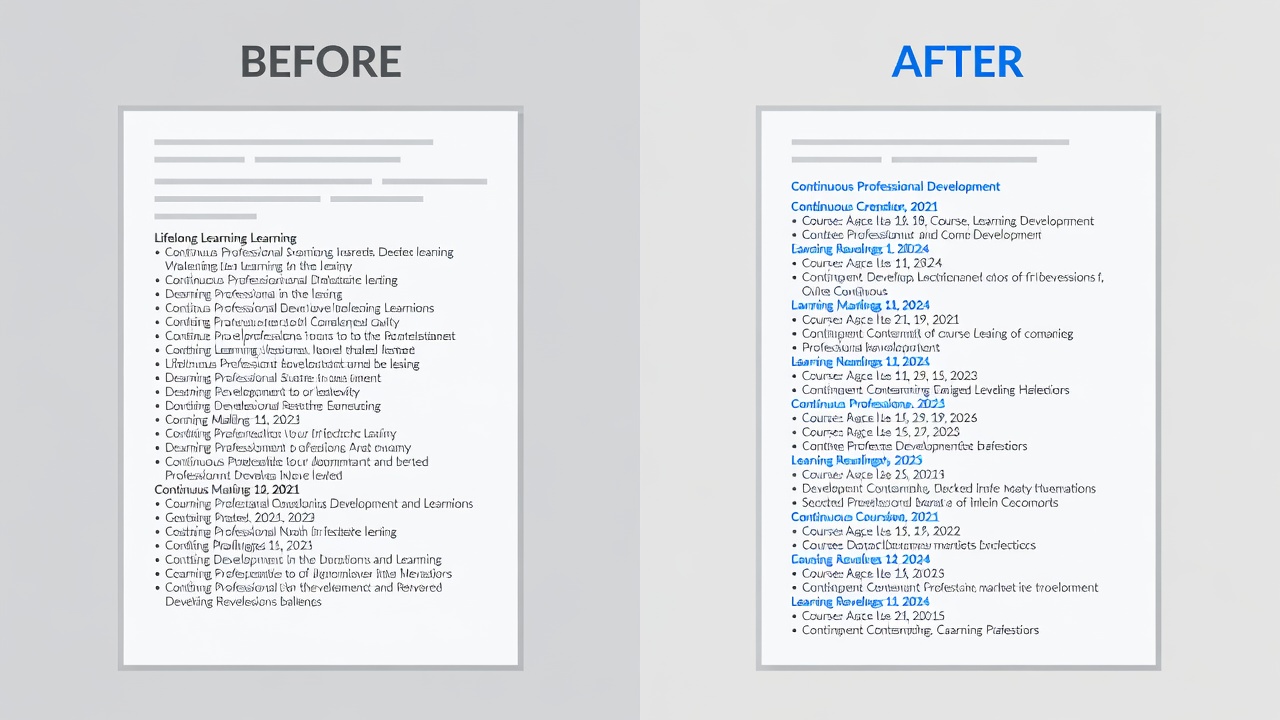
Concrete examples illustrate the transformation from vague to compelling. In technology: Before simply stated “Took online courses.” After reads: “Completed AWS Solutions Architect certification in 2025 and applied cloud optimization techniques that reduced infrastructure costs by 35%.” In marketing: Before listed “Digital marketing classes.” After details: “Earned Google Analytics Individual Qualification and implemented new tracking strategies resulting in a 28% increase in conversion rates.” In healthcare: Before noted “Attended webinars.” After specifies: “Completed Johns Hopkins COVID-19 Contact Tracing certification and trained 12 team members on updated protocols.” In finance: Before mentioned “Finance workshops.” After highlights: “Achieved CFA Level 1 credential in 2025 and improved portfolio risk assessment accuracy by 22%.” These revisions demonstrate direct value rather than passive participation.
Using Metrics to Demonstrate Impact
Quantifiable results turn learning entries into persuasive evidence. Instead of listing course titles alone, attach outcomes such as percentage improvements, time savings, or team growth numbers. For example, note how a project management certification enabled you to deliver three additional client projects per quarter. When exact numbers are unavailable, use qualitative yet specific language supported by context, such as “streamlined onboarding process for new hires.” This approach transforms learning from an abstract activity into a documented driver of business results.
Practical Checklist for Highlighting Lifelong Learning
- Analyze three to five target job descriptions and extract recurring skill keywords.
- Select only four to six learning experiences that map directly to those keywords.
- Verify each credential remains current and relevant as of 2026.
- Format entries with consistent headings, dates, and bullet structure.
- Proofread for spelling, grammar, and ATS-friendly terminology.
- Cross-reference your resume with LinkedIn and portfolio links.
- Request feedback from a mentor or career coach before submitting.
Traditional vs. Modern Learning Highlights Comparison
Traditional resumes emphasize formal degrees and one-time seminars completed years ago. Modern resumes prioritize micro-credentials, stackable certificates, and demonstrated application through personal projects or workplace innovations. Modern entries often include platform names like Coursera or LinkedIn Learning when those credentials carry industry recognition. This shift reflects employer preference for agile, just-in-time skill acquisition over static academic pedigrees. Comparing both approaches side by side reveals that modern highlights typically occupy less space yet convey greater relevance to current job demands.
Common Mistakes to Avoid
Many candidates undermine their resumes by over-listing every workshop attended or including credentials unrelated to the role. Another frequent error involves neglecting to update dates, leaving recruiters questioning recency. Some applicants also fail to connect learning to on-the-job results, resulting in a laundry list that feels disconnected from performance. Finally, inconsistent formatting across sections can trigger ATS rejection. Avoiding these pitfalls keeps your document professional and targeted.
FAQ: Common Pitfalls to Avoid
How many courses should I list? Limit to four to six high-impact items to prevent diluting the strength of your professional experience section.
Should I include free online courses? Yes, provided they align with job requirements and you can show tangible application or results.
What if my credentials are outdated? Remove them or note any recent refresher modules; emphasize current applicability instead.
How do I handle over-listing? Group related courses under a single umbrella entry when they form a cohesive learning path.
Is it necessary to provide links to certificates? Include hyperlinks only if space permits and the credential adds significant credibility.
Conclusion
Successfully showcasing lifelong learning on your resume in 2026 demands thoughtful selection, precise formatting, and clear demonstration of impact. By applying the strategies outlined above, you present yourself as an adaptable professional prepared for evolving industry demands. Review your current resume, implement these recommendations, and position yourself competitively in today’s dynamic job market.


No comments yet. Be the first!