 Jobboy

How to Handle Illegal Interview Questions in 2026
Job interviews in 2026 demand both strong qualifications and a clear understanding of your legal rights. Illegal questions can appear suddenly, often touching on protected categories that federal law safeguards. This comprehensive guide explores U.S. employment protections in depth, provides numerous scripted responses, shares industry-specific examples, and outlines escalation and documentation strategies so you can respond with confidence and professionalism.
U.S. Employment Laws on Protected Categories
Federal statutes form the backbone of interview protections. Title VII of the Civil Rights Act bans discrimination based on race, color, religion, sex, and national origin. The Age Discrimination in Employment Act covers workers aged 40 and older. The Americans with Disabilities Act prohibits questions about disabilities or medical conditions unless they directly relate to essential job functions. Additional layers include the Pregnancy Discrimination Act, the Genetic Information Nondiscrimination Act, and protections for veterans under the Uniformed Services Employment and Reemployment Rights Act. The Equal Employment Opportunity Commission investigates charges and offers guidance on what constitutes an illegal inquiry. Employers must also comply with state laws that sometimes extend further protections, such as those covering sexual orientation, gender identity, or criminal history in certain jurisdictions.
Preparing Before the Interview
Preparation reduces anxiety when unexpected questions arise. Research the company’s equal employment opportunity policy on their website and review recent EEOC guidance. Practice common illegal questions aloud using a mirror or recording device. Prepare a concise personal script for redirecting conversations. Assemble documents such as your resume, references, and notes about your achievements so you can quickly pivot to relevant qualifications. Consider role-playing with a mentor or career coach to refine your tone and body language. This groundwork helps you stay calm and focused during the actual meeting.
Common Examples of Illegal Questions
Interviewers sometimes ask about family plans, age, religion, or health without realizing the implications. Typical illegal questions include “Do you have children or plan to?” “How old are you?” “What is your marital status?” “Where were you born?” “What religion do you practice?” and “Have you ever been treated for mental health issues?” Questions about citizenship status beyond basic work authorization or inquiries into political affiliations also cross legal boundaries in most contexts. Recognizing these patterns allows you to respond swiftly and professionally.
Scripted Response Frameworks with Variations
Effective replies redirect without confrontation. Core frameworks include the polite pivot (“I’m excited to discuss my qualifications for this role—could we focus on how my project management experience would benefit your team?”), the relevance check (“I’m not certain how that connects to the position. Can you clarify what aspects of the job you’re hoping to learn more about?”), and the boundary statement (“I prefer to keep personal matters separate from professional discussions. Let me share an example of how I handled a similar challenge at my previous company.”). Adapt these scripts based on interview format. In video calls, maintain eye contact with the camera while delivering your response. On phone interviews, pause briefly to gather your thoughts before answering.
Real-World Examples Across Career Stages
A mid-career marketing professional was asked about childcare arrangements during a panel interview. She replied, “I’m fully prepared to meet the demands of this role, as demonstrated by my successful management of three major campaigns last year while maintaining high performance standards.” An entry-level software engineer faced an age-related question about “fitting in with younger team members” and responded by highlighting recent open-source contributions and agile methodology certifications. In healthcare, a nurse candidate redirected a question about physical limitations by emphasizing her track record of lifting and patient care protocols. These examples illustrate how redirecting keeps the conversation centered on job-related strengths.
During the Interview: Real-Time Strategies
Stay composed by taking a slow breath before responding. Listen carefully to the full question to determine intent. If the question seems borderline, ask for clarification rather than assuming malice. Use positive language that reinforces your enthusiasm for the role. Maintain professional posture and avoid defensive tones. If multiple illegal questions occur, note them mentally for later documentation without interrupting the flow of the interview.
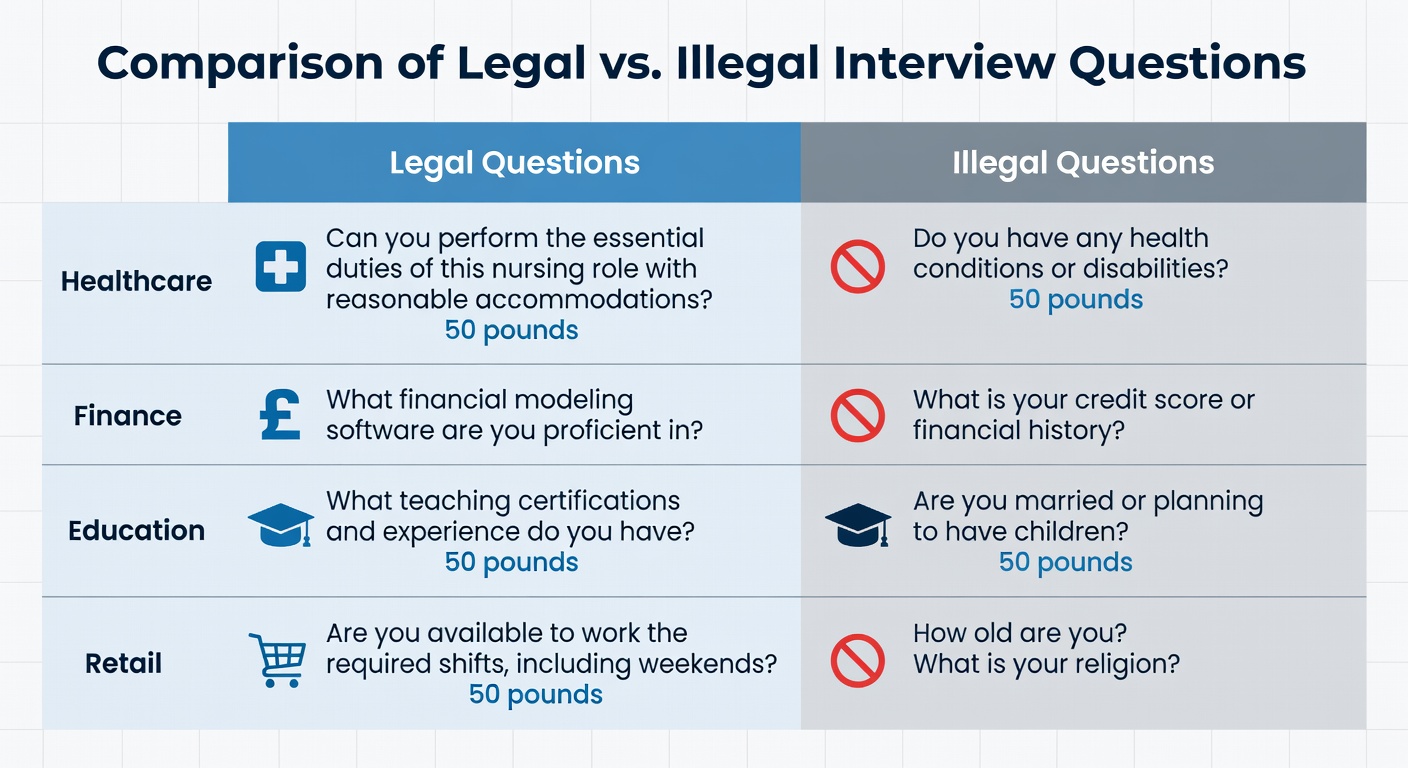
Legal vs. Illegal Questions by Industry
| Industry | Legal Question | Illegal Question |
|---|---|---|
| Healthcare | Are you able to perform the essential functions of this nursing position with or without reasonable accommodation? | Do you have any chronic illnesses or take prescription medications? |
| Finance | Can you travel for client meetings on short notice? | Are you planning to start a family in the next few years? |
| Education | How do you differentiate instruction for diverse learners? | What is your religious background or political affiliation? |
| Retail | Are you available to work evenings and weekends during peak seasons? | How many children do you have and who watches them? |
| Technology | What programming languages are you most proficient in? | How old are you and do you keep up with new trends? |
| Manufacturing | Can you lift 50 pounds repeatedly as part of daily operations? | Have you ever filed a workers’ compensation claim? |
Understanding Bona Fide Occupational Qualifications
Some questions become legal when they relate to a bona fide occupational qualification essential to the job. For example, asking about age may be permissible for roles requiring actors to portray specific age groups. Religious organizations can inquire about faith for certain positions. Always evaluate whether the question directly ties to job performance before assuming it is illegal.
State-Specific Laws and Additional Protections
Many states offer broader safeguards. California and New York prohibit questions about salary history in some contexts, while Illinois and Massachusetts extend protections to criminal records. Review your state labor department website before interviewing to understand local nuances that complement federal law.
Escalation Steps If Needed
Document every illegal question immediately after the interview, including exact wording, interviewer name, date, and surrounding context. If you believe discrimination occurred, file a charge with the EEOC within 180 days. The agency offers mediation services and investigates claims. You may also contact your state fair employment practices agency for parallel support. The Department of Labor provides additional worker rights information.
Post-Interview Documentation and Follow-Up
Retain copies of the job description, your application materials, and any correspondence. Send a professional thank-you email that reiterates your interest while avoiding mention of problematic questions unless you decide to withdraw. If you choose to report, organize your notes chronologically and include witness contact information if available.
Common Mistakes to Avoid
- Over-explaining personal details in an attempt to be helpful
- Becoming visibly upset or confrontational
- Ignoring the question entirely without redirecting
- Failing to document incidents promptly
- Assuming all unusual questions are illegal without considering job relevance
Building Long-Term Confidence
Regular practice with mock interviews builds resilience. Join professional networks or career workshops that simulate challenging scenarios. Review successful case studies published by the EEOC to understand how others navigated similar situations. Over time, these strategies become second nature.
FAQ: Reporting to the EEOC
How long do I have to file? Generally 180 days from the incident, though some states extend this period.
Can I remain anonymous? Charges are typically shared with the employer during investigation, but initial intake can begin confidentially.
What remedies are available? Possible outcomes include back pay, reinstatement, policy changes, and compensatory damages depending on the case.
Should I continue the hiring process? Many candidates proceed while documenting concerns, allowing them to evaluate the full opportunity before deciding next steps.
Conclusion
Mastering responses to illegal interview questions empowers you to protect your rights while showcasing your professional value. Through thorough preparation, clear redirection techniques, and proper documentation, you can navigate 2026 interviews with confidence and integrity. Stay informed about evolving laws and advocate for fair hiring practices in every interaction.


No comments yet. Be the first!