 Jobboy

Introduction
Job interviews in 2026 continue to evolve rapidly, with hiring managers across sectors relying on curveball questions to evaluate how candidates think under pressure, demonstrate adaptability, and reveal authentic problem-solving abilities. These unexpected prompts go beyond standard behavioral questions and can catch even seasoned professionals off guard. This comprehensive guide examines seven authentic case studies drawn from tech, finance, and healthcare, providing detailed step-by-step frameworks that help you respond with clarity and confidence.
Mid-career professionals particularly benefit from these insights because they often bring substantial experience yet must still prove ongoing relevance in dynamic markets. By mastering these techniques, you can transform challenging moments into powerful demonstrations of your core strengths and cultural alignment with prospective employers.
Understanding Curveball Questions in Modern Interviews
Curveball questions are intentionally open-ended or scenario-based to bypass prepared answers and observe real-time reasoning. In tech environments, they often probe innovation and systems thinking. Finance roles test regulatory awareness and ethical judgment during volatile conditions. Healthcare interviews emphasize empathy, quick prioritization, and patient advocacy under constraints. Examples range from abstract hypotheticals like redesigning entire industries to personal ethical dilemmas that require balancing multiple stakeholder needs.
Recognizing patterns helps candidates prepare without memorizing scripts. Common themes include resource limitations, communication challenges with non-experts, and rapid adaptation to new information. Understanding these patterns allows you to stay composed and deliver structured replies that highlight transferable skills.
Step-by-Step Framework for Handling Curveball Questions
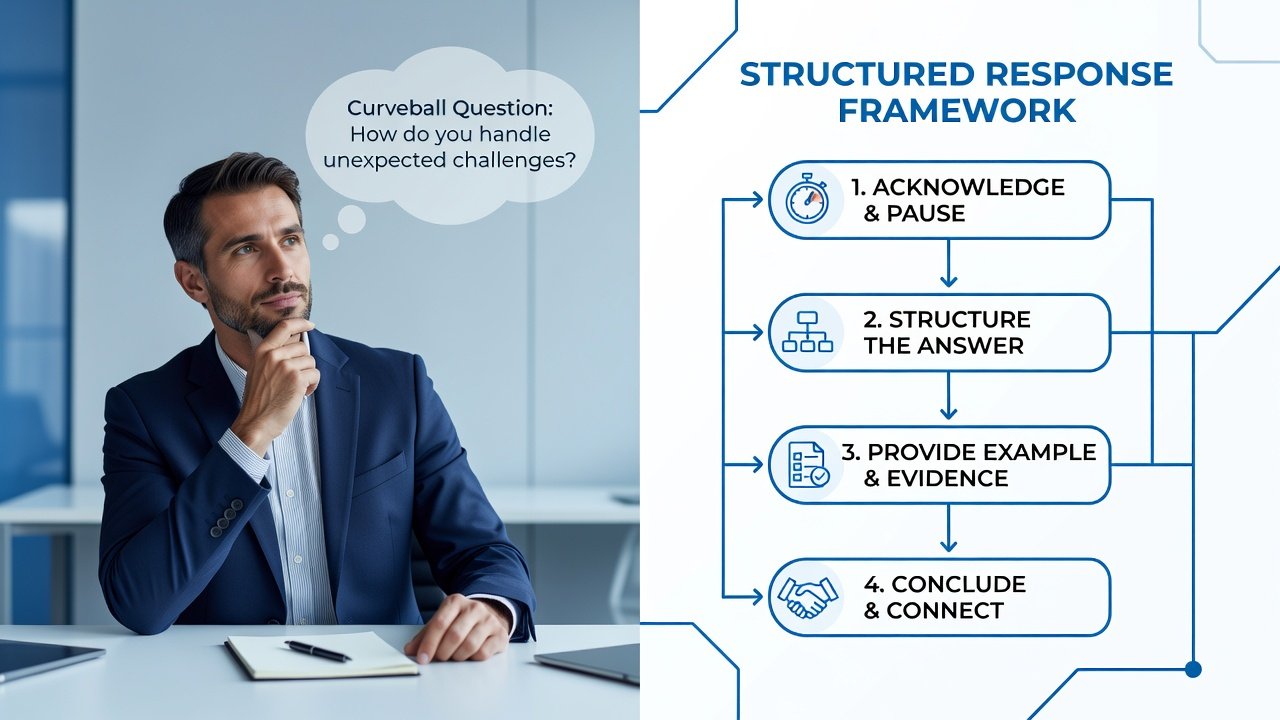
Apply this proven five-step approach every time: First, pause for three to five seconds to absorb the question fully and signal thoughtfulness rather than panic. Second, seek clarification if any element feels ambiguous, showing active listening. Third, apply an adapted STAR method by outlining the situation or hypothetical context, your task or objective, specific actions you would take, and anticipated results with measurable outcomes. Fourth, explicitly connect your response to job-relevant competencies such as leadership or data analysis. Fifth, close with a brief forward-looking statement about how this approach would benefit the team.
Practicing this sequence builds muscle memory so responses flow naturally even when surprised. Each step prevents rambling while keeping answers concise yet substantive, typically lasting 60 to 90 seconds.
7 Real Case Studies Across Industries
Tech Case Study 1: A senior software engineer faced the question, "If you could redesign the internet from scratch, what single change would you prioritize?" The winning response acknowledged technical and regulatory constraints before focusing on enhanced privacy protocols, then linked the idea to previous work scaling secure user authentication systems. Pitfall to avoid: Jumping straight to technical jargon without explaining business value.
Tech Case Study 2: Candidates were asked to explain machine learning concepts to a five-year-old. Strong answers used everyday analogies like teaching a child to recognize fruits, while weaving in personal examples of simplifying complex projects for cross-functional teams. Weak replies stayed overly technical or ignored the audience element entirely.
Finance Case Study 3: An analyst encountered, "A high-value client insists on an investment approach that skirts regulatory guidelines—what steps would you take?" Successful candidates outlined immediate escalation procedures, referenced specific compliance frameworks, and emphasized long-term client education. Common error: Agreeing too quickly or failing to mention documentation.
Finance Case Study 4: Rapid market-shift scenarios required candidates to recalculate risk models verbally. Top performers structured their thinking aloud, cited recent market data patterns, and proposed mitigation strategies tied to portfolio goals.
Healthcare Case Study 5: "A family member demands treatment that contradicts the patient’s documented wishes—how do you respond?" Effective answers balanced empathy with legal protocols, described de-escalation techniques, and referenced interdisciplinary team involvement for resolution.
Healthcare Case Study 6: Resource allocation dilemmas during staffing shortages tested prioritization logic. Strong responses applied ethical triage principles, quantified impacts on patient outcomes, and highlighted collaborative decision-making with nursing leadership.
Cross-Industry Case Study 7: A hybrid role question asked how candidates would integrate data analytics from tech, risk assessment from finance, and patient empathy from healthcare into one initiative. Winners demonstrated interdisciplinary synthesis by proposing a phased pilot project with clear success metrics.
Mid-Career Professional Tips
Mid-career applicants should frame curveball responses around leadership evolution and measurable impact from the past five to ten years. Reference specific promotions or cross-functional projects to illustrate growth. Avoid over-explaining early career details; instead, emphasize how recent experiences prepare you for the target role’s challenges. Tailor cultural fit examples to the company’s published values, which can be researched through official career pages.
Practical Exercises to Build Resilience
- Daily improvisation drills: Spend ten minutes responding aloud to randomly generated prompts from a list of 50 curveballs.
- Recorded mock interviews: Partner with a colleague and review footage for filler words or unstructured tangents.
- Journal reflections: After each real interview, note the curveball questions and refine your answers using the five-step framework.
- Peer feedback sessions: Exchange practice questions weekly and score responses on clarity, relevance, and confidence.
Tying Answers to Core Skills and Cultural Fit
Every response should explicitly bridge to problem-solving by citing quantifiable results from past work and to cultural fit by referencing shared values such as innovation or patient-centric care. For instance, after describing an action, add a sentence like, "This approach aligns with your organization’s commitment to ethical transparency, as evidenced by recent initiatives highlighted on your site." This technique reinforces both competence and belonging.
Quick-Reference Cheat Sheet
- Pause briefly and breathe to reset.
- Clarify any unclear elements.
- Structure with STAR or similar framework.
- Quantify impacts and link to role requirements.
- End with a positive, team-oriented insight.
- Follow up in thank-you notes with one relevant takeaway.
FAQ on Follow-Up Actions
Q: Should I address a curveball question in my thank-you email? A: Yes, briefly note one insight you gained from the discussion and how it reinforced your interest in the role.
Q: What if I realize my answer was incomplete after the interview? A: In the follow-up message, provide a concise additional example without dwelling on the shortfall, focusing instead on continued enthusiasm.
Q: How soon should I send follow-up communication? A: Within 24 hours, keeping the tone professional and referencing specific conversation moments.
Additional guidance is available from authoritative sources including Harvard Business Review and SHRM, which publish regularly updated interview strategy resources.
Conclusion
Handling curveball questions effectively in 2026 requires deliberate practice and structured thinking. By studying these case studies and applying the frameworks consistently, you will approach interviews with greater resilience and turn unexpected moments into compelling proof of your capabilities.

No comments yet. Be the first!