 Jobboy

Why AI Ethics Questions Matter More in 2026 Interviews
Employers across industries are ramping up their focus on AI ethics during hiring processes because responsible AI development directly impacts trust, compliance, and long-term business sustainability. In 2026, candidates who can articulate nuanced views on emerging issues like algorithmic accountability and societal impact will stand out. This preparation guide dives deep into 2026-specific angles, including updated bias detection methodologies, privacy-by-design implementations, ESG alignment strategies, and actionable frameworks drawn from real deployments in technology and financial services. By mastering these topics, you position yourself as a forward-thinking professional ready to navigate complex ethical landscapes while contributing to ethical AI innovation.
Emerging AI Regulations Shaping 2026 Interviews
Understanding the regulatory environment is essential for demonstrating awareness during interviews. The EU AI Act has entered advanced enforcement phases, categorizing AI systems by risk levels and mandating transparency for high-risk applications. In the United States, federal agencies continue refining guidance through executive actions and sector-specific rules. Candidates should prepare to discuss how these regulations influence model auditing, documentation requirements, and cross-border data flows. Reference resources from authoritative bodies such as NIST for AI risk management frameworks and White House AI policy updates to show you track evolving standards. Interviewers often probe how you would adapt development pipelines to meet conformity assessments or conduct impact evaluations under new rules.
Privacy Frameworks Every Candidate Must Know
Privacy remains a cornerstone of AI ethics conversations in 2026. Review core principles from GDPR enhancements and emerging state-level data protection statutes that emphasize data minimization, purpose limitation, and user consent mechanisms. Explain how you would integrate privacy-preserving techniques such as differential privacy or federated learning into AI training processes. Be ready with examples of how poor privacy handling has led to regulatory fines or reputational damage in recent cases. Interviewers may present scenarios involving biometric data or large-scale user profiling and expect you to outline mitigation steps that balance innovation with individual rights.
Integrating ESG Principles with AI Ethics
Environmental, social, and governance considerations now heavily overlap with AI ethics discussions. Candidates should articulate how AI systems can support sustainability goals, such as optimizing energy consumption in data centers or promoting equitable access to financial services. ESG integration demonstrates strategic thinking beyond technical skills. Discuss governance structures like ethics review boards and social impacts including workforce displacement from automation. Prepare examples showing how your previous work aligned AI projects with broader ESG objectives, highlighting measurable outcomes like reduced bias in hiring tools that improved diversity metrics.
Real-World Bias Mitigation: Tech and Finance Case Studies
Bias detection and mitigation represent high-priority topics for 2026 interviews. In technology, leading firms deploy tools that measure fairness across demographic groups using metrics such as demographic parity and equalized odds during model evaluation. For instance, a major tech company revised its recommendation algorithms after discovering skewed outputs favoring certain user segments, resulting in improved engagement balance. In finance, credit decision models have been audited for disparate impact on protected classes, leading to adjusted feature selection and post-processing techniques that lowered rejection rate disparities. Prepare detailed case studies from your experience or public examples, including the bias detection tools employed, quantitative improvements achieved, and ongoing monitoring protocols. These stories illustrate your ability to move from identification to remediation with tangible results.
Using the STAR Method for AI Ethics Responses
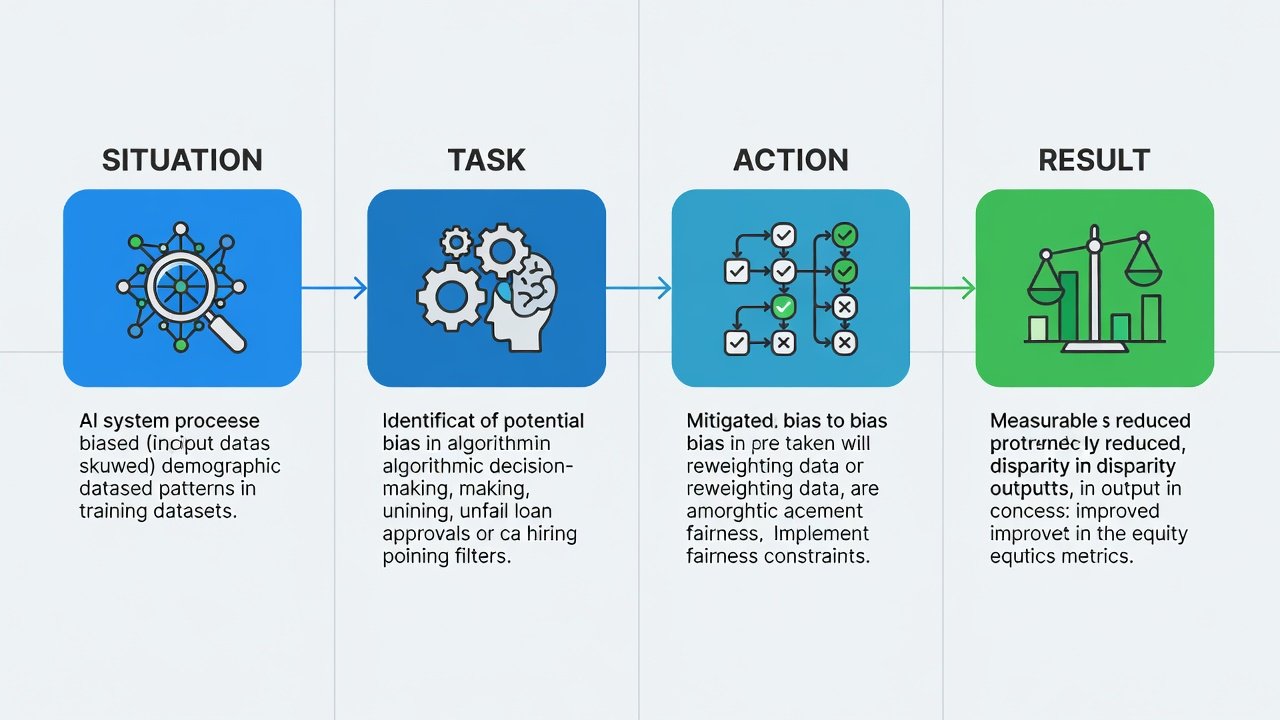
The STAR method provides a structured way to answer behavioral questions on ethical dilemmas. Begin with the Situation by setting context around a specific AI project facing bias concerns. Detail the Task, such as leading an audit of training data for representation gaps. Describe the Action steps, including collaboration with diverse stakeholders, application of bias detection software, and implementation of corrective reweighting. Conclude with the Result, quantifying benefits like a 25 percent reduction in error rates across subgroups and lessons that informed future model governance. Practice tailoring this format to common prompts about privacy breaches or transparency failures to deliver concise yet comprehensive replies.
Step-by-Step Framework for Ethical Dilemmas
When facing an ethical challenge in an interview scenario, follow this expanded framework. First, clearly identify the core issue and all affected stakeholders, ranging from end users to regulatory bodies. Second, evaluate risks quantitatively using available assessment tools and qualitative factors such as long-term societal effects. Third, consult internal policies, external guidelines from organizations like OECD, and subject matter experts. Fourth, develop transparent, documented solutions with clear accountability. Fifth, establish monitoring mechanisms and feedback loops to track effectiveness over time. This methodical approach signals analytical rigor and ethical maturity to interviewers.
Common vs. Advanced Interview Answers Compared
Basic responses typically acknowledge bias existence and suggest generic fairness checks. Advanced answers incorporate specific 2026 regulatory references, name concrete tools such as open-source fairness libraries, and provide data-backed examples from case studies. For example, instead of saying “I would check for bias,” an advanced reply might detail running fairness audits at multiple pipeline stages, adjusting loss functions accordingly, and reporting results to an ethics committee. Practice refining your answers by adding layers of specificity, metrics, and forward-looking regulatory awareness to differentiate yourself from other candidates.
Practical Exercises to Apply Immediately
- Analyze a publicly available dataset for potential bias indicators and document your findings in a short report.
- Role-play three ethical dilemma questions using the STAR method with a colleague or mentor, recording and reviewing your delivery.
- Research one recent AI-related regulatory update and prepare a two-minute summary of its implications for model development.
- Review your current or past projects and identify one area where ESG or privacy considerations could be strengthened, then outline concrete steps.
- Prepare thoughtful questions about a company’s AI ethics review process to ask during interviews, demonstrating genuine interest.
FAQ on Current AI Laws
What is the status of the EU AI Act in 2026?
Enforcement has progressed to full application for high-risk systems, requiring conformity assessments, transparency obligations, and human oversight mechanisms for affected organizations.
Are there new U.S. federal AI laws?
Recent executive orders and agency guidance emphasize risk assessments, bias testing, and public reporting for federal contractors and certain private sector uses, building on prior directives.
How do privacy laws affect AI training data?
Regulations mandate explicit consent, data minimization, and techniques like anonymization or synthetic data generation to comply with purpose limitation and individual rights protections.
What tools are recommended for bias detection?
Common options include fairness metrics libraries and auditing platforms that support continuous monitoring, often integrated into machine learning workflows for real-time alerts.
Conclusion
Comprehensive preparation on AI ethics equips you to handle 2026 interview questions with confidence and depth. Combine regulatory knowledge, practical case studies, structured response techniques, and immediate exercises to demonstrate both technical competence and ethical leadership. This approach not only improves interview performance but also prepares you to contribute responsibly in your next role.

No comments yet. Be the first!