 Jobboy

Introduction to Case Study Interview Prep for 2026
Case study interviews remain a cornerstone of hiring processes at top consulting firms, tech companies, and financial institutions. In 2026, these rounds emphasize structured problem-solving, data analytics, and adaptability to remote formats. This guide equips job seekers with actionable frameworks, real-world examples, and preparation strategies to excel in competitive environments where analytical rigor separates successful candidates from the rest. Whether you are targeting roles at firms like McKinsey or preparing for product manager positions, mastering these elements can significantly boost your performance and confidence during high-stakes evaluations.
Employers increasingly blend traditional qualitative cases with quantitative data challenges, reflecting the evolving demands of modern business. Job seekers who invest time in understanding 2026-specific trends such as AI-assisted analysis and virtual collaboration tools gain a clear advantage. This comprehensive resource breaks down proven methodologies while providing step-by-step guidance that translates directly into interview success.
Core Frameworks for Structured Problem-Solving
Effective case interviews rely on proven frameworks that organize complex information logically. The MECE principle—mutually exclusive, collectively exhaustive—ensures your analysis covers all aspects without overlap or omission. This foundational approach helps candidates demonstrate clear, professional thinking under pressure.
Applying the MECE Framework in Detail
Break down problems into distinct categories that do not overlap. For a profitability issue, divide into revenue and cost drivers, then sub-divide each without redundancy. For instance, revenue can be segmented by product line, geography, and customer segment while costs split into fixed and variable components. This approach prevents gaps and demonstrates clear thinking to interviewers who value precision. Practice applying MECE to everyday business scenarios to build fluency before your interview.
Profitability Trees and Additional Frameworks
Build decision trees starting from the core issue. For example, if profits are declining, branch into price, volume, and mix under revenue, then fixed and variable costs. Candidates should also familiarize themselves with complementary tools such as the BCG growth-share matrix for portfolio analysis and Porter’s Five Forces for competitive dynamics. These frameworks often combine in multi-layered cases. Practice sketching these on a whiteboard or shared screen during remote sessions to simulate real interview conditions.
Learn more about advanced structuring from McKinsey.
Step-by-Step Market Sizing Case Walkthrough
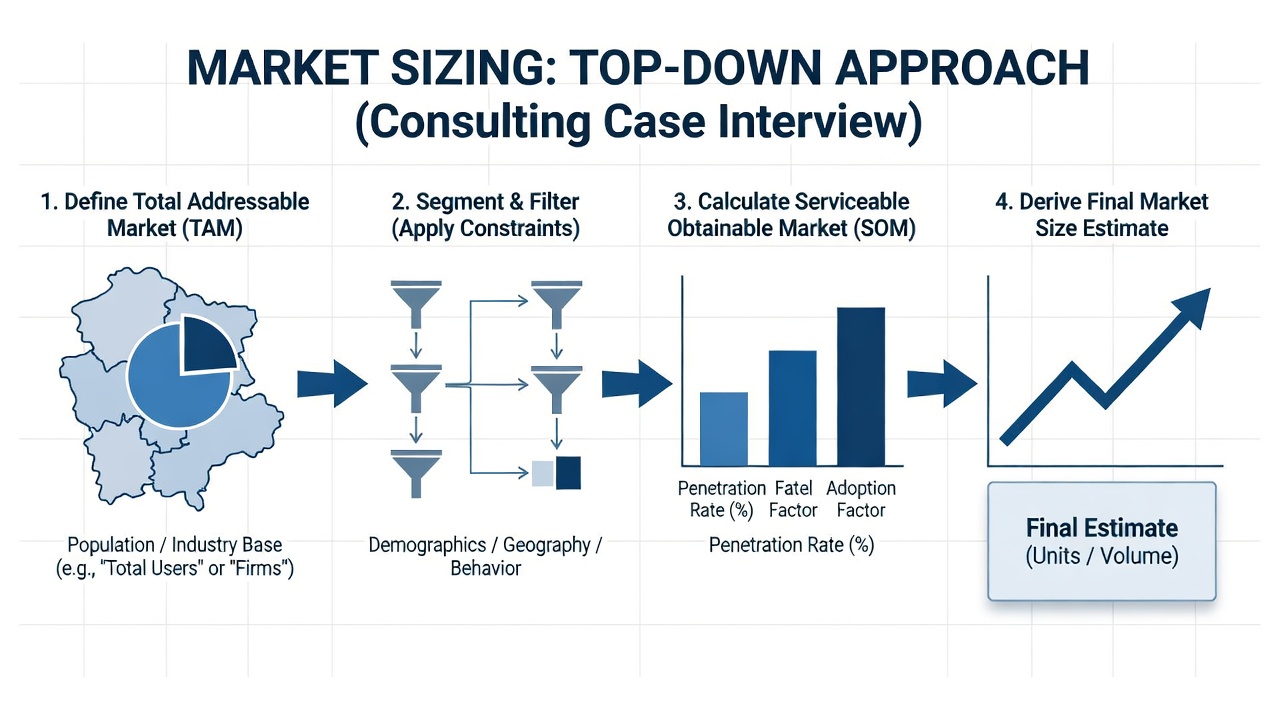
Market sizing questions test estimation skills and logical assumptions. Follow this detailed process to deliver structured responses:
- Clarify the question and define the market precisely with the interviewer.
- Choose a top-down or bottom-up approach based on available data points.
- State assumptions clearly and use round numbers for easy mental math.
- Calculate step by step while explaining your reasoning aloud.
- Sanity-check your result against known benchmarks or real-world indicators.
Example: Estimate the US smartphone market size in 2026. Start with total population of approximately 340 million, segment by age groups such as 18-34, 35-54, and 55+, estimate adoption rates around 85% for younger cohorts, and multiply by average device replacement cycles and pricing tiers. Adjust for emerging trends like increased enterprise adoption and foldable device segments. This methodical breakdown showcases both analytical depth and practical awareness.
Product Launch Case Example with Frameworks
Product launch cases often combine market analysis with go-to-market strategy. Use a profitability tree to evaluate revenue streams and costs, then layer in competitive positioning and risk assessment. A thorough response addresses customer segmentation, pricing strategy, distribution channels, and potential barriers to adoption.
Walkthrough: A tech firm wants to launch a new AI tool targeted at small businesses. Segment the market using MECE categories such as enterprise versus consumer and further split by industry verticals including retail, healthcare, and professional services. Estimate total addressable market by projecting adoption curves over three years, outline marketing spend requirements, and evaluate risks like regulatory hurdles in data privacy. Conclude with a phased rollout recommendation that includes pilot programs and performance metrics. This level of detail demonstrates strategic thinking valued in 2026 interviews.
Comparison of Common Case Types
| Case Type | Key Focus | Typical Frameworks | Difficulty Level | 2026 Emphasis |
|---|---|---|---|---|
| Market Sizing | Estimation and assumptions | Top-down/bottom-up | Medium | Data integration |
| Profitability | Root cause analysis | Profitability tree | High | Real-time analytics |
| Product Launch | Strategy and execution | MECE + 4Ps | High | AI and personalization |
| Market Entry | Opportunity assessment | Porter's Five Forces | Medium-High | Regulatory and sustainability factors |
| Operations | Process optimization | Value chain analysis | Medium | Supply chain resilience |
Common Pitfalls and How to Avoid Them
- Rushing without clarifying the problem—always ask targeted questions first to align expectations.
- Ignoring quantitative rigor—back every insight with transparent calculations and sensitivity checks.
- Overlooking 2026 trends like AI integration in cases—incorporate mentions of machine learning or predictive modeling where relevant.
- Poor communication in remote interviews—practice verbalizing your thought process clearly while using digital whiteboards effectively.
- Failing to structure the final recommendation—end every case with a concise executive summary that includes next steps and risks.
- Neglecting time management—allocate roughly equal time across analysis, discussion, and recommendation phases.
2026 Trends: Data-Driven Cases and Remote Formats
Modern cases increasingly incorporate real datasets and require quick analysis with tools like Excel or Tableau. Remote interviews via video platforms demand strong screen-sharing skills and concise explanations. Prepare by simulating these environments with timed practice sessions that include unexpected data prompts. Firms now evaluate candidates on their ability to interpret dashboards and synthesize insights under time constraints, making familiarity with common analytics platforms essential.
Explore industry insights at BCG and Deloitte. Additional perspectives on evolving interview practices appear in resources from Harvard Business Review.
Preparation Timeline and Recommended Tools
Start 4-6 weeks in advance for optimal results. Week 1-2: Master core frameworks through daily reading and simple drills. Week 3-4: Complete 10-15 full cases with a partner, focusing on both market sizing and strategy cases. Week 5-6: Conduct multiple mock interviews under realistic remote conditions and review recordings for improvement areas. Useful tools include case books from top MBA programs, Victor Cheng's framework guides, and online platforms offering live practice with peers or coaches. Supplement with free resources from consulting firm career pages to stay current on question styles.
Frequently Asked Questions
How long should I spend preparing for case interviews?
Dedicate at least 30-50 hours for solid results, focusing on both frameworks and live practice. Candidates with prior business coursework may accelerate this timeline, while career changers benefit from extended drills.
What tools help with remote case prep?
Use Zoom for mocks, Miro for collaborative whiteboarding, and Excel for data analysis drills. Recording sessions allows self-review of pacing and clarity.
Are data-driven cases becoming more common in 2026?
Yes, firms now blend traditional cases with analytics tasks to reflect real consulting work, often requiring candidates to interpret sample datasets within 10-15 minutes.
How should I handle unexpected curveball questions?
Stay calm, restate the question to buy thinking time, and apply your core frameworks flexibly to the new scenario.
Conclusion
Success in 2026 case study interviews comes from disciplined framework use, ample practice, and awareness of evolving formats. Apply these strategies consistently to turn challenging cases into opportunities for standout performances that impress recruiters and hiring managers alike.


No comments yet. Be the first!