 Jobboy

Introduction: Why AI Ethics and ESG Now Intersect in Interviews
By 2026, hiring managers expect candidates to demonstrate fluency in both artificial intelligence ethics and environmental, social, and governance (ESG) factors. Roles in tech, finance, and consulting increasingly require professionals who can navigate regulatory landscapes, mitigate algorithmic bias, and align corporate strategy with sustainability goals. This guide merges the two topics into one advanced preparation resource, showing exactly how to weave ESG metrics and AI ethics into behavioral answers using the STAR method. Employers now reference real company reports such as Microsoft’s 2025 Responsible AI report and Unilever’s 2025 ESG update when crafting questions. Candidates who can cite these examples while delivering data-backed impact statements stand out. The overlap between these domains has grown because AI systems directly influence carbon footprints through energy-intensive training and inference, while also shaping social outcomes like fair lending and workforce diversity. Preparing thoroughly means understanding not only technical details but also how ethical AI decisions support broader ESG reporting requirements from investors and regulators.
Interviewers test this intersection through behavioral questions that demand specific examples rather than abstract opinions. Successful candidates prepare stories that quantify both ethical improvements and ESG metrics, such as reduced bias rates alongside lowered emissions from optimized models. This comprehensive approach helps candidates move beyond generic answers and demonstrate strategic thinking valued in senior positions.
Using the STAR Method for Combined AI Ethics and ESG Answers
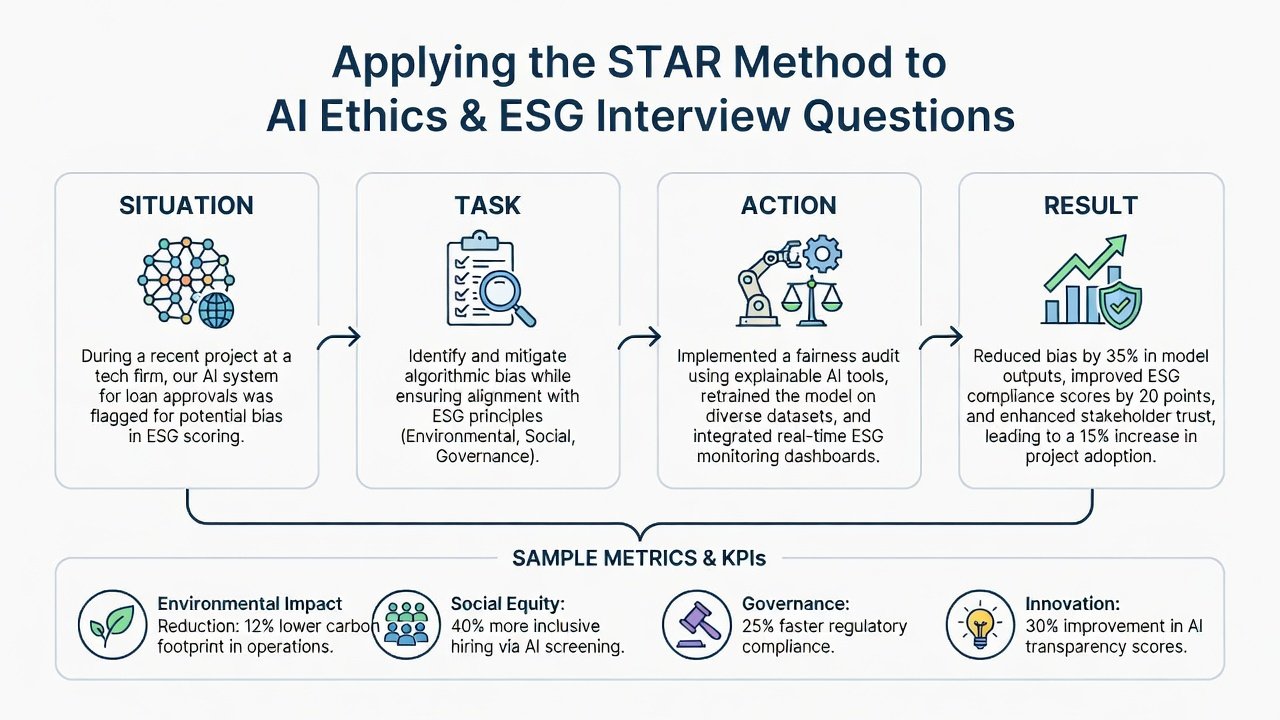
The STAR framework (Situation, Task, Action, Result) remains the gold standard for behavioral interviews. When answering questions that blend AI ethics and ESG, map each element to measurable outcomes. Start by setting the context with a clear situation that involves both domains, then define the task in terms of compliance or risk mitigation. The action phase should detail cross-functional collaboration, and the result must include dual metrics covering ethics and sustainability.
Weak vs. Strong Response Comparison
Question: “Tell me about a time you addressed bias in an AI system that also affected ESG reporting.”
Weak response: “I noticed bias in our model and fixed it. The ESG score improved.”
Strong response: “In my previous role at a fintech firm (Situation), our credit-scoring model showed 18% higher denial rates for applicants from low-income zip codes, directly impacting our social governance pillar (Task). I led a cross-functional team to audit training data and introduce fairness constraints while aligning with our net-zero targets by shifting compute workloads to renewable-powered data centers (Action). Within four months, denial-rate disparities dropped to 4% and our ESG social score rose 12 points according to Sustainalytics (Result).”
A second example could involve supply chain AI tools where ethical sourcing data improved transparency scores while reducing overall environmental impact through better route optimization.
Sector-Specific Frameworks for 2026
Technology Sector
Focus on model transparency, data privacy, and energy consumption of training runs. Reference the OECD AI Principles when discussing governance. Practical steps include conducting regular bias audits, documenting model cards for stakeholders, and selecting cloud providers with verified renewable energy commitments. Candidates should prepare examples showing how they balanced innovation speed with ethical review gates and tracked resulting improvements in both fairness metrics and carbon intensity per inference.
- Map AI fairness audits to Scope 3 emissions reductions
- Use OECD AI Principles as a benchmark
- Quantify carbon savings from efficient algorithms
Finance Sector
Emphasize climate-risk modeling and algorithmic lending fairness. Tie responses to emerging climate disclosure rules by explaining how AI models incorporate physical and transition risks into credit decisions. Prepare to discuss stress-testing scenarios that combine ESG data with fairness constraints to avoid discriminatory outcomes in green finance products.
Consulting Sector
Highlight client advisory on dual AI-ESG compliance and change-management programs that embed ethical review boards. Consultants often help clients redesign AI governance structures while aligning with sustainability roadmaps, so responses should cover stakeholder workshops, policy development, and measurement frameworks that track both ethical KPIs and ESG targets over time.
Data-Backed Impact Statements
Strong answers always include specific numbers. For instance, describe how implementing an ethical AI review process reduced false positive rates in hiring algorithms by 22% while contributing to a 9% improvement in the company’s social pillar score. Another example might involve deploying energy-efficient inference techniques that cut model-related emissions by 35% without sacrificing accuracy, directly supporting governance disclosures.
Regulatory FAQ: EU AI Act and Climate Disclosures
EU AI Act Key Points for Candidates
The EU AI Act classifies systems by risk level. High-risk applications require conformity assessments, transparency obligations, and human oversight. Candidates should prepare to discuss how they would implement these requirements in product roadmaps, including documentation practices and post-market monitoring plans.
Climate Disclosure Requirements
Prepare answers around SEC climate rules and CSRD alignment. Cite how AI can automate Scope 1-3 emissions tracking while maintaining data integrity. Additional questions often cover how organizations handle prohibited AI practices under the Act and how climate data assurance processes intersect with AI system audits.
Learn more from authoritative sources: European Commission and U.S. Securities and Exchange Commission. The United Nations also provides foundational guidance on sustainable development goals that frequently appear in ESG discussions.
Practice Prompts and Scoring Rubrics
Use these prompts to rehearse:
- Describe a project where you balanced AI innovation with ESG targets.
- How would you respond to a client requesting an AI tool that conflicts with their net-zero commitments?
- Explain your approach to auditing third-party AI vendors for both bias and carbon footprint.
- Share an example of implementing human oversight in a high-risk AI system while meeting disclosure obligations.
- Discuss how you would measure the social impact of an AI-driven ESG reporting platform.
Scoring Rubric (out of 5 points each):
- Clarity of ethical reasoning
- Quantifiable ESG impact
- Regulatory awareness
- Cross-functional collaboration
- Forward-looking mitigation strategy
Aim for at least 4 out of 5 on each criterion by preparing two detailed stories in advance.
Common Mistakes to Avoid
Many candidates fail by focusing only on technical fixes without linking to ESG outcomes, or by using vague language instead of specific metrics. Another frequent error is ignoring regulatory timelines, such as phased implementation dates under the EU AI Act. Always prepare for follow-up questions on measurement and long-term monitoring.
Conclusion: Turning Preparation into Offers
Mastering the intersection of AI ethics and ESG requires concrete examples, regulatory fluency, and measurable results. Practice the STAR responses above, study the cited frameworks, and tailor answers to the specific sector. Candidates who deliver data-backed stories aligned with the EU AI Act and climate disclosure rules will be best positioned for 2026 opportunities. Consistent rehearsal with the scoring rubric ensures responses remain comprehensive yet concise during actual interviews.

No comments yet. Be the first!