 Jobboy

Introduction to Competency Mapping in Modern Talent Acquisition
Competency mapping has emerged as a powerful strategic tool for organizations seeking to refine their talent acquisition processes in 2026. By identifying the specific behaviors, skills, and attributes required for success in each role, companies can move beyond generic job descriptions to create targeted hiring strategies that directly support business objectives. This approach not only streamlines recruitment but also enhances long-term employee retention by ensuring new hires possess the right mix of competencies from day one.
In today's competitive landscape, traditional skills-based hiring often falls short because it overlooks how individuals apply those skills in real-world contexts. Competency mapping addresses this gap by focusing on observable behaviors and outcomes. As businesses navigate rapid technological changes and hybrid work models, this method provides a framework for scalable, bias-reduced talent decisions.
Defining Core Competencies by Role
The foundation of effective competency mapping lies in clearly defining core competencies tailored to each position. Start by analyzing job functions through stakeholder interviews, performance data reviews, and industry benchmarks. For example, a mid-level marketing manager role might include competencies such as strategic thinking, data-driven decision making, cross-functional collaboration, and digital fluency.
Break competencies into categories: technical (role-specific knowledge), behavioral (interpersonal and leadership traits), and organizational (alignment with company values). This structured definition ensures consistency across departments and supports fair evaluation during hiring.
Step-by-Step Implementation Guide
Implementing competency mapping requires a methodical approach. Follow these practical steps for success:
- Conduct a needs assessment by reviewing business goals and current workforce gaps.
- Develop competency frameworks using input from managers and high performers.
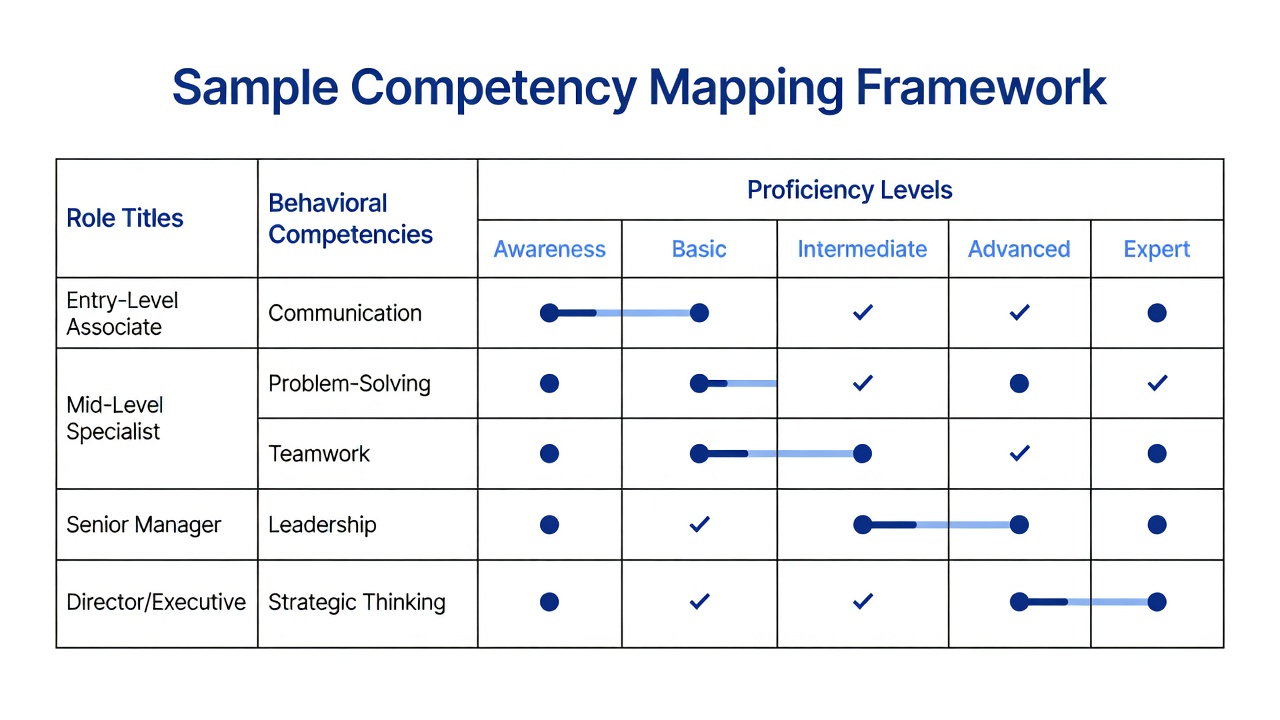
- Create detailed rubrics that describe proficiency levels for each competency.
- Integrate the framework into job postings, interview guides, and assessment tools.
- Train hiring teams on consistent application to minimize subjectivity.
- Review and refine mappings quarterly based on performance outcomes.
Many organizations find that dedicating 4-6 weeks to the initial mapping phase yields measurable improvements in hire quality.
Integrating Competency Mapping into Job Postings and Interviews
Once competencies are defined, embed them directly into recruitment materials. Job postings should highlight key competencies alongside responsibilities, using clear language that attracts aligned candidates. During interviews, shift from standard questions to behavioral probes such as “Describe a time you demonstrated strategic thinking under pressure.”
Structured interview scorecards tied to the competency framework help standardize evaluations. This integration reduces time-to-hire while increasing the likelihood of selecting candidates who will thrive.
Using Mapping Results to Guide Onboarding and Retention
Competency mapping extends beyond hiring into onboarding. New employees receive personalized development plans based on their competency profiles, accelerating productivity. For instance, if a hire scores high on technical skills but lower on collaboration, targeted coaching can address the gap early.
Over time, this data-driven approach strengthens retention by fostering continuous growth and alignment with evolving business needs.
Comparing Competency Mapping with Traditional Skills-Based Approaches
Traditional skills-based hiring emphasizes credentials and technical abilities listed on resumes. In contrast, competency mapping evaluates how those skills manifest in behavior and impact. Studies from sources like SHRM show that competency-focused methods improve retention rates by identifying cultural fit more accurately.
While skills-based approaches are faster to implement, they often lead to higher turnover when behavioral mismatches occur. Competency mapping requires upfront investment but delivers superior long-term ROI through better alignment.
Real-World Examples from Mid-Sized Companies
A mid-sized software firm in the Midwest used competency mapping to overhaul its sales team hiring. By defining competencies like consultative selling and resilience, the company reduced new-hire ramp-up time by 30 percent within six months. Another example comes from a healthcare provider that mapped nursing roles, resulting in lower turnover and improved patient satisfaction scores after integrating the framework into interviews.
Combining Competency Mapping with HR Tech Trends in 2026
In 2026, HR technology platforms increasingly incorporate AI to automate competency mapping at scale. Tools analyze performance data to suggest role-specific competencies and flag potential biases in assessments. Integrating these systems with applicant tracking software allows real-time updates to frameworks as business priorities shift.
Forward-thinking companies leverage predictive analytics from platforms recommended by Harvard Business Review to forecast competency needs, ensuring talent pipelines remain proactive rather than reactive.
Common Pitfalls to Avoid
Despite its benefits, competency mapping can falter without careful execution. Common mistakes include using overly generic competencies, failing to update frameworks regularly, and neglecting manager buy-in. To avoid bias, always validate mappings with diverse stakeholder groups and pilot test rubrics before full rollout.
Practical Templates and Sample Mapping Process
Here is a simplified sample for a project manager role:
- Strategic Planning: Defines clear project roadmaps aligned with organizational objectives.
- Stakeholder Management: Builds consensus among cross-functional teams.
- Risk Assessment: Identifies and mitigates potential project obstacles proactively.
Use this as a starting template and customize based on your industry and size.
Frequently Asked Questions
How much time does competency mapping require initially?
Most mid-sized teams complete the first full mapping cycle in 4-8 weeks, depending on the number of roles involved. Ongoing maintenance typically requires only a few hours per quarter.
Can competency mapping reduce hiring bias?
Yes, when implemented with structured rubrics and diverse review panels, it promotes objective evaluations focused on job-relevant behaviors rather than subjective impressions.
Is this approach suitable for small businesses?
Absolutely. Even teams with limited HR resources can start with 3-5 key roles and expand gradually, gaining immediate benefits in hiring precision.
Conclusion
Competency mapping represents a forward-looking strategy for talent acquisition in 2026 and beyond. By aligning hires with business goals, integrating seamlessly with modern HR technology, and addressing common implementation challenges, organizations can build stronger, more resilient teams. Begin with a focused pilot on critical roles to experience the advantages firsthand and refine your approach over time.


No comments yet. Be the first!