 Jobboy

Introduction: Why Productivity Systems Matter for Career Growth in 2026
In today's fast-evolving professional landscape, mastering productivity systems is no longer optional for those aiming to accelerate their career trajectory. These structured approaches enable individuals to optimize limited time for high-impact activities such as strategic project delivery, continuous upskilling, and meaningful networking. As 2026 approaches, professionals who align daily routines with long-term career milestones position themselves for faster promotions, expanded responsibilities, and greater visibility within their industries.
This comprehensive guide delves into advanced frameworks including adapted time-blocking and the Eisenhower Matrix, while demonstrating seamless integration with popular digital tools like Notion and Todoist. Readers will find detailed implementation steps, expanded real-world case studies from professionals who secured advancements, in-depth comparisons of methods, and targeted strategies to sustain momentum without burnout. The focus remains on practical career advice that ties routines directly to LinkedIn engagement and professional development tracking.
Core Frameworks for Career-Focused Productivity
Time-Blocking for High-Impact Tasks
Time-blocking transforms vague intentions into scheduled reality by assigning specific calendar slots to priority activities. Career-oriented professionals often reserve early morning hours for complex problem-solving tasks that drive business results, while carving out dedicated afternoon periods for skill-building exercises and relationship cultivation.
Expanded step-by-step implementation: Begin by conducting a thorough two-week audit of your existing schedule using a simple spreadsheet to log every activity. Next, define three to five overarching career objectives for the quarter, such as completing an advanced certification or increasing your professional network by fifty connections. Allocate fixed blocks of 90 to 120 minutes daily for these objectives, protecting them from meetings or interruptions. Incorporate recurring weekly review sessions every Sunday evening to evaluate completion rates and refine upcoming blocks. Finally, layer in buffer time between blocks to handle unexpected demands.
Adapting the Eisenhower Matrix for Career Decisions
The classic Eisenhower Matrix sorts tasks according to urgency and importance, but career-focused adaptations add a forward-looking filter that prioritizes activities contributing to promotions or industry recognition. Tasks are categorized into four quadrants, with special emphasis on those that enhance personal brand through consistent LinkedIn activity or targeted skill acquisition.
Practical examples include placing client-facing deliverables with tight deadlines in the urgent-and-important quadrant, while positioning industry research or personal branding content creation in the important-but-not-urgent quadrant. This ensures steady progress on long-term growth even amid daily pressures.
Integrating Digital Tools with Career Objectives
Digital platforms amplify framework effectiveness by providing automation, cross-device access, and progress visualization. Notion functions as a customizable command center where users maintain interconnected databases for quarterly goals, weekly task lists, and networking pipelines. Todoist offers lightweight task capture with powerful prioritization labels and recurring reminders that keep career actions front and center.
Detailed integration walkthrough: Create a Notion workspace containing a career dashboard with linked databases for milestones, learning logs, and contact outreach. Embed Todoist projects directly into Notion pages so daily tasks automatically feed into larger career views. Set up automated reminders that trigger based on milestone deadlines, ensuring consistent movement toward objectives like performance review preparation or internal mobility applications.
Real-World Examples from Promoted Professionals
Marketing manager Sarah implemented strict time-blocking within Notion by reserving every Friday morning exclusively for online course modules and certification exams. She documented her progress in a public LinkedIn series that attracted recruiter attention, ultimately securing a senior director role within eight months. Operations lead Raj adapted the Eisenhower Matrix inside Todoist to allocate forty percent of his weekly capacity to high-visibility cross-functional initiatives and thought-leadership posts. This focused approach led to an internal promotion and a twenty-five percent compensation increase after one annual review cycle.
Analog vs Digital Methods: Which Works Best?
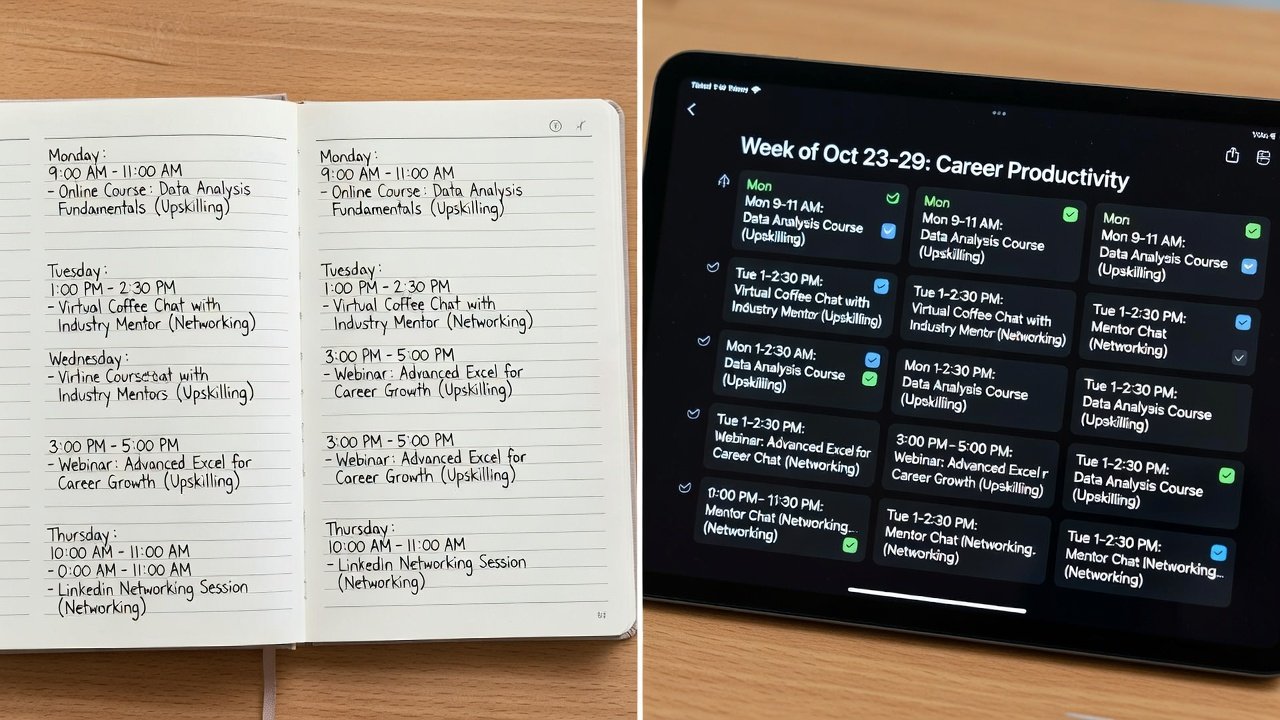
Analog tools such as paper planners deliver distraction-free planning and a satisfying tactile experience that many find enhances focus and retention. Digital solutions provide scalability through search functions, data analytics, and seamless collaboration features. The most resilient professionals often adopt a hybrid model: morning planning occurs on paper for intentionality, while task execution and metrics tracking migrate to digital platforms for accountability and reporting.
Key comparison criteria include ease of revision, ability to generate reports for performance discussions, and accessibility across devices during travel or remote work. Hybrid users report higher adherence rates because the combination leverages the strengths of both approaches without forcing an all-or-nothing choice.
Preventing Burnout While Scaling Productivity
Long-term success requires embedding recovery into every system. Schedule mandatory buffer blocks, enforce device-free evenings, and conduct monthly energy audits to identify draining activities. Incorporate micro-breaks such as ten-minute walks or breathing exercises between intense focus sessions to maintain cognitive sharpness.
Additional safeguards include capping deep-work blocks at four per day, establishing clear boundaries around after-hours communication, and referencing World Health Organization guidance on sustainable work practices when designing personal policies. Weekly reflection should emphasize qualitative career wins rather than raw task volume to prevent perfectionist spirals.
Measuring Productivity Gains Against Career Milestones
Effective measurement combines quantitative and qualitative indicators. Track weekly hours dedicated to upskilling versus networking, number of LinkedIn posts published, and connection requests accepted. Correlate these inputs with outputs such as interview invitations, internal project assignments, or completed certifications. Use simple dashboards in Notion to visualize trends over rolling 90-day windows.
Additional Strategies for Sustained Career Acceleration
Beyond core frameworks, professionals benefit from building a personal knowledge base that captures insights from articles, webinars, and conversations. This repository becomes invaluable during promotion discussions or job transitions. Another tactic involves quarterly networking audits that evaluate the quality and diversity of professional relationships, prompting targeted outreach to fill gaps. Finally, establish accountability partnerships with peers who review each other's weekly plans and celebrate milestone achievements.
Common Mistakes to Avoid
- Over-scheduling without buffer time leading to constant rescheduling
- Ignoring energy levels when assigning task types to time blocks
- Focusing solely on output volume rather than strategic alignment
- Neglecting regular reviews that allow systems to evolve with changing career priorities
Frequently Asked Questions
How long does it take to see career results from these systems?
Most professionals report noticeable improvements in focus and task completion within two weeks. Meaningful career outcomes such as completed certifications, expanded networks, or promotion discussions typically emerge between four and twelve weeks of consistent application.
Can these frameworks work for remote workers?
Absolutely. Remote environments often benefit most because structured blocks replace the natural rhythm of an office setting. Tools like Notion facilitate team visibility while preserving individual autonomy over daily scheduling.
What if I struggle with consistency?
Begin with a single framework such as basic time-blocking for one priority area. Pair the habit with an accountability partner or weekly self-review ritual. Gradually layer additional elements once the foundation feels automatic.
How do I adapt systems during high-pressure periods like annual reviews?
Temporarily increase buffer blocks and reduce non-essential networking while maintaining core upskilling time. Revert to full routines immediately after the intense period concludes.
Conclusion
Implementing robust productivity systems represents one of the highest-leverage investments any professional can make toward 2026 career advancement. By combining proven frameworks with thoughtful tool integration, maintaining awareness of burnout risks, and continuously measuring progress against tangible milestones, individuals create a repeatable engine for growth. Start today by selecting one framework and one tool, then refine the approach through consistent review and iteration.

No comments yet. Be the first!