 Jobboy

Introduction: Why Mental Models Beat Gut Decisions in 2026
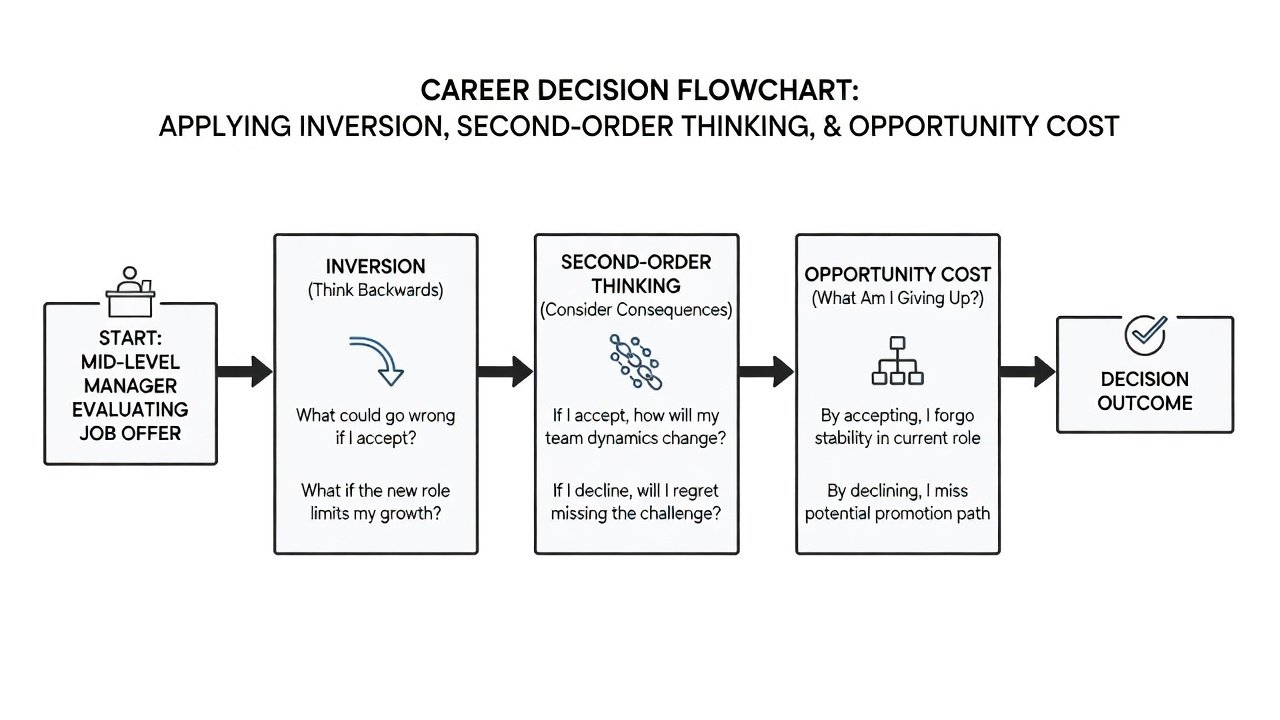
Career transitions in 2026 demand more than updated resumes and standard interview preparation. Economic uncertainty, rapid AI adoption across industries, and evolving hybrid work norms push professionals to evaluate opportunities with greater clarity than ever before. Mental models such as inversion, second-order thinking, and opportunity cost provide structured frameworks that outperform simple pros-and-cons lists by forcing deeper analysis of risks, long-term ripple effects, and alternatives. These tools help mid-level managers and tech professionals avoid emotional traps like the sunk cost fallacy while aligning moves with sustainable long-term goals rather than short-term gains.
This comprehensive guide breaks down each model with multiple real-world examples drawn from mid-level managers and tech professionals, offers repeatable step-by-step exercises you can apply immediately, and demonstrates seamless integration with LinkedIn networking and targeted upskilling plans. By the end, you will have concrete methods to evaluate job offers, weigh hidden risks, and build resilience during periods of market volatility.
Inversion: Starting from the Worst-Case Scenario
Inversion asks what you want to avoid rather than what you want to achieve. For career changes, this means identifying paths that lead to regret, burnout, or stagnation before considering attractive surface-level offers. The technique originates from rigorous problem-solving approaches used in engineering and investing, where preventing failure often proves more valuable than chasing success.
Real-world example from a mid-level manager: A marketing manager at a legacy retailer with 12 years of experience considers a lateral move to a fintech startup promising equity and rapid advancement. Using inversion, she lists outcomes she fears most: chronic burnout from unpredictable 60-hour weeks, erosion of work-life balance that damages family relationships, and specialized skills that become irrelevant if the startup pivots or fails within two years. This exercise reveals the offer lacks clear boundaries on working hours and provides no structured learning budget, prompting her to negotiate remote flexibility and a professional development stipend before accepting.
Tech professional example: A senior software engineer at a stable enterprise company receives an offer from a high-growth AI startup. Inversion highlights the risk of joining a team with high turnover, leading to constant context switching and stalled personal projects. By mapping these negatives first, he identifies the need for contract clauses around intellectual property ownership and team stability metrics.
Step-by-Step Inversion Exercise
- Write your current role and the new opportunity side by side on a single page.
- List three to five worst-case outcomes for each path, focusing on career, financial, and personal dimensions.
- Identify early warning signs for each negative outcome that you could monitor within the first 90 days.
- Score how likely each risk is on a 1-10 scale and outline one concrete mitigation step per risk.
- Reject or renegotiate any offer where unmitigated risks clearly outweigh potential upsides.
Repeat this exercise for every serious opportunity to surface hidden downsides before emotional attachment forms.
Second-Order Thinking: Beyond the First Domino
Second-order thinking examines the consequences of consequences. A salary increase might appear positive at the first order, yet create second-order effects such as higher tax brackets, longer commutes that reduce exercise time, or team friction that lowers job satisfaction over 18 months. This model encourages mapping at least two layers of downstream impact.
Tech professional example: A senior software engineer receives an offer with a 25% base salary increase but requires relocation to a high-cost coastal city. First-order gain appears clear in compensation. Second-order effects include increased housing and childcare costs that consume 60% of the raise, loss of an established professional network built over seven years, and potential isolation from extended family support systems. Mapping these layers shows the net lifestyle benefit shrinks dramatically within the first two years, leading the engineer to counter with a remote arrangement instead.
Mid-level manager example: A product manager at a mid-sized SaaS company considers moving to a larger competitor for a title promotion. Second-order analysis reveals the new role may require frequent travel that conflicts with ongoing education commitments, while the current employer offers an internal leadership track with mentorship access that compounds over five years.
Practical Second-Order Exercise
- Draw a simple flowchart showing the immediate change and label it as Order 1.
- Add arrows for likely follow-on effects at 6-month, 12-month, and 24-month marks.
- Consult one trusted peer or mentor for additional second-order angles you may have missed.
- Adjust your decision or renegotiate terms if negative ripples dominate the long-term picture.
This method prevents short-term wins that create compounding long-term pain across career and personal domains.
Opportunity Cost: The Value of the Road Not Taken
Opportunity cost forces explicit comparison against the next-best alternative. Accepting a new role means forgoing time, energy, and learning that could be invested in staying put, starting a side project, or pursuing further education. Quantifying this trade-off clarifies whether the move truly advances your trajectory.
Manager example: A product manager weighs staying for a promotion versus joining a competitor. Opportunity cost analysis shows the promotion path offers deeper domain expertise and internal visibility that accelerates future executive opportunities, while the external role provides faster title progression but resets cultural knowledge and requires rebuilding trust. Choosing the internal route preserves greater long-term optionality despite slower short-term title growth.
Integrating Models with LinkedIn Networking and Upskilling Plans
Combine these frameworks with proactive networking on LinkedIn to test second-order assumptions. Reach out to current employees at target companies and ask targeted questions about workload patterns, promotion timelines, and team stability rather than generic career advice. Document responses against your inversion risk list for objective comparison.
Pair mental models with deliberate upskilling. Before transitioning, audit courses on platforms that address inversion-identified gaps such as emerging AI tools or leadership frameworks. This reduces opportunity cost by building portable skills that remain valuable regardless of the final decision. Schedule monthly LinkedIn learning goals tied directly to the mitigation steps from your inversion exercise.
Avoiding the Sunk Cost Fallacy During Transitions
Many professionals remain in misaligned roles because of time already invested in a company or industry. Inversion and opportunity cost directly counter this bias by focusing exclusively on future outcomes instead of past effort. When evaluating offers, repeatedly ask: “If I started today with zero history, which path would I choose?” This reframing helps detach from emotional investment and highlights whether staying or leaving better serves your next five years.
Common Mistakes When Applying Mental Models
Professionals often stop after listing risks without scoring likelihood or creating mitigation plans. Another frequent error is applying second-order thinking only to the new role while ignoring second-order effects of staying in the current position. To avoid these pitfalls, always complete the full exercise for both options and review your notes with a neutral third party before finalizing any decision.
Comparison Table: Mental Models vs Traditional Pros/Cons Lists
| Aspect | Mental Models Approach | Traditional Pros/Cons List |
|---|---|---|
| Depth of Analysis | Examines consequences over multiple time horizons and layers | Focuses primarily on immediate attributes and surface trade-offs |
| Bias Reduction | Actively surfaces hidden risks through structured inversion and alternatives | Highly prone to confirmation bias and recency effects |
| Actionability | Includes specific mitigation steps and monitoring signals | Often ends in vague, unprioritized trade-offs |
| Networking Integration | Directly guides targeted outreach questions on LinkedIn | Rarely connects insights to external validation |
| Upskilling Alignment | Identifies precise skill gaps to address proactively | Provides little guidance on future development needs |
FAQ: Applying These Models in Economic Uncertainty
How do I use inversion when layoffs are rising across the sector?
Focus inversion on preserving optionality and financial runway. Prioritize roles that build transferable skills, maintain strong external networks, and include clear performance metrics even if the new company faces future cuts. Review your risk list against current industry layoff trends reported in the past 30 days.
Can second-order thinking account for broader market volatility?
Yes. Extend your flowchart to 36 months and incorporate macroeconomic variables such as interest rate shifts or sector consolidation. This highlights roles resilient to downturns versus those vulnerable to cascading effects.
Is opportunity cost analysis too time-consuming during active job searches?
Limit the full exercise to your top two offers only. Spending 30 to 45 minutes mapping alternatives typically accelerates final decisions and reduces post-acceptance regret.
What if my inversion list reveals risks in every available option?
Use the exercise to negotiate improvements or delay the move while building additional runway through targeted upskilling and networking. Sometimes the best decision is strategic patience rather than immediate change.
Conclusion
Mental models transform career transitions from reactive leaps into deliberate, forward-looking choices grounded in evidence and foresight. By consistently practicing inversion, second-order thinking, and opportunity cost, mid-level managers and tech professionals can navigate 2026 shifts with greater confidence, fewer regrets, and stronger long-term positioning. Begin with one full exercise on your current options today, then layer in LinkedIn outreach and upskilling aligned to your findings for maximum sustained impact.

No comments yet. Be the first!