 Jobboy

Introduction to SWOT Analysis in Career Planning
In today's rapidly evolving job market, professionals need structured methods to navigate career changes and achieve long-term success. SWOT analysis, a strategic framework originally developed for business planning, offers a powerful tool for personal career development. It helps individuals systematically evaluate their internal attributes and external environment to make informed decisions about upskilling, promotions, or career pivots. With industries transforming due to technology, globalization, and economic shifts, relying on intuition alone is insufficient. A structured self-assessment like SWOT provides clarity and direction, turning vague aspirations into actionable strategies. This beginner's guide delivers in-depth explanations, practical exercises, multiple real-world scenarios from diverse fields, and guidance on sustaining momentum through annual reviews. By the end, you will have everything needed to implement this framework effectively for your unique situation.
Understanding the SWOT Framework for Personal Use
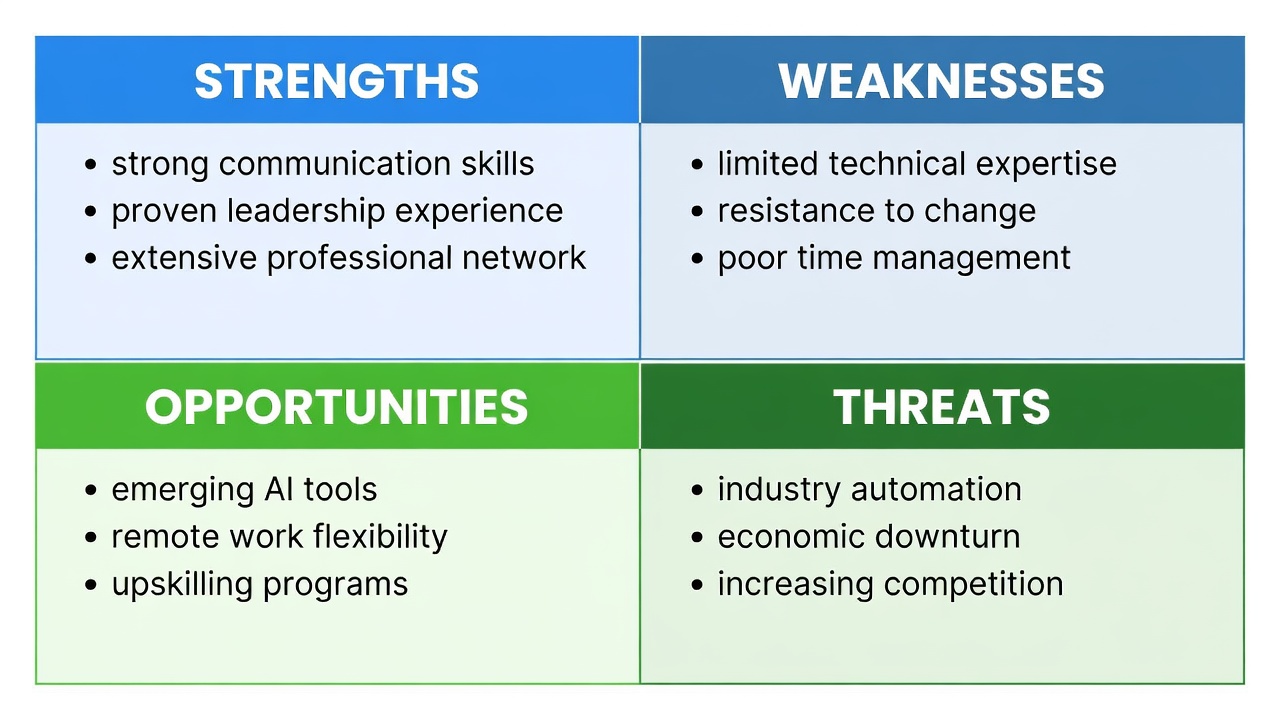
SWOT stands for Strengths, Weaknesses, Opportunities, and Threats. When applied to careers, it shifts focus from corporate strategy to self-assessment. Strengths and Weaknesses are internal factors you control, such as your education, experience, personality traits, and work habits. Opportunities and Threats represent external elements like market trends, technological advancements, regulatory changes, or competitive landscapes. The beauty of this framework lies in its simplicity paired with depth. It forces you to confront realities rather than assumptions, revealing how your unique profile interacts with the broader professional world. Unlike traditional goal-setting approaches that emphasize linear milestones such as "get a promotion in two years," SWOT encourages a holistic view. It reveals gaps between where you are and where industry shifts demand you to be, making it ideal for professionals facing automation or economic changes. For example, a strength in data interpretation might pair with an opportunity in AI-driven analytics, while a threat from remote-work normalization could highlight the need for digital collaboration skills.
Step-by-Step Guide to Conducting Your Career SWOT Analysis
- Prepare your workspace and mindset: Set aside 2-3 hours in a distraction-free environment. Gather performance reviews, LinkedIn profiles, feedback from colleagues, and recent job descriptions in your field. Reflect on the past 12-18 months honestly, perhaps journaling initial thoughts before formalizing them.
- Identify Strengths: List skills, experiences, and traits that give you an edge, such as technical expertise, leadership abilities, or resilience under pressure. Quantify where possible, noting achievements like "led a team that increased efficiency by 25%."
- Assess Weaknesses: Be honest about areas needing improvement, including skill gaps or soft skills like public speaking. Consider feedback you have received and patterns in past challenges, such as difficulty with tight deadlines.
- Explore Opportunities: Research emerging trends using resources from the U.S. Bureau of Labor Statistics and the U.S. Department of Labor. Look for growing sectors, new certifications, or networking events that align with your profile.
- Evaluate Threats: Consider factors like economic downturns, competitor advancements, or industry disruptions that could impact your role. Include personal threats such as burnout risk or geographic limitations.
- Prioritize and strategize: Match strengths to opportunities and develop action plans to mitigate weaknesses and threats. Create a simple action matrix ranking items by impact and feasibility.
Repeat this process with a trusted mentor for additional perspective.
Real-World Examples Across Industries
Consider a marketing professional in tech: Strengths might include data analytics proficiency and creative campaign design; Weaknesses could involve limited AI knowledge or difficulty with cross-functional communication; Opportunities arise from growing demand for personalized digital campaigns and emerging platforms; Threats include AI tools automating routine tasks and increased competition from freelance specialists. This analysis led one individual to pursue targeted certifications in machine learning for marketers, resulting in a promotion within 18 months and a shift to a strategic role. In healthcare, a nurse might highlight patient care empathy and crisis management as Strengths while noting administrative burnout and limited leadership experience as Weaknesses. Opportunities in telehealth expansion and specialized chronic disease management programs, combined with Threats from staffing shortages and regulatory changes, guide decisions toward certifications in virtual care coordination. A software engineer in finance could list coding expertise and problem-solving as Strengths, outdated knowledge of cybersecurity protocols as a Weakness, rising demand for fintech innovations as an Opportunity, and economic volatility affecting bonuses as a Threat. By mapping these elements, the engineer pursued targeted upskilling that positioned them for a senior role during a company expansion.
Customizable SWOT Template for Career Planning
Use this simple four-quadrant structure in a spreadsheet or notebook, expanding each quadrant with bullet points and priority ratings from one to five. Add industry-specific rows, such as remote work adaptability for freelancers or regulatory compliance knowledge for legal professionals. Digital versions can incorporate color coding and automatic sorting to highlight high-impact items. Review the completed template with a career coach or peer to validate entries and uncover blind spots.
Integrating Upskilling and Using Insights for Advancement
After completing your analysis, link identified Opportunities to targeted upskilling. For instance, if digital transformation appears as an Opportunity, prioritize courses in emerging technologies through recognized providers. Apply findings to prepare for performance reviews or job transitions by highlighting how your Strengths align with company needs. Schedule quarterly check-ins to monitor progress on action items, adjusting for new market conditions. Professionals who integrate SWOT insights into promotion discussions often present data-backed cases showing how their development directly supports organizational goals.
Comparing SWOT to Traditional Goal-Setting Methods
Traditional SMART goals focus on specific, measurable targets but often overlook external variables. SWOT complements them by providing context, allowing you to refine goals based on a full environmental scan. For example, a SMART goal of "earn a certification by June" becomes more powerful when paired with SWOT insights revealing that the certification directly counters a Threat from industry automation. Professionals who combine both approaches report higher satisfaction and faster career progression because their plans account for both personal agency and external realities.
Measuring Long-Term Success and Avoiding Common Pitfalls
Track success by setting measurable follow-up actions, such as completing three development activities within six months or securing informational interviews in two new areas. Many beginners rush the process or remain overly positive. To avoid this, seek external feedback and balance optimism with realism. Another pitfall is treating SWOT as a one-time exercise rather than an iterative tool. Schedule annual reviews to incorporate life changes or industry evolutions, ensuring the analysis remains relevant and actionable.
FAQ
How often should I update my career SWOT analysis?
Conduct a full review annually or after major life or industry events to stay aligned with changes and maintain forward momentum.
What if my Weaknesses outweigh my Strengths?
Focus first on quick wins in Strengths-to-Opportunities pairings while creating a 90-day plan to address key Weaknesses through deliberate practice and mentorship.
Can SWOT help with career changes?
Yes, it excels at identifying transferable skills and new paths by mapping internal assets against external openings, reducing the overwhelm of transitions.
Conclusion
Mastering SWOT analysis equips you with a repeatable framework for career resilience. By dedicating time to thorough self-evaluation and strategic action, you position yourself for sustained professional growth amid ongoing industry shifts. Start your first analysis today to unlock clearer pathways to success.

No comments yet. Be the first!