 Jobboy

Understanding Total Compensation in 2026: Corporate vs. Startup
In the evolving job market of 2026, total compensation has become more than just a paycheck—it's a comprehensive package that includes base salary, equity, bonuses, benefits, and even work-life balance perks. For mid-level professionals in high-demand sectors like tech and finance, choosing between a stable corporate role and a high-risk, high-reward startup position can define your financial future. This guide breaks down the key differences, drawing on 2026 benchmarks from industry reports, to help job seekers evaluate offers and negotiate effectively.
Whether you're switching careers or comparing multiple job offers, understanding the nuances beyond base pay is crucial. Corporate jobs often emphasize security and predictable growth, while startups promise explosive upside through equity. We'll explore average salaries, the risks and rewards of equity, benefits comparisons, and the inevitable trade-offs in work-life balance. By the end, you'll have practical tools to assess what's best for your goals.
Average Salaries for Mid-Level Roles in Tech and Finance
Base salaries form the foundation of total compensation, but they vary significantly by industry and company type. In 2026, economic recovery post-2025 slowdowns has pushed salaries upward, especially in tech and finance, where talent wars continue.
For mid-level roles (e.g., software engineers, product managers in tech; analysts, associates in finance), corporate giants like Google, JPMorgan, or Microsoft offer stability with higher base pay. Startups, particularly in early-stage ventures, often start lower to conserve cash but compensate with potential upside.
| Role/Industry | Corporate Base Salary (2026 Avg.) | Startup Base Salary (2026 Avg.) |
|---|---|---|
| Software Engineer (Tech) | $150,000 - $180,000 | $120,000 - $150,000 |
| Product Manager (Tech) | $160,000 - $200,000 | $130,000 - $170,000 |
| Financial Analyst (Finance) | $110,000 - $140,000 | $90,000 - $120,000 |
| Investment Associate (Finance) | $130,000 - $160,000 | $100,000 - $140,000 |
These figures are based on aggregated data from sources like the U.S. Bureau of Labor Statistics and industry surveys, adjusted for 2026 inflation and demand. Note that location plays a huge role—San Francisco or New York roles command 20-30% premiums over national averages. In corporate settings, salaries are often transparent and tied to annual reviews, while startups may offer more frequent adjustments based on funding rounds.
Real example: A mid-level software engineer at a FAANG company might secure a $170,000 base, while at a Series B startup like a fintech disruptor, the same role starts at $135,000 but includes equity that could multiply value if the company IPOs.
Equity: RSUs in Corporations vs. Startup Stock Options
Equity is where the real divergence happens. Restricted Stock Units (RSUs) in corporations provide reliable wealth-building, vesting over 4 years with minimal risk. In 2026, with stock markets stabilizing, RSUs from established firms can add 50-100% to base pay annually once vested.
Startups, on the other hand, offer stock options or early equity grants with high volatility. The reward? A potential windfall if the company succeeds—think early Uber employees becoming millionaires. But risks abound: 90% of startups fail, per U.S. Small Business Administration data, leaving equity worthless.
Risks and Rewards Comparison:
- Corporate RSUs: Low risk; value tied to mature stock prices. Example: $100,000 in annual RSUs at Microsoft could vest to $400,000 over 4 years, with dividends.
- Startup Equity: High risk/reward; options might represent 0.1-1% of the company. A $50,000 grant at a $500M-valued startup could be worth millions post-IPO, but dilution from funding rounds is common.
In 2026, with AI and green tech booms, startup equity in hot sectors like fintech or SaaS has seen 2-3x valuation jumps in successful cases. However, tax implications differ—RSUs are taxed as income upon vesting, while startup options qualify for favorable capital gains if held long-term. Always consult a tax advisor; the IRS provides guidelines on qualified small business stock.
Practical tip: Negotiate for accelerated vesting clauses in startups to protect against layoffs, which spiked 15% in 2025 per recent reports.
Bonuses, 401(k) Matching, and Flexible Perks
Beyond salary and equity, bonuses and benefits round out total comp. Corporate roles shine in structured incentives: performance bonuses average 15-25% of base in tech/finance, plus robust 401(k) matching up to 6% in 2026, thanks to enhanced employer contributions amid talent retention efforts.
Startups counter with flexible perks tailored to lifestyle—unlimited PTO, remote work stipends, or wellness budgets—but these are often less formalized. Bonuses might be profit-sharing tied to milestones, averaging 10-20% but highly variable.
| Benefit Type | Corporate Offering (2026) | Startup Offering (2026) |
|---|---|---|
| Annual Bonus | 15-25% of base, guaranteed tiers | 10-20%, milestone-based |
| Retirement Matching | 4-6% 401(k) match | 3-5% or equity alternatives |
| Health/Perks | Comprehensive insurance, gym memberships | Flexible stipends ($5K/year), mental health days |
Example package: A corporate finance associate at Goldman Sachs might total $220,000 (base $140K + $30K bonus + $20K RSUs + benefits value). At a startup like Stripe's early rival, it's $180,000 (base $110K + $15K bonus + $50K equity + $5K perks), but with upside potential.
Pro tip: Evaluate benefits' monetary value using tools like Glassdoor's total pay calculator from Glassdoor. In 2026, startups are increasingly matching corporate 401(k)s to attract talent, but watch for vesting schedules.
Work-Life Trade-Offs: Stability vs. Growth Potential
Total comp isn't just financial—it's about time and energy. Corporate jobs offer predictable 40-50 hour weeks, hybrid models, and clear career ladders, reducing burnout risks. In 2026, with labor laws emphasizing work-life balance, corporates provide sabbaticals and parental leave up to 20 weeks.
Startups demand 50-70 hour weeks, especially pre-IPO, but foster rapid skill-building and ownership. The trade-off? Higher stress, but potentially faster promotions—mid-level startup pros can reach director level in 2-3 years vs. 5+ in corporates.
Pros and Cons Lists:
Corporate Roles
- Pros: Job security (layoff rates <5%), comprehensive benefits, work-life balance.
- Cons: Slower growth, bureaucracy, less innovation excitement.
Startup Roles
- Pros: Equity upside, dynamic environment, networking with founders.
- Cons: Instability (20%+ layoff risk), long hours, uncertain benefits.
Mistakes to avoid: Overvaluing startup equity without due diligence—vet the company's funding via Crunchbase. For corporates, don't undervalue perks; a strong 401(k) match can add $50K+ over a decade.
Real-World Examples of 2026 Compensation Packages
Let's dive into hypotheticals grounded in real trends. Sarah, a mid-level product manager in tech:
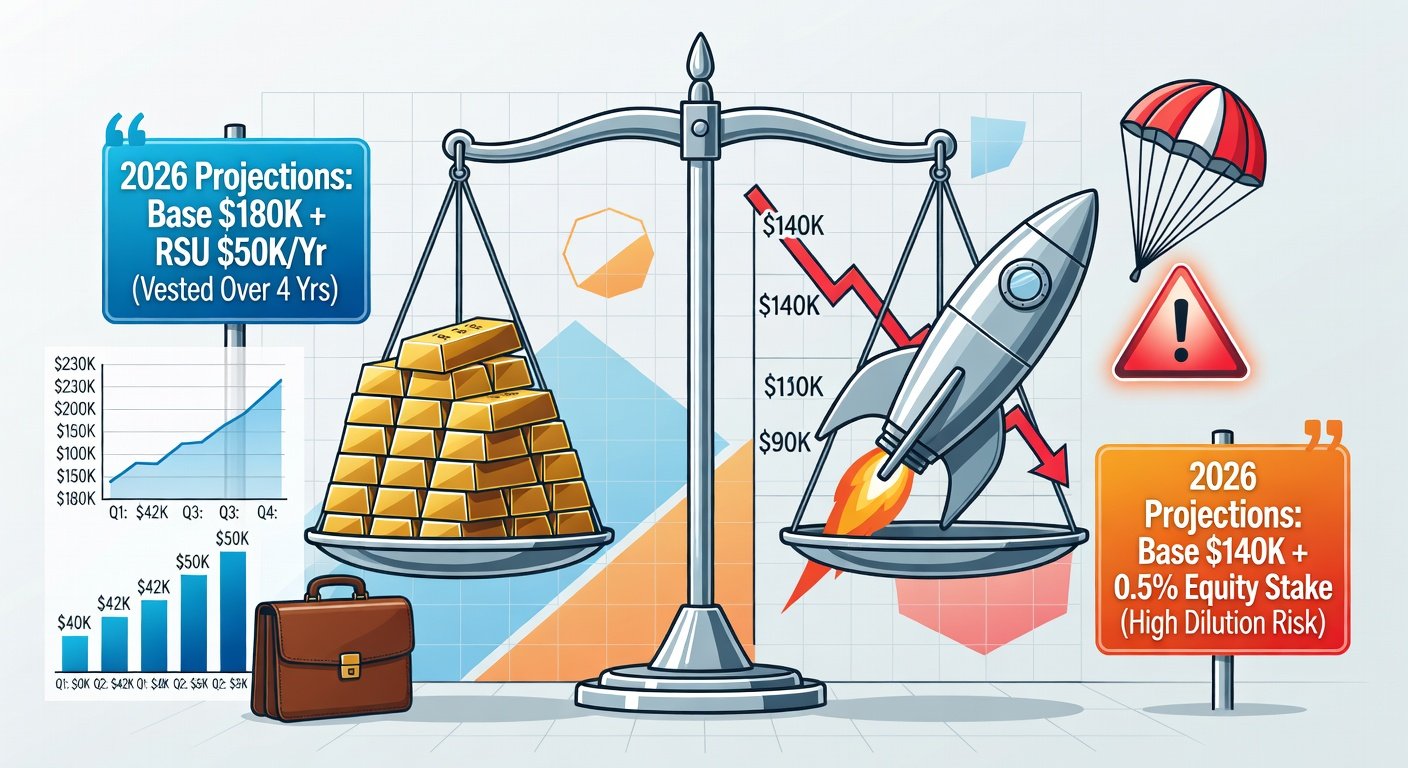
- Corporate Offer (Amazon): $175K base + $50K RSUs/year + 20% bonus + 5% 401(k) = Total ~$280K. Perks: Full health, 4 weeks PTO.
- Startup Offer (AI Startup, Series C): $145K base + 0.5% equity (valued $75K/year) + 15% bonus + wellness stipend = Total ~$240K potential, but equity could hit $1M post-IPO.
For finance: Mike, an investment associate.
- Corporate (BlackRock): $150K base + $40K bonus + $30K RSUs + benefits = ~$240K.
- Startup (Fintech Unicorn): $120K base + 0.2% equity ($40K value) + milestone bonus = ~$180K, with high growth trajectory.
These examples highlight how startups appeal to risk-takers under 35, while corporates suit those prioritizing stability.
FAQs: Navigating Corporate vs. Startup Compensation
How much equity should I negotiate in a startup? Aim for 0.1-0.5% for mid-level roles, depending on stage. Early-stage (pre-Series A) warrants more; use tools like Carta for valuation benchmarks.
Are corporate RSUs safer than startup options? Yes, due to liquidity and lower failure risk. In 2026, with market volatility, diversify by not putting all eggs in one basket.
What if I'm switching from corporate to startup? Negotiate a signing bonus to bridge the base pay gap, and ensure equity vests cliff-free after year one.
How do benefits impact long-term wealth? Corporate 401(k) matching compounds significantly—$10K annual match at 7% return grows to $500K+ in 20 years.
Is 2026 a good year for startup jumps? With VC funding rebounding 25%, yes—but focus on bootstrapped or well-funded firms to mitigate risks.
Conclusion: Choosing Your Path in 2026
Deciding between corporate stability and startup excitement boils down to your risk tolerance, life stage, and financial goals. In 2026, total comp in tech and finance favors corporates for immediate security (averaging $250K+ for mid-level), while startups offer lottery-like rewards through equity. Use the tables and examples here to model your offers, negotiate boldly, and align with what truly values your time and talent. For personalized advice, consult career coaches or run scenarios on compensation calculators. Your next move could shape decades of wealth—choose wisely.


No comments yet. Be the first!