 Jobboy

Understanding Phantom Stock in 2026 Private Company Compensation
Mid-career professionals evaluating total compensation packages often encounter phantom stock as a key component beyond base salary. Phantom stock plans grant employees the right to receive cash payments based on the appreciation of company stock without actual equity ownership. This guide explores valuation techniques tailored to 2026 private company offers, helping you achieve clarity on long-term earnings potential. In today's competitive job market, understanding these instruments can differentiate a strong offer from an average one, especially when base salary alone does not reflect the full picture of wealth-building opportunities.
What Phantom Stock Really Means for Employees
Phantom stock functions as a contractual promise rather than true shares. Upon a triggering event such as a sale or IPO, the company pays the employee the difference between the grant-date value and the current valuation. Profit-sharing variants tie payouts directly to annual profits or EBITDA multiples. This structure allows private firms to incentivize talent without diluting actual ownership, a common strategy in startups and family-owned businesses. Employees gain economic alignment with company success while avoiding the complexities of shareholder rights and voting.
Step-by-Step Methods for Valuing Phantom Stock
Valuing phantom stock requires a structured approach grounded in company financials and market conditions. Begin by reviewing the company's most recent 409A valuation, which establishes the fair market value of common stock. Next, analyze projected growth rates using historical revenue data and industry benchmarks. Apply a discounted cash flow model or comparable company analysis to estimate future share value at expected liquidity events. Factor in the specific terms of your grant agreement, such as the strike price and payout formula. Professionals should also stress-test assumptions by modeling best-case, base-case, and worst-case scenarios over five to seven years. Request supporting documentation including cap tables and recent funding rounds to refine projections accurately.
Profit-sharing plans tied to phantom equity follow similar steps but incorporate profit allocation percentages. Employees must understand how profits are calculated after expenses and reserves. This often requires cross-referencing audited financial statements with plan definitions.
Tax Implications of Phantom Stock Plans
Phantom stock payouts are typically taxed as ordinary income upon distribution, unlike actual stock options that may qualify for capital gains treatment. Employees must understand withholding requirements and potential alternative minimum tax exposure in certain scenarios. The IRS website provides official guidance on deferred compensation arrangements under Section 409A. Proper planning can minimize tax burdens, especially when payouts coincide with liquidity events like acquisitions or IPOs. Additional considerations include state income taxes and the timing of elections if the plan allows deferral. Consulting a tax professional early prevents surprises at payout time.
Vesting Schedules and Liquidity Event Considerations
Standard vesting schedules for phantom stock span three to four years with a one-year cliff, aligning employee retention with company growth milestones. Acceleration clauses often trigger upon change of control. Liquidity events determine when payments occur, and FAQs commonly address timing risks if the company remains private indefinitely. Always clarify whether unvested units forfeit upon termination and whether the plan includes repurchase rights. Some plans allow partial payouts upon retirement or disability, adding another layer of protection for long-term contributors.
Negotiation Tactics for Maximizing Phantom Equity
Negotiate for favorable terms by benchmarking against industry standards. Request higher grant percentages or lower strike prices based on your experience level. Include provisions for cash settlement at fair market value and protections against dilution. Prepare a checklist covering grant size, vesting acceleration, tax gross-ups, and post-termination exercise windows before discussions. Use data from recent comparable offers to support your requests. Consider trading salary increases for larger phantom grants if the company shows strong growth potential. Document all verbal agreements in writing and seek legal review of the plan documents before signing.
Real-World Examples: Phantom Equity vs RSUs
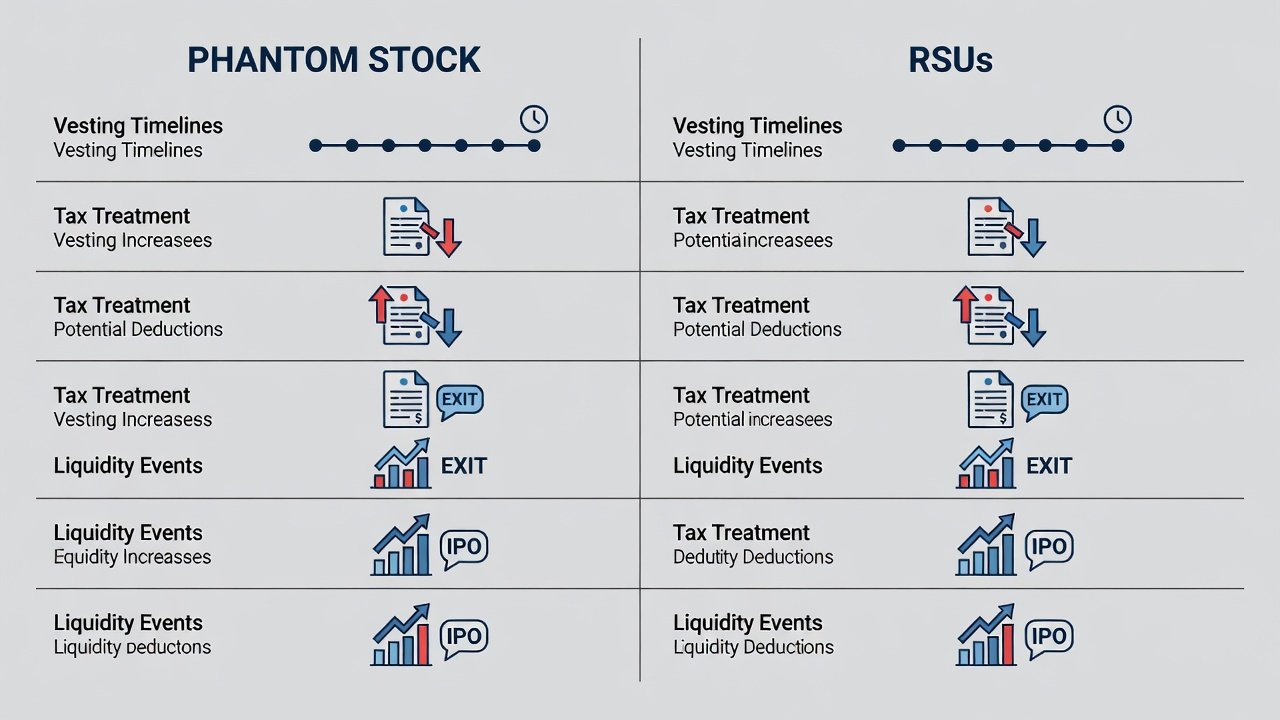
Consider a mid-level engineer at a Series C tech startup receiving 0.5% phantom stock versus an equivalent RSU grant at a public company. The phantom plan ties value to private valuation growth, potentially yielding substantial cash at exit but with higher uncertainty. RSUs provide immediate liquidity upon vesting yet face market volatility. Another example from manufacturing shows profit-sharing phantom plans delivering steady annual payouts tied to EBITDA targets, offering more predictability than equity in capital-intensive sectors. A third scenario involves a healthcare executive whose phantom units doubled in value after two funding rounds, illustrating how early grants compound over time compared to standard RSU schedules that vest linearly.
Industry and Experience-Level Benchmarks
Benchmarks vary significantly. Technology and biotech sectors often allocate larger phantom grants to mid-career hires (5–10 years experience) compared to traditional industries like finance or retail. Senior individual contributors may receive 1–2% of company value in phantom equity, while managers target 0.25–0.75%. These allocations reflect risk profiles and growth trajectories unique to each field. Reviewing multiple offer letters from peers in similar roles provides practical context for evaluating your own package.
Practical Checklists and Comparison Tables
Use this checklist when reviewing offers: confirm plan type, review valuation methodology, verify tax treatment, assess vesting alignment with career timeline, model multiple exit scenarios, and confirm anti-dilution protections. Comparison table example:
| Feature | Phantom Stock | RSUs |
|---|---|---|
| Ownership | None | Actual shares |
| Liquidity | Event-dependent | Vesting schedule |
| Tax Timing | At payout | At vesting |
| Risk Level | Company-specific | Market volatility |
| Negotiation Flexibility | High | Moderate |
Common Pitfalls to Avoid
Many professionals overlook the lack of voting rights or underestimate the impact of company debt on valuation. Others fail to negotiate for clear definitions of liquidity events, leading to disputes years later. Always request sample payout calculations and review the plan's termination clauses carefully.
Frequently Asked Questions on Liquidity Events
- What triggers a liquidity event in most phantom plans? Typical events include acquisitions, IPOs, or majority recapitalizations.
- Can I sell my phantom units before a liquidity event? Most plans prohibit transfers, requiring you to wait for the triggering event.
- How are taxes handled if the company goes public? Payouts convert to ordinary income unless specific deferral elections were made earlier.
- Do unvested units survive a merger? This depends on the acceleration language in your agreement.
- Is there a cap on total payouts? Some plans include maximum payment limits tied to company valuation thresholds.
Conclusion
Phantom stock can significantly enhance total compensation when properly valued and negotiated. By applying the methods, tax insights, and tactics outlined, mid-career professionals can make informed decisions that align equity-like rewards with personal financial goals in 2026 private company environments. Taking time to model outcomes and seek expert advice maximizes the upside while managing risks effectively.
No comments yet. Be the first!