 Jobboy

Introduction: Why Data-Driven Job Hunting Wins in 2026
The 2026 job market moves faster than ever, with many roles filled through internal referrals or early outreach before they appear on major boards. Traditional searching leaves candidates reacting instead of anticipating opportunities. This guide shows how to leverage free public labor data and lightweight AI analytics to forecast openings, giving you a measurable edge in application speed and relevance. By combining official statistics from sources like the Bureau of Labor Statistics with trend analysis, job seekers can identify rising demand in specific occupations and regions weeks in advance. Real-world examples demonstrate professionals securing interviews 3-6 weeks earlier than peers using these methods. In a competitive landscape where speed matters, understanding labor market signals allows proactive positioning that passive applicants simply cannot match.
Comparing Data-Driven Searches vs Traditional Methods
Traditional job searches rely on daily board checks and keyword alerts, often resulting in high competition once postings go live. In contrast, data-driven approaches analyze macroeconomic indicators, hiring trends, and skill signals to predict demand. For instance, a spike in manufacturing output data often precedes logistics hiring by 4-8 weeks. Key differences include timing, where proactive candidates engage employers before HR posts roles, reducing competition significantly. Accuracy improves because labor statistics provide objective signals over anecdotal advice from forums or networks. Scalability allows automated tracking to cover multiple sectors simultaneously without daily manual effort. Additional advantages emerge in reduced application fatigue, as focus shifts to high-probability targets rather than volume submissions. Studies from government sources confirm that early applicants enjoy higher response rates in competitive fields like tech and healthcare. Traditional methods also suffer from lag time, while data hacks enable preparation of tailored materials in advance, such as customized resumes highlighting forecasted skills.
Sourcing Reliable Free Labor Data in 2026
Start with the Bureau of Labor Statistics monthly Employment Situation report and Occupational Outlook Handbook for baseline projections. Supplement with U.S. Census Bureau industry statistics and state-level workforce reports. These datasets are updated regularly and require no payment. Additional sources include Department of Labor quarterly releases on job openings and labor turnover, which detail hires, separations, and openings by industry. Industry association reports from sectors like renewable energy or fintech provide granular forecasts often aligned with BLS categories. Public university labor market dashboards offer regional insights useful for location-specific targeting. Focus on metrics such as job openings rates, hires, and separations to spot emerging patterns. Access these by visiting official sites, downloading CSV files, and importing into spreadsheets for analysis. Cross-reference multiple releases to account for revisions, ensuring robust foundations for predictions. Regional data from state labor departments can reveal localized booms, such as tech growth in specific metro areas, that national averages obscure.
Spotting Keyword Trends and Skill Signals
Monitor search volume and discussion frequency around job titles using free tools like Google Trends combined with BLS occupational codes. Rising mentions of "AI ethics specialist" or "sustainable supply chain analyst" often signal upcoming postings. Cross-reference with LinkedIn public trend summaries and industry news aggregators for real-time validation. Practical tip: Create a weekly tracker spreadsheet logging top 10 keywords from BLS detailed tables and note correlations with new listings 2-4 weeks later. Expand this by analyzing job description language from recent postings to identify emerging skill clusters, such as specific software proficiencies or certifications. Track social media conversations on platforms like X or Reddit for early signals in niche communities. This multi-source approach strengthens confidence in trend identification and helps prioritize which forecasts warrant deeper investigation.
Building Lightweight Predictive Models
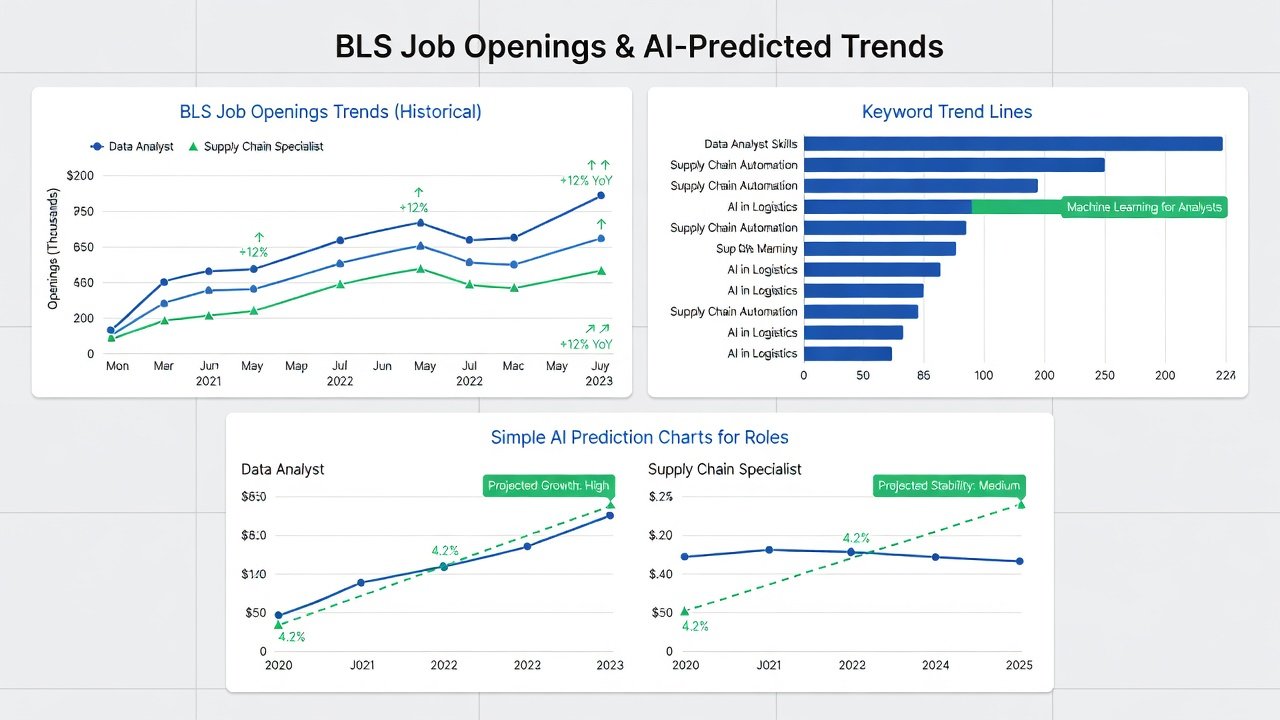
No advanced coding is required. Use spreadsheet functions or free platforms like Google Sheets with simple regression formulas on historical BLS data. Input variables include monthly job openings, unemployment rates, and sector growth percentages. Test models against past quarters to refine accuracy. Step-by-step tutorial: First, download 12-24 months of BLS data for target occupations from the official data finder tool. Second, plot trends and calculate moving averages to smooth seasonal fluctuations. Third, apply basic forecasting formulas such as linear regression to predict next month's openings. Fourth, validate predictions against actual postings from the prior period and adjust coefficients as needed. Fifth, incorporate leading indicators like new business formation rates from Census data for enhanced foresight. Many candidates achieve 70-80% directional accuracy with consistent practice. Example: A user tracking healthcare support roles noted a consistent 12% quarter-over-quarter rise tied to aging demographics, leading to successful early applications in three states.
Turning Insights into Proactive Applications
Once a role is forecasted, research target companies via their investor reports and news. Craft personalized outreach highlighting how your skills align with projected needs. Templates should reference specific data points, such as "With BLS projecting 15% growth in data analytics roles this quarter..." Case example one: A marketing professional tracked e-commerce expansion data in Q3 2025 and reached out to five retailers, landing interviews before formal postings appeared in early 2026. Case example two: An engineer monitored semiconductor production statistics, contacted three manufacturers with tailored proposals, and received offers two weeks ahead of public listings. Always follow up within 48 hours of initial contact and maintain records of all outreach for refinement. This method converts raw data into tangible career momentum.
Recommended Tools and Weekly Tracking Templates
Essential free tools include the BLS data finder, Google Alerts for industry keywords, and simple AI chat interfaces for summarizing reports. Build a template with columns for date, source, predicted role, confidence level, target companies, outreach status, and follow-up actions. Review and update every Sunday to maintain momentum without overwhelm. Include rows for notes on accuracy after each cycle to iteratively improve the system. This structured approach ensures no insight is lost and supports scaling to multiple career tracks simultaneously.
Common Mistakes to Avoid
Over-reliance on a single data source can lead to false positives, so always triangulate findings. Ignoring regional variations misses localized opportunities. Failing to act quickly on forecasts allows competitors to catch up. Neglecting privacy best practices, even with public data, risks unnecessary exposure. Finally, treating predictions as guarantees rather than probabilities leads to disappointment; maintain flexibility in your overall strategy.
FAQs on Data Accuracy and Privacy
How accurate are these predictions?
Accuracy improves with multiple data sources; single-metric reliance yields lower reliability. Always cross-verify with at least three indicators and track historical performance of your models.
Is using public data ethical for job hunting?
Yes, all referenced sources are publicly available government or aggregated industry data. No personal information scraping is involved, keeping activities fully compliant.
What if predictions miss the mark?
Treat forecasts as directional guidance. Maintain a diversified search strategy alongside data insights and adjust models based on outcomes.
How much time does weekly tracking require?
Most users spend 45-60 minutes per week after initial setup, with templates streamlining the process significantly.
Can beginners implement these techniques?
Absolutely. Start with basic BLS downloads and simple spreadsheets before advancing to more complex correlations.
Conclusion
Mastering 2026 labor data hacks transforms job searching from reactive to strategic. By consistently applying these techniques, candidates position themselves ahead of the curve, securing roles with less competition and greater alignment. Begin today with BLS reports and build your tracking system for sustained results in the evolving market.

No comments yet. Be the first!